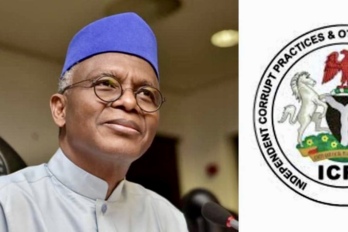
Former Kaduna State Governor Nasir El-Rufai has filed a fresh N10 billion fundamental-rights lawsuit against the Independent Corrupt Practices and Other Related Offences Commission, accusing the agency of effectively cutting him off from his wife, Aichatou Asabe, and his son, Abba El-Rufai, while he remains in custody.
The new suit, filed at the Federal High Court in Abuja on 13 August 2026 and marked FHC/ABJ/CS/1852/2026, names the ICPC, its chairman and the Attorney-General of the Federation as defendants. According to the originating motion sighted by the News Agency of Nigeria, the former governor is seeking nine reliefs, turning what began as a dispute over his detention into a wider legal contest over the conditions under which an individual may be held by a state agency.
The significance of the fresh action lies less in the N10 billion damages claim than in the constitutional question it puts before the court: does detention suspend a person’s relationship with his immediate family, or does the Constitution continue to protect those rights even while a criminal investigation or prosecution is under way?
El-Rufai’s lawyers are arguing that the answer is clear. They say incarceration may restrict liberty, but it does not automatically extinguish dignity, privacy, access to counsel, healthcare or reasonable family contact. That argument is now being tested directly against the operational practices of one of Nigeria’s principal anti-corruption agencies.
What El-Rufai Is Asking The Court To Declare
At the centre of the case is El-Rufai’s allegation that ICPC officials repeatedly prevented his wife and son from seeing him, despite an earlier court order concerning access to counsel and personal physicians.
The former governor is asking the Federal High Court to declare that his fundamental rights under Part IV of the 1999 Constitution remain enforceable despite his detention. He specifically invokes Sections 34, 37 and 46 of the Constitution, as well as Articles 5 and 18 of the African Charter on Human and Peoples’ Rights.
His legal team argues that the alleged restrictions were not merely inconvenient. They say family visits had practical importance because Asabe had, according to the supporting affidavit, been supplying food, medication, clothing and other necessities to her husband while he was in custody.
The affidavit, filed by El-Rufai’s Principal Secretary, Mohammed Shaba, states that Asabe had regularly visited the former governor before 7 July and delivered meals and other items without obstruction. It alleges that the situation changed sharply thereafter.
El-Rufai is asking the court to declare that the alleged denial of family access, without lawful justification or a court order, was unconstitutional, illegal and void.
He also wants an order compelling the respondents to give him what his lawyers describe as “unhindered and reasonable access” to family members and counsel throughout his detention.
Alleged July 7 Confrontation Raises The Stakes
One of the most serious allegations in the new case concerns an incident said to have occurred on 7 July.
El-Rufai alleges that ICPC officers physically restrained and intimidated his wife and son. The suit characterises the alleged treatment not simply as a dispute over visiting hours, but as an interference with the former governor’s spousal and filial relationships.
His lawyers describe the impact in stark terms, alleging: “This action has subjected the applicant to humiliation, emotional trauma, anxiety and psychological distress.”
They further accuse the respondents of acting “arbitrarily” and “unlawfully” and describe the alleged conduct as an unjustifiable interference with El-Rufai’s dignity and family life. Those allegations remain claims before the court and have not been judicially established.
That distinction matters.
The present litigation is not a judicial finding that ICPC officers assaulted, intimidated or unlawfully isolated the former governor’s family. It is an attempt by El-Rufai to persuade a court that those events occurred and that, taken together, they amounted to violations of constitutionally protected rights.
The April 1 Court Order At The Heart Of The Dispute
A major pillar of El-Rufai’s argument is an order he says was issued by the Federal High Court in Kaduna on 1 April 2026 by Justice R.M. Aikawa.
According to the affidavit and the originating motion, the order directed the ICPC to allow the defendants access to their lawyers and personal physicians whenever required.
El-Rufai’s camp says that order is crucial because it demonstrates that the conditions of his detention are not left entirely to the discretion of the anti-corruption commission.
“Clearly, this order reflects the settled principle of law that detainees are not to be held incommunicado and that the ICPC is subject to judicial oversight regarding the conditions of detention,” the filing states.
There is, however, an important legal nuance.
The publicly reported description of the April order relates specifically to access to counsel and personal physicians. It does not, on the material currently available, appear to expressly spell out an unlimited right of unrestricted family visitation. Whether the order can be read broadly enough to support the family-access claim, or whether separate constitutional protections independently establish such a right, will be a matter for the court to determine.
That distinction could become one of the most consequential legal questions in the new case.
What The Constitution Actually Protects
El-Rufai’s lawyers rely heavily on Section 37 of the 1999 Constitution, whose side note is headed “Right to private and family life.” The substantive provision states that the privacy of citizens, their homes, correspondence, telephone conversations and telegraphic communications is guaranteed and protected.
The wording itself is narrower than the heading. It expressly protects privacy, homes and communications rather than setting out a standalone, detailed statutory code for family visits to detainees.
That creates room for legal argument.
The former governor’s lawyers are effectively asking the court to interpret privacy and dignity protections in conjunction with the wider constitutional framework, the Fundamental Rights Enforcement Procedure Rules and Nigeria’s obligations under the African Charter.
Article 5 of the African Charter protects the dignity inherent in every human being and prohibits cruel, inhuman or degrading treatment. Article 18 declares the family to be the natural unit and basis of society and says it shall be protected by the state.
Those provisions give El-Rufai’s argument a regional human-rights dimension that goes beyond ordinary prison-visitation rules.
The Medical Access Dispute Makes The New Suit More Explosive
The family-access lawsuit comes weeks after another bitter confrontation between El-Rufai’s legal team and the ICPC over medical access.
On 7 July, the commission accused the former governor of abusing a court-approved medical visit at the National Hospital in Abuja and said his personal physician, Professor Bello Abubakar, had been arrested over alleged false statements.
The ICPC said officers had facilitated the medical visit under security arrangements and had remained outside the consultation room at the request of family members. The commission later said photographs circulated online indicated that the hospital trip had been used for purposes beyond the medical consultation contemplated by the court.
The ICPC’s position was unequivocal: it regarded the incident as an abuse of the privilege granted to El-Rufai and said it intended to draw the alleged breach to the attention of the court.
El-Rufai’s camp rejected that account.
In a formal response, his representatives said the medical consultation arose from an unresolved health issue and insisted that the April 1 order entitled him to medical care. They argued that the order did not impose a blanket restriction on who could see him while he was receiving medical attention.
The defence also challenged the basis for Professor Abubakar’s arrest, demanding that the ICPC identify the specific false statement allegedly made by the physician.
The competing accounts expose a much bigger problem than a single hospital appointment: both sides now accuse the other of misusing the legal framework governing detention.
ICPC Has Previously Rejected Claims Of Isolation
The new suit also has to be viewed against earlier public statements by the ICPC.
In May, amid mounting protests from members of El-Rufai’s family and political allies, the commission denied that the former governor had been deprived of food or medical care. The ICPC said visitors were allowed during approved visiting periods and maintained that El-Rufai had been permitted to see doctors of his choice.
The commission has therefore previously presented a markedly different picture from the one now contained in the Federal High Court filing.
That contradiction could become significant as the litigation progresses.
If El-Rufai’s lawyers can produce visitor records, correspondence, written requests, security logs, CCTV footage or witness testimony showing that authorised family visits were blocked without a documented legal basis, the case could move beyond competing public narratives and into a forensic examination of ICPC’s detention protocols.
Conversely, if the ICPC can demonstrate that visiting restrictions were authorised by established security procedures, applied consistently and based on specific judicial or operational considerations, the commission could argue that the former governor is attempting to convert regulated custodial access into an unrestricted entitlement.
That evidence battle may ultimately matter more than the headline figure of N10 billion.
The Medical-Report Controversy Adds Another Layer
The El-Rufai detention dispute has also been complicated by a separate controversy involving medical documentation submitted in support of his bail proceedings.
In late July, reports emerged that Dr Bello Abubakar acknowledged authoring a disputed medical report but denied forging any document or conspiring to mislead the court. The ICPC subsequently pursued allegations concerning the report.
That development is important because health records have become central to the dispute over El-Rufai’s detention.
The more contested the medical evidence becomes, the more likely it is that every request for access to doctors, every hospital visit and every dispute involving medication will be treated by authorities as part of a security-sensitive custodial process.
For El-Rufai, however, that same reality strengthens the argument that access to trusted family members and medical professionals is not a luxury but a safeguard against arbitrary detention.
His Corruption Trial Remains The Larger Legal Backdrop
The new human-rights action does not determine the corruption allegations against the former governor.
El-Rufai remains involved in criminal proceedings arising from allegations linked to his tenure as Kaduna State governor between 2015 and 2023. He has denied wrongdoing and pleaded not guilty in the relevant proceedings.
The substantive proceedings have themselves been slowed by a series of defence applications, including requests for the trial judge to recuse himself.
On 15 July, new lead defence counsel Paul Erokoro (SAN) withdrew three earlier applications described as confrontational and apologised to the court over the language used in the previous filings. The case was then adjourned to 22 July for consideration of a fresh application.
The prosecution has argued that repeated applications have contributed to delays in the substantive trial, while the defence has maintained its right to challenge the proceedings.
Thus, the family-access litigation is unfolding alongside a broader struggle over how El-Rufai’s detention, prosecution, medical needs and procedural rights are being managed.
Why The N10 Billion Claim Matters — And Why It May Not Be The Main Story
The N10 billion figure is likely to dominate headlines, but constitutional-rights litigation rarely turns simply on the size of the damages demanded.
The more consequential question is whether the court finds that an investigating agency crossed the line between legitimate custody management and unlawful interference with protected rights.
If the court accepts El-Rufai’s argument, the consequences could extend beyond one former governor. A ruling affirming that detainees retain enforceable rights to reasonable family contact, medical support and humane treatment could become a useful precedent for other Nigerians held by police, anti-graft agencies, military authorities and intelligence services.
If the court rejects the claim, the decision could equally reinforce the lawful scope of custodial restrictions where an agency can demonstrate a legitimate security, investigative or judicial basis.
Either way, the case has the ingredients of a potentially important test of the boundaries of executive detention in Nigeria.
The Human-Rights Question Behind The Political Drama
The case also raises a question that is easy to lose amid the political controversy surrounding El-Rufai.
A criminal allegation does not amount to a conviction.
A detainee can be investigated, prosecuted and even denied bail while still retaining basic human dignity. The African Charter expressly protects dignity and family as matters deserving state protection, while the United Nations Nelson Mandela Rules provide international benchmarks for the treatment of people deprived of liberty, including regular family contact and access to appropriate healthcare.
The Mandela Rules state that prisoners should receive healthcare equivalent to standards available in the community and that they should have regular opportunities to communicate with family members, including receiving visits.
Those rules are not, by themselves, a substitute for Nigerian law or a domestic court order. But they provide an important international benchmark for assessing whether detention conditions are proportionate, humane and consistent with human-rights norms.
The Evidence Will Now Matter More Than The Rhetoric
For the Federal High Court, the next stage will likely be evidence.
Did ICPC actually bar Asabe and Abba from seeing El-Rufai?
Was there a written directive?
Was that directive based on a court order, security assessment or internal visiting protocol?
Were there prior approvals for visits that were subsequently cancelled?
What exactly happened on 7 July?
Was there physical restraint, and if so, why?
What do security records, visitor logs and CCTV footage show?
And, critically, did any restriction affect the provision of food, medication or medical care?
Those questions will determine whether the case becomes a landmark human-rights decision or another chapter in the increasingly bitter legal battle between El-Rufai and Nigeria’s anti-corruption authorities.
As of 16 August 2026, the fresh suit itself is still at the allegation stage. The publicly available material reviewed for this report does not show a substantive ICPC response to the new N10 billion action. The commission’s earlier public position, however, has been that it follows established access procedures, has not denied El-Rufai essential care and has complied with applicable court directives.
That means the central dispute remains unresolved.
What began as a corruption investigation has now developed into a parallel constitutional confrontation over detention, dignity, family access and the limits of state power.
And that is why El-Rufai’s latest lawsuit may ultimately be far more consequential than its N10 billion price tag suggests.
Follow us on our broadcast channels today!
- WhatsApp: https://whatsapp.com/channel/0029VawZ8TbDDmFT1a1Syg46
- Telegram: https://t.me/atlanticpostchannel
- Facebook: https://www.messenger.com/channel/atlanticpostng