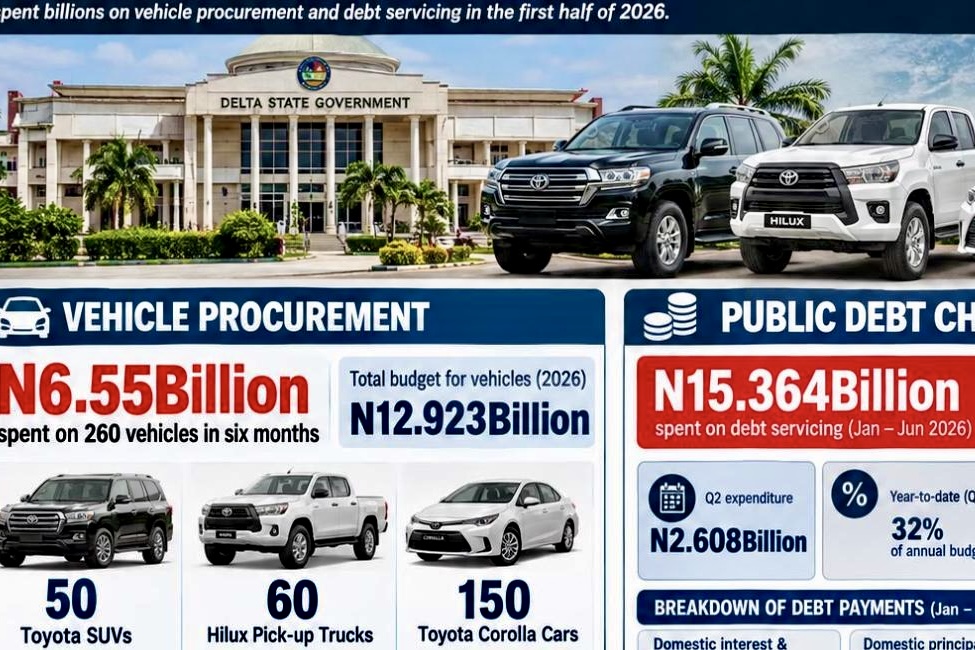
The first-half vehicle bill consumed 50.7 per cent of its annual allocation. Separate Debt Management Office figures show Delta’s domestic debt stock jumped by ₦155.45 billion in the second quarter, raising fresh questions about spending priorities and value for money.
Delta State’s spending on 260 vehicles in the first half of 2026 raises a question that goes beyond the size of the bill: can the government demonstrate that billions of naira spent on its vehicle fleet are delivering value to the people, particularly as its debt obligations demand substantial public funds?
The state government recorded ₦6.556 billion in expenditure on the procurement of 260 vehicles between January and June 2026, according to figures from its second-quarter budget performance report reviewed in the supplied news update.
The fleet comprises 50 Toyota sport utility vehicles (SUVs), 60 Hilux pickup trucks and 150 Toyota Corolla cars.
The government had earmarked ₦12.923 billion for the procurement during the 2026 financial year. By the end of June, it had spent approximately 50.7 per cent of that allocation.
The figures do not establish that the purchases were excessive or that public money was misused. They do, however, make transparency over pricing, procurement and deployment essential.
The question is not simply how many vehicles the government bought. It is whether the public can establish what each category cost, who received the vehicles and why the expenditure was necessary.
₦6.22bn Spent on Vehicles in One Quarter
One detail in the figures deserves particular attention.
The government recorded ₦6.226 billion in vehicle procurement expenditure during the second quarter alone. Its cumulative spending for the first six months was ₦6.556 billion.
That means approximately ₦330 million was recorded in the first quarter, while nearly 95 per cent of the first-half expenditure occurred between April and June.
Such a concentration may reflect the timing of contracts, deliveries or payment schedules. The figures alone do not explain which of these factors drove the spending.
The explanation matters because budget performance figures tell the public how much a government has recorded as expenditure, but they do not necessarily reveal the full chain of decisions behind that expenditure.
When was the procurement approved? When were the contracts awarded? Were the vehicles delivered together or in stages? Which ministries, departments and agencies received them? And did the payments correspond with documented deliveries and the terms of the contracts?
These are ordinary but essential questions in public procurement.
A detailed schedule showing contract dates, suppliers, individual vehicle prices, delivery certificates and receiving agencies would help answer them. Without that information, the public cannot independently assess whether the expenditure was competitive or represented good value.
What Did the 260 Vehicles Actually Cost?
The budget performance figures provide the number and broad categories of vehicles but do not give a model-by-model breakdown of their costs.
A simple division of ₦6.556 billion by 260 produces an average of approximately ₦25.2 million per vehicle.
That is only a blended mathematical average. It is not evidence that each vehicle cost that amount, nor does it establish whether any particular purchase was overpriced. SUVs, pickup trucks and saloon cars differ in specification, price and intended use.
The absence of individual prices is therefore significant.
A proper assessment would require the specific Toyota SUV models and trims, the Hilux specifications, the Corolla variants, the quantities delivered under each contract and the corresponding payments.
It would also require information about procurement methods, contract awards and any additional costs included in the reported expenditure.
Vehicles can be legitimate operational assets. They may be needed for inspections, field operations, engineering supervision, health services, security duties and other government responsibilities.
The issue is whether the vehicles were procured for identifiable public purposes and whether their costs can be justified against those purposes.
A fleet register and an allocation schedule would help establish whether the vehicles reached the agencies that needed them and whether the purchases addressed genuine operational requirements.
Without those records, the headline amount tells only part of the story.
Delta Records ₦15.36bn in Public Debt Charges
The same budget performance figures show that Delta State recorded ₦15.364 billion in public debt charges between January and June 2026.
The government had budgeted ₦48.05 billion for the category for the full year.
The first-half expenditure therefore represented approximately 32 per cent of the annual provision.
The report also records ₦2.608 billion in public debt charges during the second quarter. Based on the cumulative and quarterly figures, approximately ₦12.756 billion was recorded in the first quarter.
As with vehicle procurement, the distribution of payments across the two quarters warrants examination of the underlying schedule. Debt repayments can fall due at different times of the year, so the timing alone does not establish a problem.
The composition of the debt charges is particularly important.
The figures identify ₦5.159 billion in domestic interest and discount payments, alongside ₦8.451 billion in repayments of domestic principal on long-term borrowings.
A further ₦661.43 million was reported as foreign interest and discount payments.
These categories must be understood correctly. Principal repayments are repayments of borrowed funds, while interest represents the cost of borrowing. The full ₦15.364 billion should not be described as interest payments alone.
There is also a reconciliation question in the figures reproduced in the supplied update. Domestic interest and principal repayments total approximately ₦13.61 billion. Including the listed foreign interest payment brings the identified components to about ₦14.27 billion.
That leaves approximately ₦1.09 billion of the reported total not accounted for by those particular line items in the supplied breakdown. The complete expenditure schedule is needed to identify the remaining amount and reconcile the total.
For citizens seeking to understand the state’s finances, the distinction is important. Knowing how much was paid is useful; knowing which obligations were settled, under what terms and against which borrowing arrangements is more revealing.
Debt Stock Rose by ₦155.45bn in the Second Quarter
A separate official dataset adds another dimension to the debate.
The Debt Management Office’s domestic debt statistics show that Delta State’s reported domestic debt stock increased from approximately ₦213.85 billion at the end of March 2026 to ₦369.30 billion at the end of June.
That is an increase of about ₦155.45 billion, or 72.7 per cent, in one quarter. Delta recorded the largest increase among Nigeria’s states and the Federal Capital Territory during the period. The DMO says its figures are based on reports signed off by the states and the FCT.
This finding raises an important question about the state’s wider financial position: what explains the substantial increase in reported domestic debt, and what obligations will it create for future budgets?
The debt-stock figure and the ₦15.364 billion in first-half public debt charges measure different things.
Debt stock represents the outstanding domestic debt reported at a particular date. Debt charges represent expenditure recorded over a period, including principal repayments and interest. The figures should not be added together or treated as interchangeable.
Nor does the increase in domestic debt stock establish that borrowing financed the vehicle purchases. The available figures do not demonstrate such a connection.
But taken together, the figures make it more important to understand the state’s financial commitments, the purposes for which its funds are deployed and the public benefits those expenditures deliver.
The relevant investigation is not whether one category of spending caused another. It is whether residents have enough information to assess the government’s overall fiscal choices.
The Test of the 2026 Budget
Delta’s 2026 budget was initially presented at ₦1.664 trillion before the State House of Assembly increased it to ₦1.729 trillion. During the announcement of the increase, Speaker Guwor Emomotimi Dennis said it was intended to “provide additional resources for critical projects and programmes that directly impact the lives of the people”.
That stated objective offers a straightforward test for the spending recorded in the budget performance report.
Can the government show how the vehicle purchases support public service delivery? Can it disclose the contracts, prices and delivery records? Can it reconcile the debt charges and explain the substantial change in the reported domestic debt stock?
These questions do not presume that buying vehicles is wrong or that taking on debt is inherently irresponsible. Governments need operational assets, and borrowing can finance productive investment.
The accountability test is whether expenditure is necessary, properly authorised, transparently procured and capable of delivering measurable public value.
The vehicle procurement figures make that test concrete. A clear breakdown of the prices and recipients would allow residents to see whether the ₦6.556 billion delivered an appropriate fleet for the state’s needs. A complete debt schedule would help show which obligations were paid, the cost of servicing them and the commitments that remain.
Public scrutiny should also extend beyond the procurement line. If a state’s debt stock changes substantially within a quarter, residents need a clear explanation of the underlying transactions and the implications for future spending.
That is not an allegation of wrongdoing. It is a demand for the evidence required to assess public expenditure.
The final question for Delta’s government is simple: can it account for the money spent, demonstrate what the state received in return and show how those decisions serve the people whose resources it manages?
Follow us on our broadcast channels today!
- WhatsApp: https://whatsapp.com/channel/0029VawZ8TbDDmFT1a1Syg46
- Telegram: https://t.me/atlanticpostchannel
- Facebook: https://www.messenger.com/channel/atlanticpostng
Join the debate; let’s know your opinion.