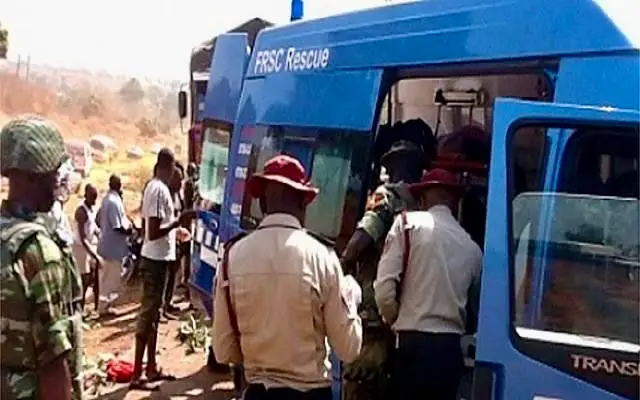
On Monday, a fatal accident on the Lagos-Ibadan Expressway resulted in nine deaths and three injuries when a speeding bus crashed into a stationary truck. The incident highlights the systemic issues of driver negligence, including fatigue and traffic law violations, calling for urgent reforms to improve road safety in Nigeria.
LAGOS, Nigeria – In the predawn gloom on Monday, calamity struck the Lagos-Ibadan Expressway as a Toyota bus lost control and violently rammed into a stationary truck around the Ayetoro area.
The catastrophic incident, which unfolded at approximately 5:30 am, claimed the lives of nine individuals—six men and three women—and left three others injured, marking yet another grim chapter in Nigeria’s ongoing road safety crisis.
The bus, bearing the number plate UYY165ZY, was reportedly overloaded and plying at excessive speed when the driver, overcome by fatigue, lost control. This unfortunate lapse in vigilance resulted in the fatal collision with a truck registered as DKA244XC.
The crash, detailed by Florence Okpe, Spokesperson for the Ogun State Sector Command of the Federal Road Safety Corps (FRSC), underscores a disturbing pattern of driver negligence and regulatory defiance along one of Nigeria’s busiest arteries.
A Microcosm of a National Dilemma
The Lagos-Ibadan Expressway has long been notorious for its perilous conditions. This tragic episode is emblematic of a broader systemic failure where excessive speed, driver fatigue, and a blatant disregard for established rest periods converge to create lethal conditions.
According to the FRSC, the practice of ignoring the mandated 15-minute rest after a 4-hour journey is alarmingly common—a practice that significantly contributes to the high incidence of fatal road accidents across the country.
Critics argue that while infrastructural challenges and poor road maintenance are often cited, the core issue lies in the enforcement—or lack thereof—of traffic regulations.
This incident, which involved 13 individuals (10 male and 3 female adults), starkly reveals how negligence at the driver level, compounded by insufficient regulatory oversight, continues to exact a heavy toll on Nigerian lives.
The bus driver’s failure to adhere to speed limits and mandated rest periods not only endangered his passengers but also imperilled other road users.
The Human Cost and Systemic Negligence
Families affected by this tragedy now face irreparable loss. The injured victims were rushed to Famobis Hospital in Mowe, while the deceased were solemnly deposited at Idera Morgue in Sagamu.
In a poignant statement, the Sector Commander of the Ogun State FRSC expressed profound sorrow over the incident.
“We are pained by the recklessness displayed by some drivers. Failure to obey the stipulated speed limit and the mandatory rest period after prolonged driving not only jeopardises lives but also undermines the integrity of our transport system,” he lamented.
This sentiment is shared by road safety advocates who have long warned that without stringent measures and a cultural shift towards road discipline, Nigeria will continue to witness such heart-wrenching incidents.
The Lagos-Ibadan Expressway, a critical artery connecting Nigeria’s commercial and industrial hubs, is frequently under siege by fatal crashes—a trend that reflects the underlying challenges of rapid urbanisation, inadequate infrastructure investment, and lax enforcement of traffic laws.
A Call for Immediate Action
The debate now intensifies over how best to mitigate these recurring tragedies. Critics argue that the government must overhaul its approach to road safety.
Enhanced monitoring systems, rigorous enforcement of traffic laws, and comprehensive training programmes for drivers are urgently needed.
Furthermore, some experts have called for the introduction of modern technologies such as speed cameras and real-time monitoring systems to deter reckless driving and provide immediate accountability.
In the wake of this latest incident, there is mounting pressure on policy-makers to revisit and reinforce road safety protocols. It is no longer sufficient to issue statements of condolence; there must be a concerted effort to implement robust measures that protect the lives of everyday Nigerians.
As discussions ensue in the corridors of power, one thing remains clear: the current status quo is unsustainable, and failure to act decisively will only result in more lives lost on Nigeria’s highways.
A Broader Reflection on Nigerian Transport Culture
This tragic event serves as a stark reminder of the perils lurking on Nigeria’s roadways. The culture of ‘get there fast’—where speed and fatigue are often worn as badges of honour—must give way to a new paradigm that values safety over haste.
The relentless pursuit of profit and efficiency in the transport sector, often at the expense of passenger safety, has long been a contentious issue. Without a fundamental shift in attitudes and practices, the cycle of tragedy will undoubtedly continue.
As the nation mourns yet another loss on the Lagos-Ibadan Expressway, the call for accountability grows louder. Families, drivers, and policy-makers alike are now compelled to confront the harsh reality: without immediate and decisive reforms, Nigeria’s roads will remain a veritable death trap for those who traverse them.
- Additional report by Omonigho Macaulay, Atlantic Post National Correspondent