The attack that turned a political journey into a security operation
The convoy of All Progressives Congress (APC) governorship candidate in Borno State, Engr Mustapha Gubio, came under a sustained terrorist attack on Thursday along the volatile Kareto–Damasak road in northern Borno, exposing once again the extraordinary security risks surrounding movement through parts of the state.
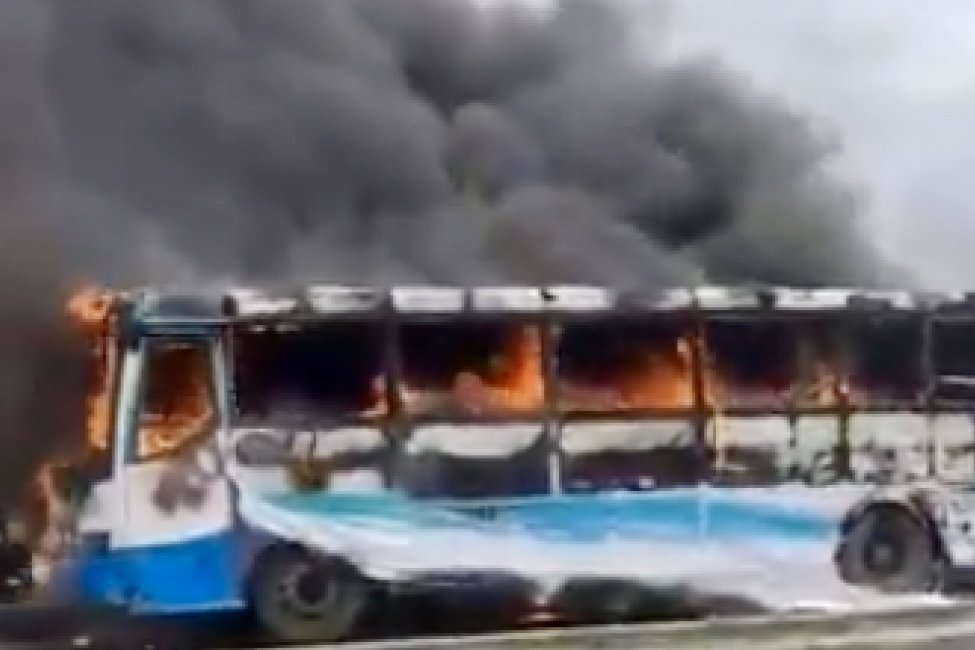
The assault occurred at about 2:30pm near Kareto, in Mobbar Local Government Area, according to police and media reports. The attackers used improvised explosive devices (IEDs) and rocket-propelled grenades (RPGs) before opening fire on the convoy. Police tactical operatives and other security personnel attached to the delegation returned fire and forced the attackers to withdraw into the surrounding bush.
Gubio, government officials and other political stakeholders escaped unharmed. The Nigeria Police Force said there were no casualties among members of the entourage, while reports from the scene indicated that at least one police armoured vehicle was damaged during the encounter.
The incident is more than another roadside ambush in a state that has endured 17 years of insurgency. It occurred as Nigeria enters a politically sensitive phase ahead of the 2027 elections and, significantly, along a road where security forces faced another serious terrorist ambush almost exactly one year earlier.
What happened on the Kareto-Damasak road?
According to Vanguard, Gubio’s convoy was undertaking an appreciation tour connected to his emergence as the APC’s governorship candidate. Early reporting described the delegation as travelling towards Mobbar, where Damasak is located. A later police confirmation reported by Vanguard placed the convoy on its return journey from Damasak towards Maiduguri.
That difference matters.
The central facts — the attack, the location, the approximate time, the use of explosives and RPGs, the security response and the absence of reported casualties — are independently corroborated. But the precise direction of travel in the initial accounts was not consistently reported.
The available evidence therefore supports a cautious reconstruction: Gubio and his delegation travelled to the Damasak area for a political engagement, and the convoy came under attack around Kareto during the journey back towards Maiduguri, according to the later police account.
A source who was part of the convoy told Vanguard that the experience was terrifying.
“It was a terrifying moment for us.”
The source said the attackers launched several RPGs before following the explosions with sporadic gunfire, adding that police armoured vehicles were damaged but nobody in the convoy was killed or wounded.
Police confirm terrorist ambush
Force Public Relations Officer CSP Ani Iniedu confirmed the attack and said the police tactical team fought back against the assailants.
In a statement reported by TheCable, Iniedu said the attackers engaged the convoy with IEDs and RPGs, prompting tactical operatives to counter-engage them. The attackers were forced to retreat into surrounding bush, after which the security team searched the area for possible secondary explosives before moving the convoy to safety.
Iniedu said:
“The tactical team forced the terrorists to retreat into the surrounding bush.”
He also said the convoy, carrying the governorship candidate, government officials and political stakeholders, was evacuated safely with no casualties recorded among the entourage.
Borno State Police spokesman ASP Nahum Daso separately confirmed to PUNCH that the convoy had been attacked around 2:30pm and said no member of the entourage was killed. He added that security agencies believed at least one fleeing terrorist might have sustained a gunshot wound, although that assessment had not been independently verified.
That distinction is important. There is no confirmed report from the available authoritative accounts of a terrorist casualty. The suspected injury remains a police assessment rather than an independently established fact.
Who attacked the convoy?
Initial reports widely described the attackers as Boko Haram terrorists. However, the most defensible description at this stage is suspected Boko Haram/ISWAP terrorists.
The police statement itself used the broader term “suspected terrorists”, while PUNCH quoted the Borno police spokesman as referring to suspected Boko Haram/ISWAP fighters.
This is not merely semantic.
The Lake Chad Basin insurgency is no longer a simple conflict involving a single Boko Haram structure. The violent ecosystem has been fractured by splits, competing commanders, rival ideological networks and the emergence of Islamic State West Africa Province (ISWAP) as a major armed faction. A responsible security report should therefore avoid presenting factional attribution as conclusively established unless security authorities provide evidence.
At present, the method of attack is established more firmly than the exact identity of the attackers.
Why Kareto should worry security planners
The geographical location of Thursday’s ambush is perhaps the most revealing part of the story.
Kareto is in Mobbar Local Government Area, a strategic part of northern Borno close to Nigeria’s international frontier and within the broader Lake Chad security environment.
The route has already demonstrated that it remains dangerous.
On 3 September 2025, exactly a year before Thursday’s attack, troops of Operation Hadin Kai encountered a terrorist ambush at Kareto while escorting humanitarian trucks along the Gubio-Damasak road. According to Channels Television’s account of the military statement, the attackers detonated two command IEDs and followed them with heavy fire. Troops said they killed 13 insurgents, while four MRAP tyres were damaged and two military trucks caught fire.
The significance is difficult to miss.
The same general corridor that was the site of a major insurgent ambush against a military convoy in September 2025 was again used to attack a high-profile political convoy in September 2026.
That points to a persistent security problem, rather than an isolated roadside incident.
The question now facing security planners is not simply whether the convoy survived Thursday’s attack. It is why the same operational environment continues to provide armed groups with opportunities to observe, position, attack and withdraw from major road movements.
A road cannot be considered secure simply because terrorists are repelled
There is a tendency in official security communication to measure success by the immediate outcome of an encounter: terrorists are repelled, casualties are avoided and the convoy reaches safety.
Those are unquestionably important outcomes.
But counter-insurgency has a second test: can civilians, political actors, humanitarian organisations and commercial operators move repeatedly along the same corridor without becoming predictable targets?
The evidence from Kareto suggests the answer remains uncomfortable.
In July 2026, troops also arrested a suspected logistics supplier linked to Boko Haram/ISWAP activity around the Binduldul–Kareto axis in Gubio LGA. The suspect was allegedly supplying petrol to terrorists operating in the area, according to specialist security publication Zagazola Makama.
That report adds another layer to the picture.
An insurgent group does not sustain itself solely by firing weapons. It needs fuel, food, communications, intelligence, transportation and access to local logistics networks. The reported arrest therefore suggests that counter-terrorism pressure in the area is also being directed at the support infrastructure sustaining militant activity.
Kareto is not an isolated security story
The wider Borno theatre remains active despite sustained military operations.
In July, Operation Hadin Kai troops rescued 31 civilians after terrorists intercepted four civilian vehicles and abducted their occupants along the Buratai–Kamuya road. Military officials said real-time surveillance enabled a rapid response that forced the attackers to abandon their victims and flee.
In April 2026, the Federal Government described the wider North-East as one of the most active counter-terrorism theatres in the country and said the Jilli axis in Gubio LGA had historically functioned as an insurgent logistics and operational hub. The government linked terrorist activity in the area to levy collection, supply procurement and attacks.
So Thursday’s attack should not be read as evidence that security operations have achieved nothing. They clearly have.
Rather, it demonstrates something more complicated: military operations can degrade terrorist formations without necessarily eliminating their capacity to mount sudden, high-impact attacks along vulnerable transport corridors.
The political significance is enormous
There is another reason Thursday’s attack demands attention.
Gubio is not an ordinary traveller.
He is the APC’s candidate for governor of a state where security is likely to remain one of the defining issues of the 2027 election.
The State House confirmed in May that Gubio emerged as the APC’s governorship flagbearer during the party’s primary in Borno.
Now, barely months after his emergence, he has personally experienced the problem that will almost certainly dominate the political debate over Borno’s next administration: whether the state’s roads, communities and rural economy can be made genuinely secure.
That gives the incident a powerful political dimension.
A candidate whose campaign promises improved security has literally had his own convoy engaged by terrorists while travelling through one of the state’s insurgency-affected areas.
That is not a campaign slogan. It is a direct encounter with the problem.
The timing could hardly be more politically sensitive
Nigeria’s 2027 electoral calendar is already moving.
INEC’s revised timetable places the Presidential and National Assembly elections on January 16, 2027, while the Governorship and State Houses of Assembly elections are scheduled for February 6, 2027. Public campaigns for governorship and State Assembly elections are scheduled to begin on September 9, 2026.
That means Thursday’s attack occurred just days before the formal commencement of governorship campaigning.
It is an unsettling coincidence.
The implications extend beyond Gubio himself. Security agencies will now have to consider whether political rallies, motorcades and grassroots mobilisation in remote parts of Borno could create additional opportunities for terrorist groups to exploit predictable movements.
The issue is particularly serious in a state where large security escorts are already normal for senior political and government figures.
The lesson from Zulum’s convoy attacks
Borno has experienced this kind of warning before.
In 2020, the convoy of Governor Babagana Zulum came under repeated attacks around the Baga axis. One of the attacks killed 15 security personnel, according to contemporary reports, while another assault on the governor’s convoy caused vehicle damage but no deaths.
The historical comparison matters because Zulum himself was part of the APC political structure that produced Gubio as the party’s governorship candidate in 2026.
The message is stark: high-profile political convoys remain attractive targets even when they include soldiers, police, intelligence personnel and local security auxiliaries.
That raises difficult questions about intelligence, route security, advance reconnaissance and the ability of security agencies to detect roadside explosive preparations before a convoy reaches the kill zone.
The security response was successful — but the threat was real
There should be no ambiguity about one aspect of Thursday’s incident.
The combined security detail appears to have prevented a much worse outcome.
The convoy reportedly included personnel from the military, police, Nigeria Security and Civil Defence Corps, Department of State Services, Civilian Joint Task Force and vigilante formations. Those forces engaged the attackers and prevented the convoy from being overrun.
The police also carried out a post-contact search to guard against secondary explosives, a particularly important step where IEDs have been employed.
In that respect, the operation illustrates the value of layered security.
But a successful defence of a convoy does not erase the fact that the attackers were capable of getting close enough to deploy explosive devices and RPGs against it.
That is the intelligence question that deserves the greatest scrutiny.
What happens next?
The immediate priority will be route clearance, surveillance and attempts to identify the attackers, their weapons suppliers, their local informants and the logistics networks enabling them to operate around Kareto.
The longer-term challenge is harder.
Northern Borno needs roads that can be used by civilians without military-style protection. Farmers need access to their fields. Traders need predictable transportation. Humanitarian agencies need dependable routes. Political candidates need to meet communities. Government officials need to visit rural areas.
A road repeatedly vulnerable to IEDs and RPG ambushes cannot be judged secure merely because armed escorts can fight their way through.
The September 2025 and September 2026 incidents on the Kareto corridor show why the focus must move beyond encounter statistics towards sustained route security, intelligence-led disruption of terrorist logistics, community intelligence and the restoration of civilian freedom of movement.
Thursday’s attack ended without the loss of a life in Gubio’s convoy.
That is good news.
But it would be a mistake to allow that outcome to conceal the harder truth.
The terrorists did not need to kill the APC candidate to send a message. They only needed to demonstrate that, in northern Borno, they could still choose the road, choose the moment and open fire.
For a state preparing for a governorship election in the shadow of a long-running insurgency, that may be the most important fact emerging from the Kareto attack.
Follow us on our broadcast channels today!
- WhatsApp: https://whatsapp.com/channel/0029VawZ8TbDDmFT1a1Syg46
- Telegram: https://t.me/atlanticpostchannel
- Facebook: https://www.messenger.com/channel/atlanticpostng