MAIDUGURI, Nigeria — The latest controversy out of Borno State has reopened one of Nigeria’s most sensitive security questions: can former Boko Haram fighters ever be trusted close to active military operations.
According to SaharaReporters, soldiers battling insurgents in the North-East have accused the Borno State government of pushing a fresh arrangement that would compel them to work alongside “repentant” terrorists recently reintegrated under the state’s deradicalisation programme.
The allegation has not been independently verified, but it has already deepened fears among frontline personnel about sabotage, intelligence leaks and the integrity of field operations.
Those fears are not emerging in a vacuum. The North-East remains one of Nigeria’s most dangerous theatres, with Boko Haram and its ISWAP offshoot still capable of mounting deadly attacks on military positions and civilian communities.
Reuters reported in March that Nigerian troops backed by air support killed at least 80 insurgents in a Borno base assault, while AP reported two weeks ago that the army freed 360 people abducted by Boko Haram in southern Borno.
The conflict is therefore not a closed chapter but an active war zone where trust, speed and intelligence still decide who lives and who dies.
In the SaharaReporters account, one soldier said the government wanted to prove that the reintegration programme was working, adding that some of the former insurgents were being attached to security groups that support military operations.
He warned that “Trust is a major issue.” Another source said, “We don’t trust them completely,” while a third insisted, “It won’t work.”
Considered collectively, the remarks reveal a deep operational anxiety inside parts of the military, especially among troops who believe past leaks may already have cost lives.
The report also says some of the former fighters have been kept in separate accommodation within military facilities because troops fear lingering links to active terror cells.
That detail is important because it suggests the distrust is not simply political or emotional, but rooted in a practical fear that insurgent networks may still be feeding on battlefield information.
SaharaReporters further said the army had not publicly confirmed any order to deploy the rehabilitated fighters alongside troops and that its attempts to obtain a response from the Director of Army Public Relations, Colonel Appolonia Anele, were unsuccessful at the time of filing.
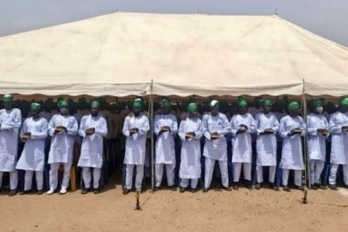
The timing is particularly delicate because the Borno State government only recently completed another large reintegration exercise. On 12 June 2026, the state said it had reintegrated 720 repentant insurgents, alongside 992 spouses and 2,050 children, after rehabilitation at the Hajj Camp in Maiduguri.
The Guardian reported that the latest group was classified as low-risk and minor clients under Batch 9 of the programme, while Punch said the new batch brought the total number reintegrated under the scheme to 9,680.
Speaking for the state, retired Brigadier General Abdullahi Ishaq, Special Adviser to Governor Babagana Zulum on Security, defended the Borno Model as a central part of the state’s non-kinetic response to insurgency.
He described it as “one of the most effective non-kinetic programmes” and said “over 350,000 persons” had surrendered to the military since the initiative began.
According to the official account, the beneficiaries underwent documentation, profiling, deradicalisation, rehabilitation and skills training before being returned to their communities.
The state has also tried to show that the process is tightly screened. Guardian reported that community leaders, the Civilian Joint Task Force and hunters groups took part in the vetting process before reintegration.
Officials said the women in the batch received vocational training in catering, knitting, tailoring, cap making and soap production, while starter packs were provided to help them restart civilian life.
For the government, that is proof that the policy is structured and monitored. For critics, it is still a gamble being taken with communities that have paid a very high price for the insurgency.
The national memory of this issue is also important. In 2020, the Presidency said “nobody has ever been absorbed into the military” from the de-radicalised Boko Haram graduates and that none of the 601 former fighters then under the federal rehabilitation scheme was going into the army.
That earlier clarification shows how politically explosive any suggestion of direct integration into military operations remains, especially in a country where survivors of insurgency still want stronger accountability, clearer safeguards and visible protection for civilians and soldiers alike.
For now, the central problem is not simply whether former insurgents can be rehabilitated. It is whether soldiers on active deployment believe the system protecting them is watertight enough to prevent betrayal from within.
If the allegation is accurate, then the state must explain why such an arrangement was contemplated and what safeguards exist to stop leaks. If it is not accurate, then the military and Borno authorities need to say so quickly and publicly, because silence only feeds suspicion in a conflict zone where suspicion itself can be fatal.
At the heart of the matter is a brutal Nigerian security paradox. Borno’s leaders are trying to combine forgiveness, rehabilitation and community acceptance with an insurgency that still kills, kidnaps and adapts.
The soldiers on the front line, meanwhile, are asking a much harder question: how do you fight an enemy when you are not sure who has already been allowed back into the room?
Follow us on our broadcast channels today!
- WhatsApp: https://whatsapp.com/channel/0029VawZ8TbDDmFT1a1Syg46
- Telegram: https://t.me/atlanticpostchannel
- Facebook: https://www.messenger.com/channel/atlanticpostng