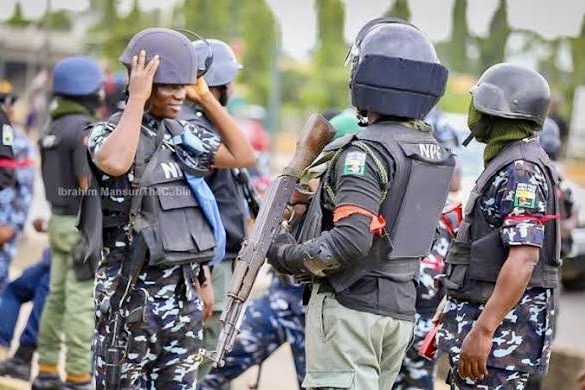
A police corporal’s decision to announce his resignation after allegedly being unable to access his salary for about two years has triggered a formal investigation by the Bauchi State Police Command, exposing a troubling distinction between whether a public servant has been paid on paper and whether he can actually use the money to survive.
The officer, identified as Force Number 524180, Corporal Yusuf Aliyu, reportedly served with the Nigeria Police Force’s Dambam Division in Bauchi State. His resignation became public after he took his grievance to social media, saying an unresolved salary-access problem had subjected him to severe financial hardship.
The development has now produced two sharply different accounts.
Aliyu’s position, as contained in a resignation letter reported to have been dated 30 August 2026, was that although his salary had been processed and reflected, he had been unable to withdraw or otherwise access the funds despite repeated attempts to resolve the problem through official channels.
The Bauchi Command, however, said its preliminary findings showed that the officer’s salary had in fact been paid regularly and promptly. According to the Command, the obstacle was not a failure by the police authorities to process his salary, but a problem involving the officer’s Bank Verification Number (BVN).
That distinction is now at the centre of the inquiry.
Two versions of the same salary crisis
In his reported resignation letter, Aliyu said the salary had “been processed and reflected”, but that he had been “unable to access or withdraw it despite several efforts made through the appropriate channels”.
He further stated: “I have reported the matter on numerous occasions and followed all the necessary procedures, yet the issue remains unresolved.”
The corporal said the consequences went well beyond an administrative inconvenience.
“This situation has caused me severe financial hardship and has made it extremely difficult for me to meet my personal and family responsibilities,” he wrote, according to the reported copy of the letter.
He said he had consequently “lost confidence in the system” and decided to resign from the Force. The reported letter indicated an intended exit date of 30 September 2026, subject to the relevant clearance and disengagement procedures.
It is important, however, not to reduce the dispute to the simplistic claim that the corporal went two years without being paid.
The Command’s preliminary position is that he was paid.
His complaint, by contrast, is that he could not access the money.
For an officer responsible for policing, those are technically different circumstances, but from the standpoint of household survival, the difference can become almost meaningless. A salary sitting in an inaccessible account cannot pay rent, feed a family, settle medical bills or meet transportation costs.
That is why the investigation matters.
Police: Salary was paid “promptly and consistently”
The Bauchi State Police Command responded after Aliyu’s public resignation and ordered an investigation into the circumstances surrounding the matter.
Police spokesman SP Nafi’u Habib said Commissioner of Police Sani-Omolori Aliyu directed a discreet and comprehensive probe.
Habib said: “Preliminary findings indicate that the officer’s salary has been paid promptly and consistently by the Police authorities.”
But the Command did not deny that the officer had experienced a problem accessing his money.
Instead, it attributed the difficulty to what it described as a BVN discrepancy.
“The observed difficulty is attributable to a discrepancy in his Bank Verification Number (BVN), as the name linked to the BVN differs entirely from the name on his salary account, thereby resulting in the restriction,” Habib said.
That explanation raises an obvious question that the investigation will have to answer:
How did an identity discrepancy capable of preventing a serving police officer from accessing his salary remain unresolved for such a prolonged period?
The Command’s statement does not, at this stage, publicly establish when the discrepancy was first identified, when the officer first complained, which institution controlled the restriction, what corrective steps were taken, or why those steps did not resolve the matter earlier.
Those details are crucial.
The BVN question
The Bank Verification Number system was introduced to strengthen identity management within Nigeria’s banking system. The Central Bank of Nigeria has previously directed financial institutions to ensure consistency between customers’ names on BVN records and their bank accounts.
In a CBN circular on BVN-related issues, the regulator stated that a customer’s name in the BVN database should correspond with the name used across the customer’s accounts. The same guidance provided procedures for correcting name discrepancies and stated that BVN issues should generally be resolved within five working days once the customer submits all required documentation.
That background does not, by itself, prove wrongdoing by either the police or the officer.
It does, however, make the reported two-year duration particularly important.
If the account was restricted because of a mismatch in identity information, the investigation should establish whether the problem originated from the bank, the BVN record, payroll data, documentation submitted by the officer, or some combination of those factors.
It should equally establish whether the police administration was aware that an officer’s monthly earnings were accumulating in an account he could not access.
The difference between salary processing and salary usability is not merely semantic. Payroll records can show that government funds were transferred successfully while the intended beneficiary remains unable to utilise them.
The social-media dispute
The matter took another turn when the officer made his grievance public.
The Bauchi Command expressed displeasure that Aliyu chose social media to ventilate his complaint and announce his resignation instead of relying on internal administrative channels.
Habib said: “The Command notes with concern that the officer resorted to the use of social media to ventilate his grievance and announce a purported resignation, rather than exploiting the established internal mechanisms for redress.”
The Command went further.
“This conduct constitutes a clear violation of the Nigeria Police Force Social Media Policy and amounts to an attempt to discredit the Command and the Force at large,” the spokesman said.
This aspect of the case cannot be separated from a wider effort by the police hierarchy to tighten control over officers’ online activities.
In June 2026, Inspector-General of Police Olatunji Disu directed personnel to desist from unauthorised social-media activities capable of undermining the integrity, professionalism and public image of the Force. The directive addressed activities including unauthorised videos, livestreams and online material involving officers while in uniform or otherwise identifying themselves as police personnel.
The Bauchi Command’s position therefore fits into an existing national policy framework.
But the Yusuf Aliyu case presents a difficult administrative question: what happens when the conventional grievance machinery appears, from the complainant’s perspective, to have failed?
The police are entitled to insist that officers observe internal procedures.
At the same time, a functioning grievance system must ultimately be judged not simply by whether it exists on paper but by whether personnel can obtain timely remedies when something as fundamental as their wages becomes inaccessible.
The welfare issue behind the controversy
The most consequential part of this story may ultimately have little to do with social media.
It may be about police welfare.
Police officers perform a demanding public function under difficult conditions. Their salaries are not simply accounting entries; they are the primary income supporting homes, children, parents and other dependants.
When a salary is inaccessible for months, the consequences can compound rapidly.
A police officer who cannot access his earnings may be forced to borrow money, rely on relatives, accumulate debt or struggle to meet basic household obligations. For lower-ranking personnel in particular, the practical consequences of disrupted income can be severe.
Aliyu’s reported resignation therefore deserves scrutiny not merely as an individual disciplinary matter but as a test of the systems responsible for protecting the welfare of serving personnel.
The Command has stressed that welfare remains a priority.
Habib quoted the Commissioner as saying: “No genuine complaint will be left unattended.”
That assurance is significant because the investigation now has an opportunity to demonstrate precisely what that commitment means in practice.
What the investigation needs to establish
The announced inquiry should ideally go beyond confirming that monthly salary payments appeared on a payroll system.
It needs to establish whether Aliyu had genuine access to those payments and, if not, why the problem persisted.
Among the key questions are when the BVN discrepancy began; whether the name mismatch existed before the officer’s salary account was established or emerged subsequently; whether the bank formally notified the officer of the restriction; when the police administration became aware of the problem; what complaints were lodged; which officials or institutions received those complaints; and what action followed.
The investigation should also clarify whether any money accumulated in the account during the period in question remains intact and immediately recoverable by the officer once the identity issue is resolved.
Most importantly, the inquiry needs to establish whether this was an isolated administrative error or evidence of a wider vulnerability affecting other police personnel.
There is no evidence at present to conclude that other officers have experienced the same problem. But that is precisely the sort of question a comprehensive review should be capable of answering.
Resignation is not yet the end of the story
Aliyu’s reported letter said he appreciated the opportunity to serve and was prepared to return government property in his possession as part of the disengagement process.
Whether his resignation ultimately takes effect is now another matter.
The Command’s investigation could potentially resolve the salary-access problem, address the underlying BVN discrepancy and determine the administrative status of his resignation.
It could also determine whether disciplinary consequences arise from his use of social media.
But the wider lesson will be judged elsewhere.
For the Nigerian Police Force, the credibility of its welfare assurances will depend not only on confirming that its payroll worked but on demonstrating that the officer who was supposed to receive the money could actually use it.
And for Corporal Yusuf Aliyu, the central issue is equally straightforward: a payslip is not the same thing as a livelihood.
Until the investigation establishes exactly what happened to the money, why the BVN discrepancy existed, what steps were taken to correct it and why the problem allegedly lasted so long, the public will have only two competing narratives — one in which the officer’s salary was paid, and another in which a serving policeman says he effectively could not live on it.
The task before the Bauchi Command is to establish, with documentary evidence, where those two narratives meet.
Atlantic Post Investigative Note
This report distinguishes allegations and the officer’s account from the police command’s preliminary findings. The investigation ordered by the Bauchi State Police Command remains ongoing, and the available evidence does not establish that the officer was denied salary payments by the Nigeria Police Force.
Follow us on our broadcast channels today!
- WhatsApp: https://whatsapp.com/channel/0029VawZ8TbDDmFT1a1Syg46
- Telegram: https://t.me/atlanticpostchannel
- Facebook: https://www.messenger.com/channel/atlanticpostng