Five killed in a brutal church raid, 14 abducted, seven rescued, and a fresh row over conflicting rescue claims as security chiefs race to contain the fallout.
Ariko village near Gurara Dam has become the latest grim symbol of Nigeria’s collapsing rural security architecture.
What should have been a day of worship turned into bloodshed on 5 April 2026 when armed bandits stormed ECWA and Catholic churches in the community, opened fire on worshippers and vanished into the forest with abducted victims.
Five people were confirmed dead.
About 14 others were seized.
And in the hours that followed, the state’s response exposed both the scale of the threat and the confusion that still shadows official security operations in the North.
The Inspector-General of Police, IGP Olatunji Rilwan Disu, has now ordered the immediate redeployment of the Deputy Inspector-General of Police in charge of Operations, Shehu Umar Nadada, to Kaduna State.
The directive is more than an administrative shuffle.
It is an admission that the Ariko attack has become a major security emergency requiring direct federal command, multi-agency coordination and visible pressure on the terrain where the kidnappers are believed to be hiding.
According to the police statement issued by Force Public Relations Officer, DCP Anthony Okon Placid, DIG Nadada was sent to the state to conduct an on-the-spot assessment and coordinate rescue and stabilisation efforts.
That move came after what the police described as an urgent operational response involving the Nigeria Police Force, the Nigerian Army and the Department of State Services.
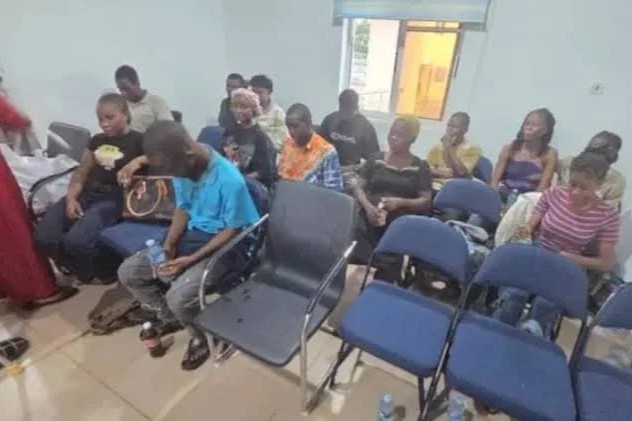
Seven of the abducted worshippers were later rescued.
They were taken to Katari Hospital, where authorities say they are receiving treatment and are in stable condition.
That rescue will bring relief to anxious families.
But it does not erase the deeper questions now hanging over the attack, the security response and the competing versions of what happened.
Because almost as soon as the official rescue claim was circulated, residents and community leaders began to dispute parts of the military account.
SaharaReporters had earlier reported that a fresh controversy erupted over the fate of 31 civilian worshippers allegedly abducted during Easter celebrations in Kaduna State, after a community group openly contradicted the Nigerian Army’s claim that a successful rescue operation had taken place.
Residents of Ariko community in Kachia Local Government Area reportedly insisted that no such rescue occurred in the form claimed by the army.
That contradiction matters.
In a country already battered by mass abductions, bandit raids and public distrust, any clash between community testimony and official reporting cuts straight to the heart of state credibility.
If residents believe the security forces are overstating success, then the space for trust narrows further.
If the army insists it freed worshippers and the community denies it, then the public is left trying to piece together the truth from fragments, fear and rumour.
That is exactly the kind of confusion armed groups thrive on.
The attack itself was brutal in its simplicity.
Gunmen arrived at a place of worship.
They fired indiscriminately.
They killed.
They abducted.
They fled.
No elaborate battlefield.
No prolonged siege.
Just another ruthless strike on civilians gathered in prayer.
That pattern has become painfully familiar across parts of Kaduna and other northern states, where churches, schools, villages and roadside settlements have repeatedly been targeted by armed groups seeking ransom, leverage and terror.
The consequences are never limited to the immediate casualties.
Each attack drains public confidence, empties churches, paralyses farming communities and forces families into cycles of displacement and fear.
It also places intense pressure on the security agencies to prove that the state still has the ability to detect, disrupt and defeat armed gangs before they strike.
In Ariko, that test now falls directly on DIG Nadada and the combined security team.
The operation is reportedly ongoing, with efforts focused on tracking the perpetrators and rescuing the remaining abducted victims.
But the hard truth is that the response is running behind the violence.
The attackers have already hit, escaped and scattered into difficult terrain.
The state is now chasing them.
That sequence remains one of the strongest indictments of Nigeria’s anti-banditry strategy.
Because when armed men can enter a church during worship, kill worshippers, abduct others and disappear into nearby forests before any meaningful interception, the system is not merely under pressure.
It is failing at the most basic level of prevention.
Kaduna has seen too many such episodes.
It has become one of the country’s most battered security theatres, where rural communities live under the constant threat of raids, kidnappings and retaliatory violence.
The forests, the roads and the isolated villages have become operational corridors for criminal groups that exploit weak surveillance, delayed response and the vast distance between government statements and frontline reality.
And this is why the latest controversy over rescue claims is so damaging.
For families searching for missing loved ones, accuracy is not a luxury.
It is a lifeline.
They need to know who is alive, who has been recovered, where the missing are being held and whether the security agencies are speaking with one voice.
Instead, Ariko has produced another mess of partial reports, disputed claims and hurried official reassurance.
The police say the rescued victims are safe.
The community says there is more to the story.
The military is under pressure to explain its version.
And the public is left staring into another dark corner of Nigeria’s insecurity crisis.
IGP Disu has urged residents to stay vigilant and cooperate with security agencies by supplying credible information that could help ongoing operations.
That appeal is standard in moments like this.
But in Kaduna’s present reality, vigilance alone is not enough.
Communities need protection before the gunmen arrive, not only searches after the damage is done.
They need patrols that deter.
Intelligence that anticipates.
And a security system that does not collapse into confusion at the first test of a major attack.
Ariko is now more than a village under siege.
It is a warning.
A warning that bandit violence remains operationally agile.
A warning that rural worshippers are still exposed.
A warning that official narratives can fracture almost instantly under the pressure of facts on the ground.
And, above all, a warning that unless the security architecture in Kaduna is urgently strengthened, the next attack may arrive just as suddenly, just as brutally and just as close to home.
Follow us on our broadcast channels today!
- WhatsApp: https://whatsapp.com/channel/0029VawZ8TbDDmFT1a1Syg46
- Telegram: https://t.me/atlanticpostchannel
- Facebook: https://www.messenger.com/channel/atlanticpostng