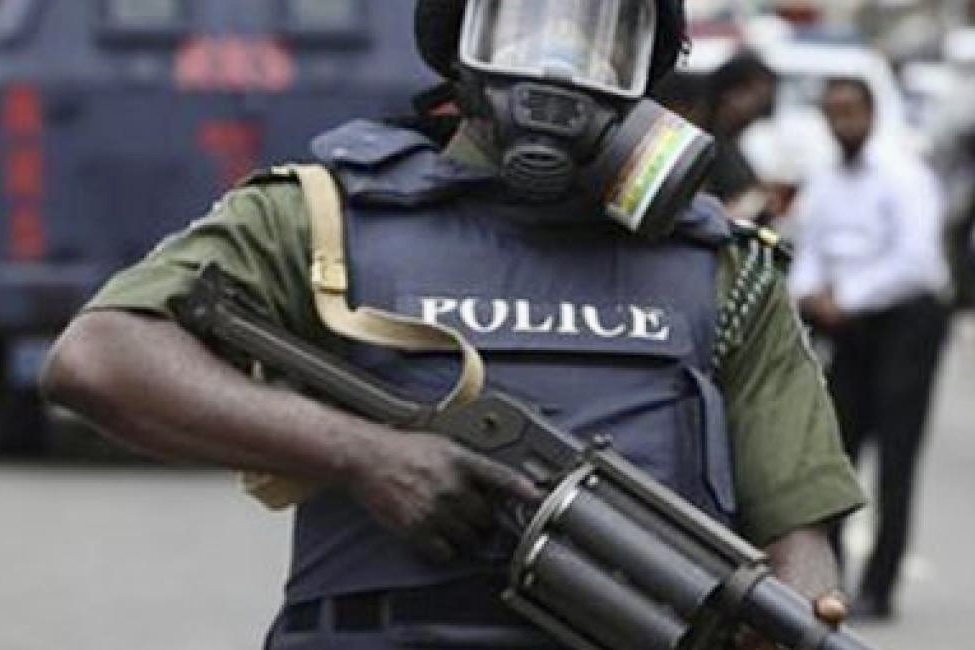
A reported police shooting in Ilorin has reopened a troubling question: what happens when repeated warnings about extortion and harassment fail to change what young Nigerians experience on the street?
A young man lies unconscious on a roadside in Ilorin. Police officers gather around him. Moments later, they lift his body into a police van and drive away.
The disturbing scene, captured on video and reported by SaharaReporters on Wednesday, has raised a question bigger than the fate of one unidentified man.
Did another confrontation between police officers and young people suspected of internet fraud spiral into gunfire, as a resident alleged?
And, more urgently, why is this question resurfacing in Kwara after years of complaints, police investigations, disciplinary action and repeated warnings about harassment and extortion?
As of Wednesday, September 23, 2026, the identity of the victim and his medical condition had not been independently established. SaharaReporters reported that the man was taken towards a nearby hospital, while the Kwara State Police Command had yet to publicly explain the circumstances surrounding the shooting.
That gap matters.
When an armed police officer fires a weapon in a crowded civilian environment, the public needs to know what happened before, during and after the shot.
The incident at Oyun Bridge
According to the account reported by SaharaReporters, the incident occurred on the Oyun Bridge-Fate Roundabout axis in Ilorin on Wednesday afternoon.
A resident told the publication that the confrontation began as an altercation between police officers who regularly patrol the area and a group of young men believed to be students of Kwara State Polytechnic.
The resident said:
“It started like a random altercation between some policemen that always patrol between Oyun Bridge and Fate Roundabout and some young guys who appeared to be students of Kwara Poly.”
The resident then described what he alleged was a familiar pattern in the area.
“I’m not sure if they are students but people said they are students. Everyone knows that the police always harass these students and other young people and illegally tag them as fraudsters.”
The resident alleged that the encounters were frequently connected to demands for money.
“The police always use that to extort these students. Many of them always run away from the police.”
He added:
“There is no time you will pass through this community that you will not witness any form of harassment from these police officers.”
The resident said he believed the Wednesday confrontation followed another alleged attempt at extortion.
“So I heard that the police, in their usual ways, were trying to extort these young guys and things escalated and he was shot.”
That account remains an allegation. It has not been independently established that the officers involved were attempting to extort money, nor has the police explained what led to the shooting.
The video that changed the question
The footage reported by SaharaReporters appears to show several officers surrounding the injured man before carrying him into a police vehicle.
An eyewitness could be heard shouting:
“They have shot this innocent man. The unfortunate police officers have shot him dead.”
The language reflects the immediate fear at the scene, but it does not establish that the man was dead.
The resident who spoke to SaharaReporters was more cautious.
“From the video I also saw, the guy was seen unconscious but we are yet to conclude if he died. What I can confirm is that he has been rushed to a nearby hospital.”
That distinction is important.
In breaking incidents involving alleged police shootings, an unconscious victim is not automatically a confirmed fatality. Until a medical facility or the police formally establishes the victim’s condition, reporting should stop short of declaring a death.
The uncomfortable history behind the confrontation
What makes the Oyun Bridge allegation particularly significant is not simply that a man was reportedly shot.
It is that the allegation resembles a pattern that has already been publicly documented in Kwara.
In May 2022, the Kwara State Police Command said it had initiated investigations into 26 officers and men over allegations of harassment, intimidation and extortion involving youths, students and motorists. The affected personnel included officers attached to anti-cultism and anti-cybercrime units and were redeployed pending investigation.
The command at the time publicly promised to deal with officers found culpable.
Three years later, another case involving a student and alleged police extortion reached the office of the Commissioner of Police.
In August 2025, Commissioner Adekimi Ojo ordered the arrest and trial of police personnel accused of extorting ₦200,000 from a Federal Polytechnic, Offa student. The reported account involved officers stopping the student, demanding access to his phone and subsequently forcing a money transfer. Ojo said he was embarrassed by the conduct and ordered action against the officers.
Then came another case in January 2026.
The Foundation for Investigative Journalism reported that a Kwara State Polytechnic student was allegedly stripped of ₦70,000 by mobile police officers after being accused of being a “Yahoo Boy”. The officers allegedly seized his phone and took him to the command headquarters.
Two weeks later, FIJ reported that the command’s Complaint Response Unit was still trying to identify the officers. The unit told the publication it was “still looking for those officers”.
The important point is not that every allegation has been proved.
It has not.
The point is that the same broad complaint keeps returning: young people, suspicion of internet fraud, police encounters, allegations of intimidation, demands for money and disputes over the use of police powers.
The 2024 case that should not be forgotten
There is an even more serious precedent.
On September 4, 2024, Kwara State Polytechnic student Abdulqoyyum Abdulyekeen Ishola was fatally shot in Ilorin.
The incident prompted demands for accountability from the polytechnic community. The Kwara State Police Command later said three officers had been found guilty internally of leaving their beat, corrupt practices and unlawful or unnecessary exercise of authority.
The three officers were dismissed from the Nigeria Police Force with effect from October 4, 2024, and the command said they would be arraigned in court.
That case is significant because it demonstrates that serious disciplinary action is possible.
It also raises a harder institutional question.
What happens between one disciplinary announcement and the next alleged incident?
A warning issued only 34 days ago
The latest development is particularly striking because of something Kwara’s current police leadership said just 34 days before the alleged Oyun Bridge shooting.
On August 20, 2026, Commissioner Ojo Adekimi publicly warned officers against indiscriminately searching the phones of National Youth Service Corps members on the road under the guise of checking whether they were involved in internet fraud.
He said:
“No police officer should indiscriminately search through the mobile phones of corps members on the road under the guise of checking whether they are involved in internet fraud.”
Adekimi also told corps members to report inappropriate police conduct through the command’s channels.
That warning was not isolated.
In June, the commissioner had told senior officers that “the era of impunity is over” and warned that officers involved in misconduct, abuse of authority, extortion or harassment would face disciplinary action.
Then, on September 10, during an operational inspection of the command, Assistant Inspector-General Betty Otimenyin warned officers against extortion, intimidation and abuse of authority.
Her message was blunt:
“The uniform represents a responsibility to protect and must never become an instrument of fear.”
That makes the Oyun Bridge allegation more than a routine misconduct complaint.
It becomes a test of whether publicly announced standards are reaching the point where policing actually happens.
What the law requires
The Nigeria Police Act 2020 gives officers powers to stop and search people in specified circumstances, but those powers are not unlimited.
The Act says police officers exercising stop-and-search powers must have reasonable grounds for suspicion. Before a search, the officer is required to explain his name and station, the object of the search and the grounds or authorisation for it. The law also requires police to minimise embarrassment and seek the cooperation of the person being searched.
The Act further states that personal characteristics or stereotyped images of particular groups cannot themselves constitute grounds for reasonable suspicion. That is significant in an environment where young men are sometimes treated as suspects because of appearance, age or perceived lifestyle.
Nigeria’s policing framework also recognises the right to life, dignity and lawful treatment. The Nigeria Police Force has itself acknowledged that its rules governing the use of force do not authorise unlawful killing or degrading treatment.
The critical issue in any police shooting is therefore not simply whether an officer fired a gun.
It is why the officer fired.
What threat existed?
Was anyone in immediate danger of death or serious injury?
Was a less dangerous response available?
Were warnings given?
Was the weapon discharged in accordance with the applicable rules?
And was the shooting properly recorded and independently investigated?
Those are questions that cannot be answered from a short roadside video.
The bigger failure may be the space between complaints and evidence
There is a recurring problem in police accountability cases in Nigeria.
The public sees the beginning of the incident.
Police authorities announce an investigation.
The news cycle moves on.
The public then rarely gets a complete account of what happened next.
The 2022 Kwara investigation involved 26 officers. In 2024, three officers were dismissed over the death of a polytechnic student. In 2025, another group of officers faced arrest and investigation over alleged extortion. In January 2026, the police Complaint Response Unit was still searching for officers accused of taking ₦70,000 from a student.
Each case generated a response.
The harder question is whether they generated institutional memory.
Because accountability is not only about punishing an officer after something goes badly wrong. It is also about identifying patterns before another confrontation becomes another emergency.
What should happen now
The Oyun Bridge incident requires a documented investigation that establishes the sequence of events rather than relying on competing narratives.
The identity of the victim should be established.
His medical condition should be confirmed independently.
The officers involved should be identified.
Their units, weapons and deployment orders should be established.
Witnesses should be interviewed and available video footage preserved.
The circumstances leading to the firearm discharge should be reconstructed.
The police should also establish whether any arrest or search took place before the shooting and whether any demand for money was made.
Most importantly, the outcome should not end with the phrase “investigation ongoing”.
The public needs to know whether the allegation was substantiated, rejected or left unresolved, and what disciplinary or criminal action follows.
That is particularly important now because the current Kwara police leadership has spent months publicly promising professionalism, accountability and better treatment of citizens.
The question Oyun Bridge leaves behind
The most important question may ultimately have nothing to do with the identity of the man on the ground.
It is whether a young Nigerian can encounter an armed police patrol without the encounter automatically becoming a negotiation over suspicion, money, authority and fear.
Kwara’s police leadership has repeatedly said the answer should be yes.
The allegation at Oyun Bridge, once the facts are established, will help determine whether that promise is becoming reality.
For now, the facts remain incomplete.
A man was reportedly shot.
He was taken away unconscious.
The police have yet to publicly explain the circumstances.
And a city that has heard repeated assurances about reform is once again waiting for an answer.
Follow us on our broadcast channels today!
- WhatsApp: https://whatsapp.com/channel/0029VawZ8TbDDmFT1a1Syg46
- Telegram: https://t.me/atlanticpostchannel
- Facebook: https://www.messenger.com/channel/atlanticpostng