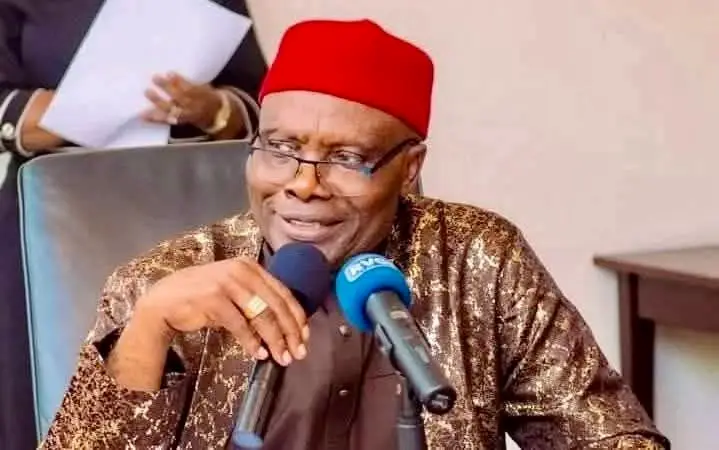
Abia PDP expels BoT Chairman Wabara, igniting a fierce power struggle. Dive into Nigeria’s latest political drama.
UMUAHIA, Abia – In a dramatic escalation of internal tensions within the Peoples Democratic Party (PDP), the Abia State chapter has expelled Adolphus Wabara, the embattled Chairman of the party’s Board of Trustees (BoT) and a former Senate President.
This unprecedented move has set off a political firestorm, underscoring the deep fractures within the PDP’s national and state structures.
The expulsion, which was announced on Tuesday by the Abia State Working Committee (SWC) after an emergency meeting, has thrown the party into further crisis.
The decision followed the recommendation of the PDP Disciplinary Committee, which investigated allegations against Wabara.
According to a statement signed by the State Chairman, Abraham Amah, and the State Secretary, Peter Nwaokonko, Wabara’s expulsion was a unanimous decision based on findings from the Disciplinary Committee’s report.
“After a thorough review of the committee’s findings and recommendations regarding the expulsion of Senator Adolphus Wabara, the SWC unanimously approved the recommendation contained in the report. Senator Adolphus Wabara is hereby expelled from the Peoples Democratic Party (PDP),” the statement declared.
PDP Constitution Invoked: No Mercy for Wabara
The party leadership cited Articles 57(3) and 59(1) of the PDP Constitution (2017 as amended) to justify its decision. The articles stipulate that an expelled member loses all rights and privileges within the party.
With this expulsion, Wabara no longer has any legitimate claim to his role as the PDP BoT Chairman, prompting the Abia PDP to demand that the National Working Committee (NWC) and the National Executive Committee (NEC) immediately appoint an Acting BoT Chairman.
“In line with Article 57(3) and 59(1) of the PDP Constitution (2017 as amended), which stipulates that an expelled member cannot exercise any rights or privileges within the party, the Abia State Executive Committee hereby recommends the immediate appointment of an Acting BoT Chairman by the National Working Committee (NWC) and the National Executive Committee (NEC) of our great party,” Amah stated.
A Battle of Wills: State vs. National Leadership
The expulsion of Wabara is the latest twist in a bitter power struggle between the state and national leadership of the PDP. Just weeks ago, the Abia PDP suspended Wabara over alleged anti-party activities.
However, the national body swiftly declared the suspension null and void, indicating a clear rift between the factions.
Despite the NWC’s intervention, the Abia PDP refused to back down. The insistence on Wabara’s expulsion sends a strong message that the state chapter is unwilling to accept interference from the national leadership, potentially setting the stage for a prolonged confrontation.
Wabara, who has enjoyed a long political career, has not taken these decisions lightly. Reports indicate that he has challenged his suspension in court, but with his expulsion now confirmed, his legal battle may take on new dimensions.
What Led to Wabara’s Downfall?
While the Abia PDP has not explicitly detailed the allegations against Wabara, his troubles appear to stem from accusations of disloyalty and anti-party activities.
Given his role as BoT Chairman, Wabara was expected to be a unifying figure within the party. Instead, insiders suggest that he was perceived as working against the interests of the state chapter’s leadership.
Political analysts believe that his perceived alliance with forces outside the Abia PDP hierarchy may have contributed to his downfall.
Some reports suggest that Wabara was accused of working closely with certain national figures to undermine the state chapter’s authority, leading to his eventual suspension and expulsion.
The PDP’s statement reaffirmed its commitment to internal discipline and its expectation that all members adhere strictly to the party’s constitution.
“The Abia State PDP reaffirms its commitment to upholding party discipline and ensuring that all members operate within the framework of the PDP Constitution (2017 as amended). The party remains resolute in preserving unity, loyalty, and respect for party structures. No member, regardless of status, is above the party’s rules and regulations,” the statement read.
The Larger Implications: A Fractured PDP Ahead of 2027?
The expulsion of a high-ranking figure like Wabara signals deeper instability within the PDP, both at the state and national levels. The timing of this crisis is particularly crucial as the party struggles to rebuild after its 2023 electoral setbacks.
PDP’s internal conflicts, especially in strategic states like Abia, raise concerns about its ability to mount a credible challenge against the ruling All Progressives Congress (APC) in the 2027 elections.
If unresolved, the rift could weaken the party’s structure in the South-East, a region historically crucial to its electoral success.
Political observers warn that unless the PDP resolves these internal conflicts swiftly, it risks further alienating party faithful and losing its influence.
What Next for Wabara?
With his expulsion now official, the question remains: What will Wabara do next?
Given his political stature and experience, it is unlikely that he will quietly accept his fate. His legal challenge against his earlier suspension suggests that he may explore further legal avenues to contest his expulsion.
However, the PDP’s constitution is clear on the status of expelled members, making it an uphill battle.
Another possibility is that Wabara could defect to another political party. With Nigeria’s ever-evolving political landscape, he could align with opposition forces or even seek to form a new political alliance.
His next steps will determine whether this crisis remains an internal PDP affair or transforms into a broader political saga with nationwide implications.
Conclusion: A House Divided Against Itself
The expulsion of Adolphus Wabara is a clear indication that the Abia PDP is determined to assert its authority, even if it means defying the party’s national leadership.
However, the fallout from this decision could have far-reaching consequences for the party’s unity and future electoral prospects.
As the PDP scrambles to appoint a new BoT Chairman and navigate its internal divisions, one thing is clear: the crisis in Abia is far from over.
The coming weeks will determine whether the party can mend its fractured house or whether this latest controversy will be another nail in its political coffin.
- Additional report by Osaigbovo Okungbowa, Atlantic Post Senior Political Correspondent