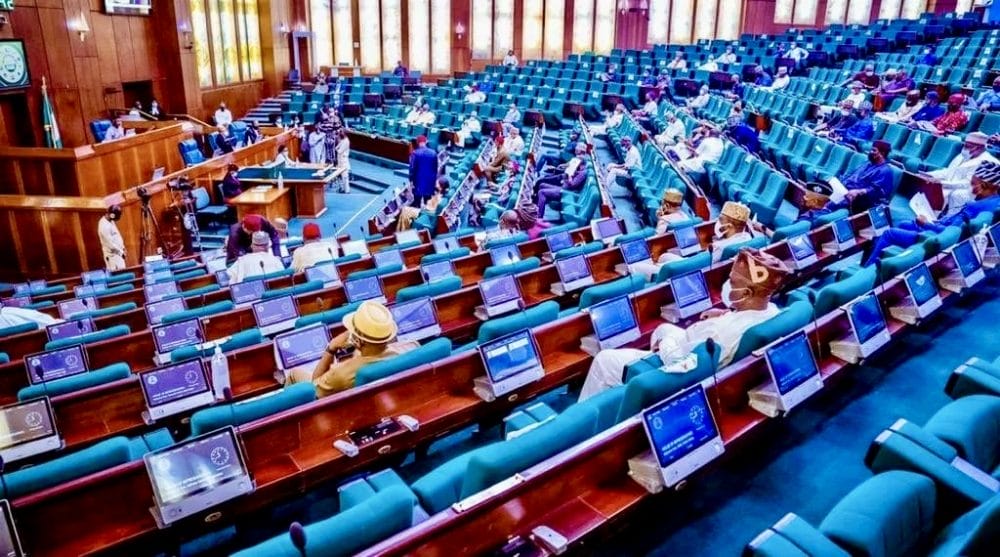
The Nigerian House of Representatives has passed a controversial bill imposing a 60-year age limit on presidential and gubernatorial candidates, arousing debates about universal suffrage and democracy. Critics argue it discriminates against experienced leaders, questioning its constitutionality, while supporters see it as a means to rejuvenate political leadership in Nigeria.
Controversial 60-Year Age Limit Bill: A Blow to Universal Suffrage and Democratic Ideals
ABUJA, Nigeria — In a move that has stirred fierce debates in Nigeria’s political arena, the House of Representatives has passed the second reading of a bill that seeks to impose a strict 60-year age limit for presidential and gubernatorial candidates.
Touted by its sponsor, Imo lawmaker Ikenga Ugochinyere, as a reformative measure, critics argue that the proposed legislation undermines the principles of universal suffrage and the right to franchise, and could be a blatant affront to constitutional guarantees.
A Measure with Far-Reaching Implications
The bill, officially titled “A Bill for an Act to alter the Constitution of the Federal Republic of Nigeria, 1999 to review the requirements that qualify a person to be elected as President and Vice President of the Federal Republic of Nigeria, Governors and Deputy Governor of a State of the Federal Republic of Nigeria and for Related Matters,” has raised significant concerns among political analysts and constitutional experts alike.
By mandating that a candidate must not exceed 60 years of age at the time of contesting the offices of President or Governor, the measure would effectively preclude stalwarts of Nigerian politics such as President Bola Tinubu, former Vice President Atiku Abubakar, and the prominent Labour Party figure Peter Obi from the 2027 presidential race.
This legislative move is seen by many as a double-edged sword. Proponents argue that the bill is a necessary corrective to the ageing political class, intended to inject fresh blood into the nation’s leadership and ensure that candidates are both intellectually vigorous and physically capable of handling the rigours of high office.
However, critics contend that such a rigid age cap is inherently discriminatory and unconstitutionally restrictive, as it impinges on the right to contest for office—a right that is integral to the universal suffrage and the democratic process.
Universal Suffrage and the Right to Franchise: The Bedrock of Democracy
At the heart of this contentious debate lies the principle of universal suffrage—the notion that every adult citizen should have an equal opportunity to participate in the democratic process, not only as voters but also as candidates.
Historically, universal suffrage has been celebrated as the cornerstone of democratic governance. The right to franchise is not just a procedural formality but a profound affirmation of individual dignity, enabling citizens to have a voice in shaping the destiny of their nation.
Critics of the 60-year age limit bill argue that imposing an arbitrary cut-off based on age marginalises experienced leaders who have the acumen and wisdom borne of years in public service.
They assert that such a restriction is counterintuitive to the spirit of universal suffrage. After all, the democratic process should empower citizens to decide who is fit to lead rather than having those criteria predetermined by legislators.
The right to run for public office, they contend, should not be subject to age-based limitations that may inadvertently exclude highly capable individuals who continue to offer visionary leadership well into their later years.
The Constitutional Conundrum
The bill’s focus on age brings with it a host of constitutional challenges. Nigeria’s 1999 Constitution, a document that has withstood numerous political and legal battles over the decades, enshrines the principles of equality and non-discrimination.
Any measure that sets out to curtail an individual’s eligibility based solely on age risks being interpreted as unconstitutionally arbitrary. Constitutional experts warn that such age-based provisions could undermine the democratic ethos that the constitution seeks to protect.
Moreover, the imposition of the 60-year limit raises pertinent questions about the evolving nature of political leadership. In an era when many global leaders continue to serve effectively beyond their sixtieth birthday, the insistence on a fixed age threshold appears out of step with modern governance standards.
Critics maintain that rather than imposing an age barrier, efforts should be channelled into ensuring that candidates meet rigorous standards of competence, transparency, and accountability—criteria that transcend numerical age limits.
Implications for Nigeria’s Political Landscape
Should the bill be signed into law, the impact on Nigeria’s political landscape could be seismic. By sidelining veteran politicians, the legislation could usher in a new era marked by the ascendancy of younger, less experienced leaders.
While there is undeniable merit in infusing politics with fresh ideas, there is also a risk that in the absence of seasoned leadership, the country may lose the valuable insights and stability that experienced figures bring to the table.
Political observers have expressed alarm over the potential for unintended consequences. Many fear that the bill might be used as a political tool to marginalise established figures who have been central to shaping Nigeria’s recent political history.
Such a move could deepen existing political divides and lead to an environment where decisions are made based on arbitrary criteria rather than on merit and public support.
A Wider Push for Inclusive Governance
It is noteworthy that the 60-year age limit bill was not the only legislative measure receiving attention during the recent plenary session. Other bills—ranging from statutory backing for the establishment of Alvan Ikoku Federal University of Education to proposals aimed at increasing the representation of youths, women, and persons living with disabilities in political appointments—signal a broader push for a more inclusive and dynamic governance structure.
Yet, even within this broader reform agenda, the age limit proposal stands out for its potential to disrupt the democratic status quo by interfering with the fundamental right to run for public office.
The Road Ahead: A Call for Judicial Oversight
As the bill moves through the legislative process, there is an urgent call for rigorous judicial scrutiny. Legal experts insist that any measure perceived to undermine constitutional rights must be subjected to stringent review to ensure that it does not set a dangerous precedent for future legislative actions.
With the spectre of judicial intervention looming large, the coming months will be crucial in determining whether the bill can be reconciled with the democratic principles of universal suffrage.
In conclusion, while the 60-year age limit bill purports to modernise and rejuvenate Nigeria’s political leadership, its potential to curtail the right to franchise and to marginalise experienced political figures renders it a controversial and divisive measure.
As the nation stands at a crossroads, it is imperative that the democratic ideals of equality, fairness, and inclusivity are upheld above all else. Only through a balanced approach that respects both the wisdom of experience and the need for youthful innovation can Nigeria hope to secure a future that is both dynamic and constitutionally sound.
Atlantic Post will continue to monitor this evolving story as Nigeria grapples with the challenges of modern governance, ensuring that our readers remain informed about every twist and turn in the pursuit of true democratic reform.