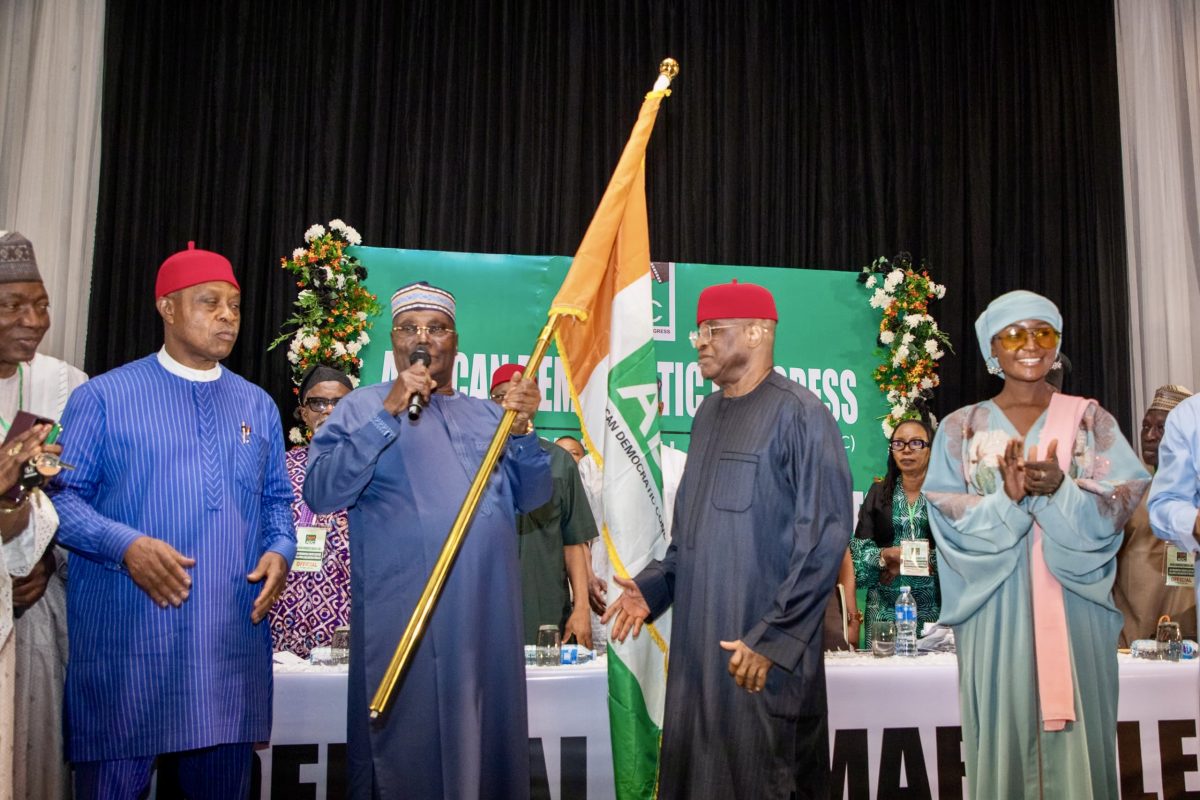
2027 Presidential Race: ADC Bets on Atiku as Coalition Dream Fades
The African Democratic Congress has raised the political stakes ahead of Nigeria’s 2027 presidential election by declaring that it can defeat President Bola Ahmed Tinubu without the broad opposition coalition once viewed as central to its strategy.
The declaration, delivered by ADC National Publicity Secretary Bolaji Abdullahi on Channels Television’s Politics Todayon Friday, amounts to a significant repositioning of the opposition party.
Only months ago, the ADC platform was at the heart of an ambitious attempt to unite major opposition politicians and parties around a common vehicle capable of removing the All Progressives Congress from power. That experiment has since fractured, most dramatically with the departure of Peter Obi and Rabiu Musa Kwankwaso, now aligned with the Nigeria Democratic Congress.
Yet Abdullahi insists the ADC has moved beyond that setback.
“What I am saying is that we don’t need a coalition to win this election. The African Democratic Congress does not need a coalition to win this election.”
He nevertheless acknowledged that a broader alliance could make the task easier.
“If we are able to do the kind of coalition that we started, it will make our job easier, but we don’t necessarily need the coalition to win the election.”
The distinction is important. The ADC is no longer saying that opposition unity is the essential mechanism for defeating Tinubu. It is now presenting cooperation as an optional electoral advantage rather than a prerequisite for victory.
That change has profound implications for the shape of the 2027 contest.
Atiku, Not a Coalition, Is Now the ADC’s Bet
Asked directly whether Atiku could defeat Tinubu without the support of a wider coalition, Abdullahi gave an unequivocal answer.
“I believe so, and that’s our thinking, and that’s what we are working with.”
Other reports of the interview carried an even more emphatic formulation from the ADC spokesman, who said:
“Absolutely, we don’t. Atiku can so amicably do the job. I believe so.”
The rhetoric is politically significant because Atiku is not entering the 2027 race as an unknown quantity.
He was Tinubu’s principal challenger from the Peoples Democratic Party in 2023 and secured 6,984,520 votes, compared with Tinubu’s 8,794,726. Peter Obi won 6,101,533 votes. Official results compiled by the Independent National Electoral Commission show that the three leading opposition and ruling-party candidates collectively dominated the election, but opposition fragmentation left Tinubu ahead of both major challengers.
That history lies at the centre of the coalition argument.
The arithmetic of 2023 demonstrated the potential power of consolidation. But electoral arithmetic is not the same thing as electoral transferability. Voters who supported Obi or Kwankwaso in 2023 cannot simply be presumed to move behind Atiku because political elites reach an agreement.
That is the first major test facing the ADC
The Coalition That Was Supposed to Change Everything
The ADC emerged as an umbrella platform for a potentially formidable opposition realignment. Atiku, Obi, Kwankwaso, Rotimi Amaechi and other political figures had been associated with the wider effort to construct a common front against Tinubu.
The concept was straightforward: combine political structures, regional influence, voter blocs and campaign machinery instead of allowing several opposition candidates to divide the anti-APC vote.
For a time, it appeared to be one of the most consequential developments in Nigerian politics ahead of 2027.
Then the project began to crack.
Peter Obi and Rabiu Kwankwaso eventually left the ADC and moved to the NDC, fundamentally altering the opposition map. Reuters described the development as a major setback to the effort to unify the opposition, while Nigerian media reports have documented disagreements over leadership, presidential ambition and the structure of the proposed alliance.
The political symbolism was difficult to miss.
The coalition that had been designed to prevent opposition vote-splitting became itself an illustration of how difficult opposition consolidation can be.
The ADC now has to sell a different proposition: that Atiku and the party’s own structure are sufficient to defeat Tinubu.
Why the Obi-Kwankwaso Exit Matters
The departure of Obi and Kwankwaso is not simply a matter of personalities.
In the 2023 presidential election, Obi secured more than 6.1 million votes, while Kwankwaso won nearly 1.5 million. Their combined 7.6 million votes represented a substantial electoral constituency, although there is no guarantee that these votes would have transferred to Atiku in a hypothetical joint ticket.
Indeed, that uncertainty is one of the most important realities of Nigerian presidential politics.
A voter is not a transferable political asset.
Obi’s strongest support in 2023 was concentrated in the South-East and among sections of urban, younger and reform-oriented voters, while Kwankwaso retained significant political influence in Kano and parts of the northern political space. Atiku’s historical strength is different again, rooted heavily in northern networks and a long-established national political structure.
The idea that these constituencies could automatically be fused under one candidate was always more complicated than the headline numbers suggested.
The latest realignment has therefore produced two competing opposition centres of gravity.
Atiku leads the ADC.
Obi and Kwankwaso lead the NDC.
Tinubu controls the APC and the machinery of the federal government.
The result is not the united opposition some of the early coalition architects envisioned.
It is another three-way contest.
ADC Changes the Definition of Opposition Cooperation
Abdullahi’s comments reveal that the ADC has not completely abandoned cross-party cooperation.
What has changed is the objective.
“The conversation is not about how do we produce a single presidential candidate. The conversation predominantly is about what areas of cooperation is possible.”
That is a far less ambitious proposition.
Rather than asking opposition leaders to surrender their presidential aspirations, the ADC is proposing tactical cooperation on election-day and campaign infrastructure.
Abdullahi singled out election monitoring and protection of votes.
“For example, if we are able to develop a common protocol for election monitoring and for policing our votes, that is major.”
This could prove more realistic than another attempt to force rival presidential ambitions into a single ticket.
A common monitoring framework could potentially improve coordination among opposition agents, reduce duplication and help parties respond to disputed results.
But such cooperation does not solve the central problem confronting the opposition: who gets the votes?
Monitoring ballots after they are cast is important.
Building a coalition capable of winning the ballots before they are cast is much harder.
The Economic Question May Be the ADC’s Biggest Weapon
The most politically potent part of Abdullahi’s argument is not actually the coalition issue.
It is the economy.
His argument is that Nigerians who voted for Tinubu in 2023 are not permanently tied to the APC.
“They will say, oh, this man, I voted for him in the last election, he has betrayed me. He didn’t do what I wanted him to. He betrayed the social contract. I therefore will not vote for him. This time I will vote for somebody else.”
That is the opposition’s central theory of the 2027 election: that the presidential poll will become a referendum on household economic reality.
There is evidence that the economic argument will matter.
The World Bank says Nigeria has made progress towards macroeconomic stabilisation following major reforms, with inflation easing and external and fiscal conditions strengthening. But it also says household incomes have not fully recovered and poverty remains high.
The IMF similarly says Nigeria’s reform programme has improved macroeconomic outcomes and resilience, while warning that conditions for many Nigerians remain difficult. It estimated national poverty at 63 per cent and said 27 million Nigerians were estimated to have faced food insecurity in late 2025. The IMF projected real GDP growth of 4.1 per cent for 2026.
That creates an awkward political contradiction for Tinubu.
The administration can point to improving macroeconomic indicators, stronger reserves, improved fiscal performance and greater investor confidence.
The opposition can point to the price of food, transport, energy and the loss of purchasing power experienced by ordinary households.
Both narratives can be true simultaneously.
That is why the 2027 election may become less about whether Nigeria’s economy is technically stabilising and more about whether Nigerians believe that stabilisation is reaching their homes.
Investors See Improvement; Households Remain Impatient
The divergence has become increasingly visible.
Reuters reported in August that investors have responded positively to Tinubu’s reforms, including subsidy removal and foreign-exchange reforms, while millions of Nigerians continue to struggle with high living costs. The report said nearly 80 per cent of Nigerians surveyed believed the country was moving in the wrong direction, while noting that investor confidence and household experience were telling very different stories.
Then came another positive signal for the government’s economic story.
Moody’s on August 28 revised Nigeria’s sovereign outlook from stable to positive, citing stronger-than-expected growth, improved foreign-exchange reserves and greater resilience to external shocks. The agency nevertheless maintained Nigeria’s B3 rating, pointing to continued fiscal pressure and weak debt affordability.
This is precisely where the political battle becomes more sophisticated.
Tinubu can argue that painful reforms prevented a deeper economic crisis and are beginning to create stronger fundamentals.
Atiku can argue that an economy cannot be declared a success while families remain trapped by high prices and declining real purchasing power.
The winner of that argument will not necessarily be the candidate with the strongest economic statistics.
It will be the candidate whose interpretation of those statistics voters believe.
Atiku’s Economic Offer
The ADC has sought to make the 2027 campaign an economic contest as much as a political one.
Channels Television reported that Atiku’s platform includes restoring petrol subsidies immediately, followed by gradual removal once social protections are in place, alongside plans to repair local refineries, stabilise the naira and tackle corruption associated with subsidy administration.
Abdullahi has also said the ADC is willing to debate the issue publicly with the APC.
That proposal is politically clever.
Tinubu’s government has made the removal of fuel subsidy one of the signature features of its reform programme. Reopening that question allows Atiku to frame himself as the candidate offering an alternative path rather than merely criticising the outcome.
But it also exposes the ADC to a difficult question:
How much would a restored subsidy cost, and how would it be financed without recreating the fiscal pressures that made the old subsidy regime unsustainable?
That is where the 2027 contest could move from political slogans to economic credibility.
Tinubu Still Has the Advantages of Incumbency
The ADC’s confidence should not be mistaken for evidence that the party is already electorally ahead.
President Tinubu possesses advantages that no opposition candidate can easily replicate: incumbency, the institutional presence of the APC, federal visibility, a large political network and access to an established national governing structure.
The APC also has a direct argument to make: that the economic reforms inherited by Nigerians were painful because the previous system was unsustainable, but that the government now believes the worst of the macroeconomic turbulence can be overcome.
Finance Minister Taiwo Oyedele recently argued that Tinubu’s reforms helped avert an economic collapse and strengthened public finances, foreign reserves and investor confidence, even while acknowledging the hardship caused by the measures.
This creates a remarkably clear battle of narratives.
The APC’s message is likely to be: give the reforms time to work.
The opposition’s message is likely to be: Nigerians have already given you enough time.
The Real Weakness in the ADC’s Argument
Abdullahi’s declaration is politically powerful but strategically vulnerable.
The ADC says it does not need a coalition.
But that raises an obvious question:
If a coalition makes victory easier, why reject the political value of one?
The answer appears to be practical rather than ideological.
The original coalition did not produce the unified ticket its architects envisioned. Atiku became the ADC presidential candidate. Amaechi was subsequently chosen as his running mate. The ADC itself now presents the Atiku-Amaechi ticket as a national “unity and rescue” partnership.
Meanwhile, Obi and Kwankwaso are firmly in the NDC camp, and recent reports indicate that even supporters around competing opposition platforms have rejected another merger arrangement.
ADC vice-presidential candidate Amaechi himself recently acknowledged the difficulty of opposition coalition-building, blaming the ambitions of individual political leaders for some of the problems.
The contradiction is therefore stark.
The ADC says unity is unnecessary.
Yet senior figures within the opposition continue to discuss forms of cooperation precisely because they recognise the electoral cost of fragmentation.
The 2027 Election Is Now 140 Days Away
There is no longer much time for political experimentation.
INEC lists the presidential and National Assembly elections for January 16, 2027. As of August 29, only 140 days remain.
That timetable changes the strategic calculation.
At this stage, opposition parties cannot spend indefinitely negotiating over an ideal coalition architecture.
They must build ward structures, recruit agents, fund logistics, communicate policy, identify voters and protect votes.
For the ADC, the next six months will determine whether its confidence reflects genuine grassroots expansion or simply the need to put a positive face on a fractured coalition project.
Abdullahi’s argument is that the ADC can mobilise Nigerians directly.
“The 2027 election will not be contested on the floor of the National Assembly. It is the people of Nigeria that will decide who they want to vote for.”
That is unquestionably true.
But winning a Nigerian presidential election requires more than broad public dissatisfaction.
It requires national spread, state-by-state organisation and the constitutional voting thresholds required to win.
The ADC therefore faces the same challenge that has confronted virtually every opposition challenger to a sitting Nigerian president: converting anger into organised votes.
What the ADC Must Prove
The most important test for Atiku is not whether Nigerians are unhappy.
There is substantial evidence that many are.
The harder question is whether dissatisfied voters see the ADC as the vehicle for change.
Atiku must convince voters that he is more than the beneficiary of anti-Tinubu sentiment. He must explain precisely how his economic alternative would work, how subsidy restoration would be financed, how the naira would be stabilised, how insecurity would be addressed and how Nigerians would experience measurable improvement in their incomes and living standards.
He must also overcome political fatigue.
Atiku contested the presidency in 2019 and 2023. In 2027, his campaign will necessarily be judged against the record of those previous attempts as well as against Tinubu’s incumbency.
For the ADC, this is no longer simply a question of whether Atiku is popular enough to win.
It is whether the party can create a political proposition compelling enough to make voters overlook the opposition’s fragmentation.
The Bigger Political Reality
The ADC’s new message may ultimately prove less about abandoning coalition politics than accepting political reality.
A single opposition presidential candidate may no longer be achievable.
Instead, Nigeria could head into 2027 with three principal political blocs — Tinubu and the APC, Atiku and the ADC, and Obi and Kwankwaso through the NDC — each attempting to build its own winning coalition among voters.
That makes the election potentially more volatile, not less.
And it leaves one uncomfortable lesson from 2023 hanging over the entire race.
Tinubu won with 8,794,726 votes in an election in which Atiku and Obi together received more than 13 million votes. That arithmetic does not mean a combined opposition would automatically have defeated Tinubu; votes do not transfer mechanically between candidates. But it demonstrates the political consequences of a divided opposition.
The ADC now believes it has learned the lesson without needing another merger.
That is the gamble.
Abdullahi has effectively challenged Nigerians to judge the next election not by the size of a political alliance but by their own experience under the current government.
As he put it:
“What about Bola Tinubu versus Nigerians?”
It is an effective political line.
But it also exposes the ADC to the most important question of all.
When Nigerians stand before the ballot box on January 16, 2027, will they be voting primarily against Tinubu, or will they be voting for Atiku?
That distinction could decide whether the ADC’s confidence becomes one of the defining political predictions of the 2027 election, or one of its most memorable miscalculations.
Follow us on our broadcast channels today!
- WhatsApp: https://whatsapp.com/channel/0029VawZ8TbDDmFT1a1Syg46
- Telegram: https://t.me/atlanticpostchannel
- Facebook: https://www.messenger.com/channel/atlanticpostng