FCT Minister says PDP remains free to field candidates as APC governors reject cross-party arrangements that could weaken the ruling party
By Atlantic Post Political Desk
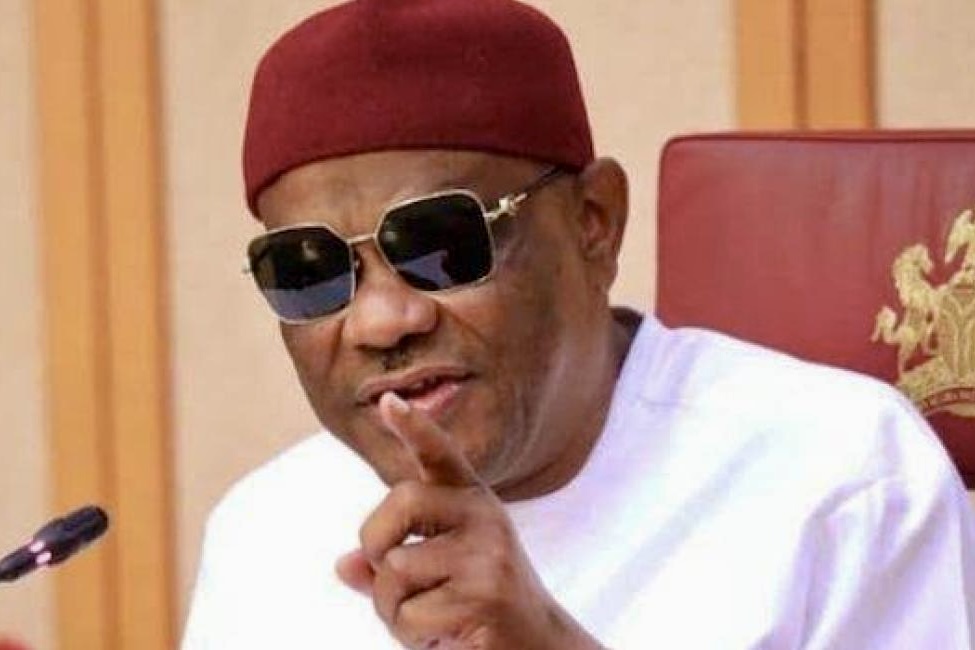
ABUJA — The political alliance being assembled around President Bola Ahmed Tinubu’s 2027 re-election campaign has run into a potentially serious fault line after Federal Capital Territory Minister Nyesom Wike drew a firm distinction between supporting the President and supporting candidates of his All Progressives Congress at other levels of the election.
Wike said his commitment was to mobilise votes for Tinubu’s second term but did not amount to an agreement that the Peoples Democratic Party would withdraw from governorship, Senate, House of Representatives or State House of Assembly contests.
The position places him directly at odds with the APC governors, who have now drawn their own line: support for Tinubu, in their view, cannot be separated from support for the APC candidates whose victories they say are necessary to strengthen both the party and the President.
The disagreement is more than a clash of personalities between Wike and Imo State Governor Hope Uzodimma.
It goes to the heart of how Tinubu’s coalition will function in an election in which Nigerians will vote for the presidency and National Assembly on the same day, while also making separate choices in state contests.
Uzodimma, chairman of the Progressive Governors’ Forum, said after a meeting of APC governors in Abuja that the governors would not support political arrangements capable of weakening the APC or damaging the prospects of its candidates.
“No arrangement that creates confusion, divided loyalty, or competing interests within the party will be entertained,” Uzodimma said.
The governors also declared that they would not participate in an alliance or political arrangement that adversely affected an APC candidate at any level.
That position effectively puts the governors and Wike on opposite sides of an important strategic question: whether Tinubu can build a broad electoral coalition that includes politicians campaigning under opposition party tickets while APC leaders simultaneously seek to maximise the ruling party’s performance across the ballot.
Wike: My Support Is for Tinubu
Wike responded through his Senior Special Assistant on Public Communications and Social Media, Lere Olayinka, insisting that his position had been misunderstood.
“What I said and stand for is that I will mobilise support for the reelection of the President. I never promised anyone that PDP will not field candidates to contest governorship, National Assembly and States House of Assembly elections,” Wike said.
The minister also rejected the suggestion that his proposed “rainbow coalition” was an APC structure.
“Most importantly, rainbow coalition has nothing to do with the APC. Rather, it is [our] own way of mobilising support across political parties for Mr President, who has done well to deserve a second term,” he said.
The distinction is politically significant.
Wike is effectively arguing that a politician can remain a member of another political party, support Tinubu for president and still campaign against an APC candidate seeking a Senate, House of Representatives or governorship seat.
For the APC governors, that arrangement presents an obvious problem.
A cross-party coalition supporting Tinubu at the presidential level could simultaneously assist candidates who defeat APC politicians on the same ballot or in subsequent state elections.
The governors’ concern is therefore not simply about whether Tinubu wins. It is also about what political structure emerges beneath a second Tinubu presidency.
The 2023 Evidence Wike Is Using
Wike has based much of his argument on the voting patterns of the 2023 elections.
His central point is that Nigerian voters have already demonstrated that they can make different choices for different offices.
He cited Imo State, where the APC won two Senate seats despite Tinubu performing poorly in the presidential election.
Official election data show that Tinubu received about 66,000 votes in Imo State in 2023, far behind Labour Party candidate Peter Obi, who won the state with more than 350,000 votes. APC nevertheless emerged with two Senate seats in the state.
Wike asked:
“In Imo State under Governor Hope Uzodinma, how did APC win two senate seats in 2023, in an election held the same day with that of the President and APC had less than 15 percent in the presidential election? Was it rainbow coalition? Were the voters confused?”
The question exposes the weakness in any assumption that voters must automatically vote along party lines across every contest.
The Senate election and presidential election were held on 25 February 2023, giving voters an opportunity to vote for an APC senatorial candidate while choosing a different presidential candidate. INEC’s records confirm that National Assembly elections use a separate winner-takes-all process from the presidential contest.
Wike extended the argument to the South-East.
He pointed to Ebonyi, Abia and Enugu, where APC candidates won National Assembly seats even though Tinubu recorded weak presidential performances in those states.
The pattern was particularly striking in Ebonyi. APC won all three senatorial seats in the state in 2023, including the victory of then-governor Dave Umahi in Ebonyi South.
In Abia, APC won the Abia North Senate seat while Labour Party and APGA candidates took the other two districts. INEC’s 2023 election report records the three different party outcomes across the state.
Wike’s broader argument is therefore not that party structures do not matter.
It is that Nigerian elections do not necessarily produce a single uniform voting pattern.
That distinction could become crucial in 2027.
The Real Problem for APC Governors
The APC governors’ objection is rooted in the opposite calculation.
For them, a presidential coalition that operates independently of the APC risks creating competing political centres.
The governors want Tinubu’s popularity and federal incumbency converted into victories for APC candidates across the ballot.
A coalition that supports Tinubu but leaves its members free to campaign against APC candidates could achieve the opposite.
It could give Tinubu additional presidential votes while weakening governors, senators and lawmakers belonging to his own party.
That creates an awkward political equation.
A politician from the PDP, Labour Party or another platform could campaign for Tinubu while simultaneously telling voters that a different candidate should represent them in the Senate or House of Representatives.
From the perspective of the APC leadership, that is not merely coalition politics.
It could become a parallel electoral machine.
The Progressive Governors’ Forum has therefore rejected any arrangement capable of producing “divided loyalty” or weakening the party’s candidates.
That position also reflects a practical concern.
Governors are among the most important political actors in Nigerian elections. They control extensive party structures, mobilisation networks and political relationships within their states.
They are unlikely to enthusiastically fund or facilitate a political arrangement that could produce opposition legislators, rival governorship candidates or competing local political networks.
Wike Refuses to Make That Commitment
Wike appears equally unwilling to make that concession.
He said he did not negotiate with the APC before he and members of the G5 governors supported Tinubu in the 2023 presidential election.
His message is that support for a presidential candidate does not require surrendering political identity.
He also rejected the idea that politicians should use Tinubu’s re-election campaign to settle local political disputes.
“Politics is local and those having problems in their States should resolve them instead of using the reelection of the President to whip up sentiments,” he said.
That statement could become one of the defining lines of the 2027 campaign.
At the national level, Tinubu needs broad support.
At the state level, APC governors need strong candidates, loyal political structures and legislative allies.
Those objectives overlap but are not necessarily identical.
The PDP Question
Wike’s insistence that the PDP should remain free to field candidates creates another complication.
The PDP is already deeply divided by competing factions and political interests. Wike’s continued cooperation with the Tinubu administration has placed him in an unusual position: he remains associated with the opposition party while openly supporting the re-election of the President elected on the APC platform.
His latest statement reinforces that hybrid political strategy.
He is not saying the PDP should support Tinubu.
He is saying politicians within and outside the PDP can support Tinubu for president while retaining the freedom to contest other positions.
That is a much broader proposition.
It would allow political actors to construct different alliances for different electoral contests.
For Tinubu, such an arrangement could be attractive because it potentially expands the presidential coalition beyond the APC.
For APC governors and candidates, it could be dangerous because the same coalition could empower their opponents.
Tinubu’s Coalition Faces a Test of Structure
The dispute also raises a bigger question about whether the proposed “rainbow coalition” is an informal support network or the beginning of a political structure with ambitions beyond the presidency.
Wike insists it is about mobilising Nigerians from different political parties who believe Tinubu deserves another term.
The APC governors appear determined to ensure that such mobilisation does not become a parallel structure capable of influencing other contests.
That distinction will become harder to maintain as the election approaches.
Political organisations need ward-level coordinators, polling-unit agents, campaign structures, funding and candidates.
Once those structures begin operating on the ground, the boundary between a presidential support group and a political machine can become blurred.
That is likely to be where the dispute becomes more consequential.
The 2027 Ballot May Not Behave the Way Parties Expect
Nigeria’s 2023 elections offer a warning to all parties.
The results did not produce a uniform party vote.
Voters made different choices across presidential and legislative contests. INEC’s official results show that parties could win National Assembly seats in states where their presidential candidates performed poorly.
Wike is betting that voters will do the same thing again.
The APC governors are betting on the strength of party organisation and the ability of a united ruling party to align the presidential and legislative vote.
Both strategies cannot fully operate in the same political space.
If Wike succeeds, Tinubu could benefit from support outside the APC while opposition parties retain enough strength to challenge APC candidates in individual states.
If the governors prevail, the presidential campaign will become a much more integrated APC operation, with party structures expected to work for Tinubu and the party’s candidates simultaneously.
The difference could become decisive in closely contested states and senatorial districts.
Wike’s Warning to the Governors
Wike’s final argument was that politicians should stop assuming that political calculations and elite agreements automatically determine elections.
“The Minister said politics is no longer about coming from fourth position to be governor, it is about genuinely mobilising support and winning elections from the polling units,” his statement said.
That is both a political message and a warning.
For APC governors, the challenge is to turn the President’s national campaign into measurable local victories.
For Wike, the challenge is to demonstrate that a cross-party presidential coalition can deliver Tinubu votes without surrendering the independent political ambitions of its members.
And for Tinubu, the challenge is even greater.
He must hold together politicians whose interests converge at the presidential level but may collide immediately below it.
The question now is not simply whether the “rainbow coalition” will help Tinubu.
It is whether a coalition designed to cross party lines can coexist with a ruling party determined to defend every seat it contests.
Wike says both are possible.
The APC governors are signalling that they do not believe they are.
Follow us on our broadcast channels today!
- WhatsApp: https://whatsapp.com/channel/0029VawZ8TbDDmFT1a1Syg46
- Telegram: https://t.me/atlanticpostchannel
- Facebook: https://www.messenger.com/channel/atlanticpostng