PORT HARCOURT, Rivers — In a dramatic intervention that has sent ripples through Nigeria’s political landscape, President Bola Tinubu has issued an unequivocal directive for all political stakeholders in Rivers State to adhere strictly to judicial decisions, aiming to restore peace in a region long plagued by crisis.
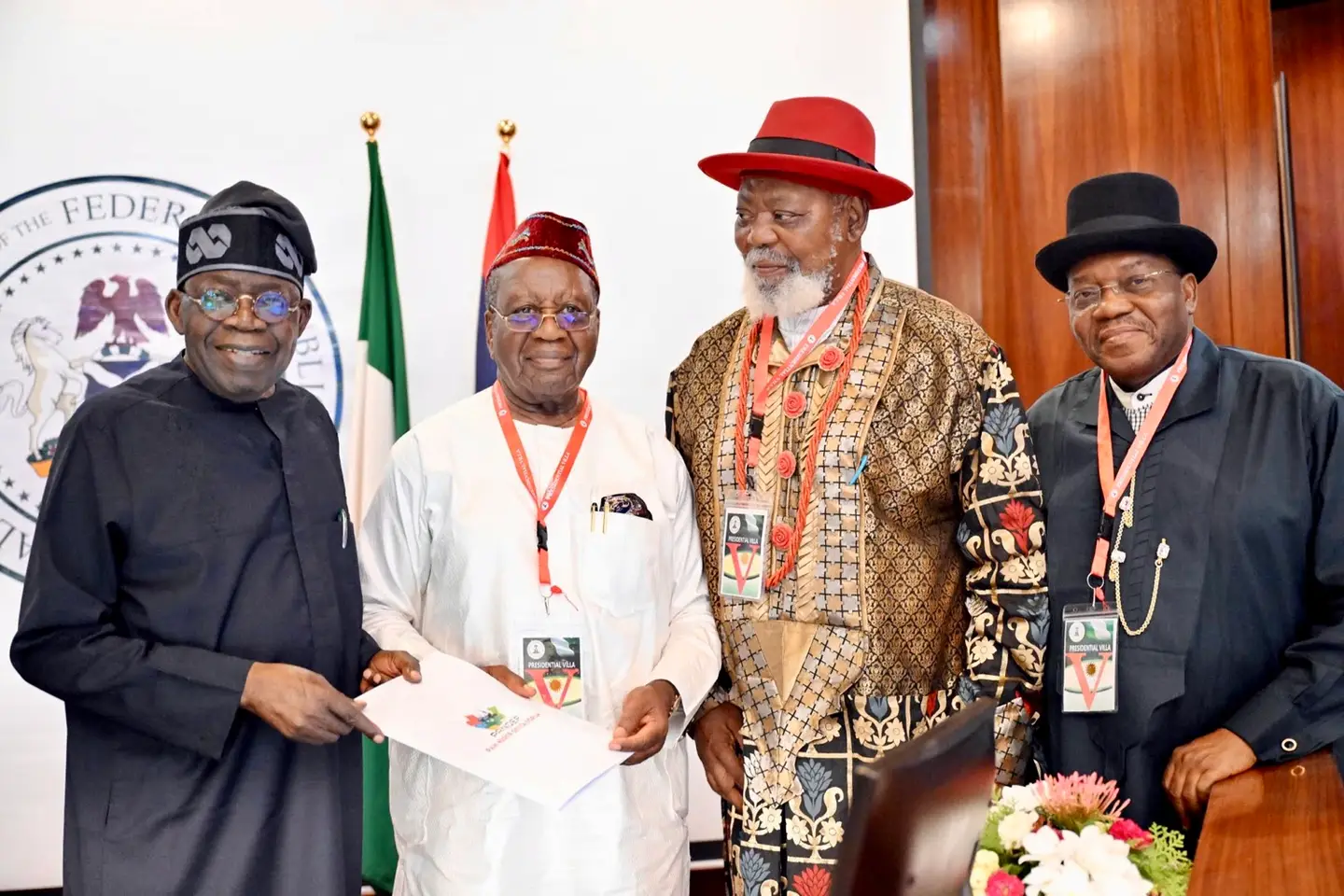
Speaking from Abuja, Tinubu’s message—disseminated through a statement signed by his Special Adviser on Information and Strategy, Bayo Onanuga—was delivered during a high-stakes meeting with leaders of the Pan-Niger Delta Forum (PANDEF).
A Resolute Stand for the Rule of Law
At the heart of President Tinubu’s address was a steadfast commitment to the rule of law—a cornerstone of democratic governance that the President passionately insists must guide all political actions in the nation.
“This is a nation governed by the rule of law. I should not be here as President without a rule of law. I have total confidence in our judiciary. We have expectations. Human beings can make errors. But once the court has spoken, that is it,” he declared.
Such forthright insistence on judicial supremacy is seen by many as both a reaffirmation of Nigeria’s constitutional values and a strategic manoeuvre aimed at quelling the political unrest that has festered in the oil-rich Niger Delta region.
Political analysts, including those with decades of experience in Nigerian politics, have long warned that any deviation from the judicial mandate could further destabilise the delicate balance of power in the region.
With Rivers State now at the epicentre of a growing political crisis, Tinubu’s call for respect of court rulings is viewed as a necessary, albeit bold, step towards restoring order.
The Oil-Rich Niger Delta: A Strategic Economic Asset
The Niger Delta, often metaphorically referred to as “the goose that lays the golden egg”, is not merely a politically sensitive area but also a crucial economic asset for Nigeria.
President Tinubu’s vivid analogy underscored the region’s significance:
“Yes, Niger Delta is the goose that lays the golden egg. We must care for the goose; otherwise, we lose the golden egg.”
His words reflect the mounting concern among political elites that any sustained instability in Rivers State could have far-reaching repercussions, potentially jeopardising Nigeria’s economic interests and the prosperity of millions.
Tinubu’s intervention comes at a time when Rivers State has been mired in a political standoff, the consequences of which extend beyond local governance to national security and economic stability.
In his address, the President reassured stakeholders that his government is committed to ensuring that the people of Rivers State do not bear the brunt of political discord.
“The people of Rivers State will not suffer because of democracy. We worked together on it. They will not suffer. They must be protected,” he vowed, a promise that resonates deeply with communities who have long suffered under the weight of political neglect and economic mismanagement.
PANDEF’s Endorsement and the Call for Reconciliation
The significance of Tinubu’s call was further underscored by the supportive response from PANDEF leaders.
Notable figures such as King Alfred Papapreye Diete-Spiff, Amanyanabo of Twon-Brass Kingdom, and former Akwa Ibom State Governor Obong Victor Attah, who also chairs PANDEF’s reconciliation committee for Rivers State, echoed the President’s sentiment.
Attah was particularly vocal, cautioning that the political turmoil in Rivers State presents a grave national security threat.
“Instability there has far-reaching consequences on the peace and stability of the nation,” he warned.
The PANDEF delegation, comprising former governors, legislators, ministers, traditional rulers, religious leaders, and representatives of youth and women, rallied around Tinubu’s call for judicial compliance.
Their support is seen as pivotal in bridging the divide between contentious political factions and in steering the region towards a path of sustainable peace and stability.
This coalition of influential leaders signifies a rare moment of unity among Nigeria’s elite, offering a glimmer of hope that reconciliation, rather than further fragmentation, could be the way forward.
Political Crisis, Economic Stakes, and the Road Ahead
The crisis in Rivers State is not occurring in a vacuum. It is emblematic of broader challenges facing Nigeria’s political system, where disputes often escalate into crises with dire consequences for both governance and economic stability.
As one veteran political correspondent noted, “Tinubu’s intervention is a clear signal that the age-old practice of disregarding judicial decisions is over. For too long, political actors have manipulated the system to serve their interests, to the detriment of the common good.”
Tinubu’s direct approach, utilising both public pronouncements and closed-door meetings, reflects a nuanced understanding of the intricate interplay between politics, economics, and the rule of law in Nigeria.
His message to PANDEF—to “help implement the court rulings within the shortest possible time” and to “pursue the path of peace and stability”—is a clarion call for all political actors to eschew divisiveness and to work collectively for the greater national interest.
Conclusion: A Pivotal Moment in Nigeria’s Democratic Journey
As Nigeria navigates this critical juncture, the President’s resolute stance on the rule of law offers a beacon of hope amid widespread uncertainty.
His unwavering commitment to judicial decisions is not only a testament to his dedication to democratic principles but also a strategic effort to prevent the escalation of conflict in one of Nigeria’s most volatile regions.
For a nation as diverse and dynamic as Nigeria, the call to respect the court’s rulings is a reminder that stability and progress hinge on the integrity of its institutions.
As political actors in Rivers State and beyond grapple with longstanding issues of governance and accountability, Tinubu’s words serve as both a warning and a promise: that adherence to the rule of law is the only path to lasting peace and prosperity.
In this defining moment, the future of Rivers State—and by extension, the Niger Delta and Nigeria as a whole—rests on a collective commitment to justice, reconciliation, and the unyielding principles of democratic governance.
Atlantic Post will continue to monitor this developing story, providing in-depth analysis and reportage as events unfold.
- Additional reports by Osaigbovo Okungbowa and Kalada Jumbo