By Atlantic Post Investigative Desk
A police investigation into allegations of threats, harassment, abuse of office and unlawful interference with bank accounts has placed Deputy Inspector-General of Police Ibrahim Baba Zango under scrutiny after his estranged Egyptian wife, Karma Saleh, petitioned the Inspector-General of Police.
The dispute, according to an investigation report cited in the petition, grew out of the breakdown of the couple’s marriage but has widened into questions about how a criminal complaint against Saleh was handled and why her bank accounts were allegedly restricted.
The petition, submitted by Aliyu Saiki, SAN & Co. on Saleh’s behalf, was referred through a letter dated April 29, 2026, to the Deputy Inspector-General overseeing the Force Intelligence Department and later sent to the Counter Intelligence Unit for discreet investigation.
The investigation report said Saleh accused Zango of making criminal allegations against her, threatening her with arrest and deportation through Interpol, monitoring her financial transactions, blocking her bank accounts and those of some of her friends, and using his influence within the Nigeria Police Force against her.
She also alleged that a criminal case was initiated against her at the Force Criminal Investigation Department Annex in Kaduna and identified the investigating officer as SP DanMallam.
According to the petition, Saleh alleged that DanMallam demanded and received N200,000 from her on the understanding that the money would help secure the release of her bank accounts. She said the accounts nevertheless remained blocked and that the alleged threats continued.
Marriage dispute at the centre
During the investigation, Saleh was invited to adopt her petition and provide a written statement and supporting documents.
The 29-year-old Egyptian student told investigators that she married Zango under the Marriage Act on January 8, 2020.
“My name is Karma Saleh. I am from Egypt. I am a student. I got married to Ibrahim Baba Zango DIG on 8th January, 2020 under the Marriage Act.”
She said the marriage produced no children and that the couple had spent little time living together.
“We never stayed together much as I always stayed on my own. I only visit him once in a while. We have no children together. We have been separated for several years now.”
Saleh said she had lost interest in the marriage and had commenced divorce proceedings at the High Court in Lagos.
“I am not interested in the marriage and I have filed a petition for divorce.”
She told investigators that she supplied a copy of the divorce petition as part of the materials supporting her complaint.
Bank account question
One of the most significant unresolved issues in the investigation concerns Saleh’s allegation that her Access Bank account was blocked in December 2025.
She said she contacted the bank by email but was not given an explanation.
“I tried to find out from my bank through email why my account was blocked but they refused to tell me.”
Saleh further alleged that she later learnt that the bank had been instructed to arrest her if she appeared at a branch to conduct transactions. She said she was outside Nigeria when the restriction occurred.
The allegation matters beyond the private dispute because restrictions placed on bank accounts during criminal investigations are subject to legal safeguards.
In an April 2, 2026 judgment in a separate case involving the police and several banks, the Federal High Court in Abuja held that police-backed restrictions on bank accounts required an order from a court with proper jurisdiction and declared a magistrates’ court order used in that particular case null and void. The judgment concerned a different investigation and does not establish what happened in Saleh’s case, but it illustrates the legal scrutiny surrounding police-linked account restrictions.
The Nigeria Police Act 2020 also provides a statutory framework governing police investigations and arrests, including requirements around investigation and the treatment of suspects.
The central question in Saleh’s case is therefore not simply whether her account was restricted, but who authorised the restriction, on what legal basis, for how long, and whether the procedure followed the applicable law.
Zango rejects allegations
Zango denied the allegations in his statement to investigators.
Instead, according to the police report, he accused Saleh and one of her friends of conspiring to defraud him of N2 million.
He alleged that the money was meant for the purchase of a laptop and a tablet, but said he did not receive the items.
The DIG also alleged that Saleh was in possession of five of his vehicles.
The report did not resolve those competing allegations as a criminal finding. Instead, it said the wider dispute appeared to have its roots in the breakdown of the marriage.
That distinction is important.
A police investigation report linking a dispute to a marital breakdown is not the same as a judicial finding on allegations of fraud, harassment, threats or abuse of office.
Investigation stops short of clearing Zango
The investigation team concluded that the dispute appeared to stem from an unresolved marital disagreement.
“Flowing from above, it will appear that the issues between the petitioner and DIG Ibrahim Baba Zango stemmed entirely from unresolved marital dispute.”
But the investigators did not close the matter there.
They specifically called for what the report described as a “diligent probe” into the circumstances surrounding the blocking of Saleh’s accounts by the FCID Annex in Kaduna, particularly because the allegation raised the possibility of abuse of office.
The team recommended that the FCID Annex Kaduna case be transferred for review.
“Therefore, it is humbly recommended that the Inspector-General of Police approve the transfer of the case under investigation at the Force CID Annex, Kaduna for a review.”
That recommendation leaves several questions unanswered.
Was the account restriction supported by a court order or another lawful instrument?
Which police formation requested the restriction?
What evidence supported the criminal complaint against Saleh?
Was the alleged N200,000 payment to the investigating officer formally reported or investigated?
What became of the five vehicles Zango said were in Saleh’s possession?
And what exactly is the status of the FCID case after the recommendation for an independent review?
The published investigation report did not answer those questions.
A senior officer under scrutiny
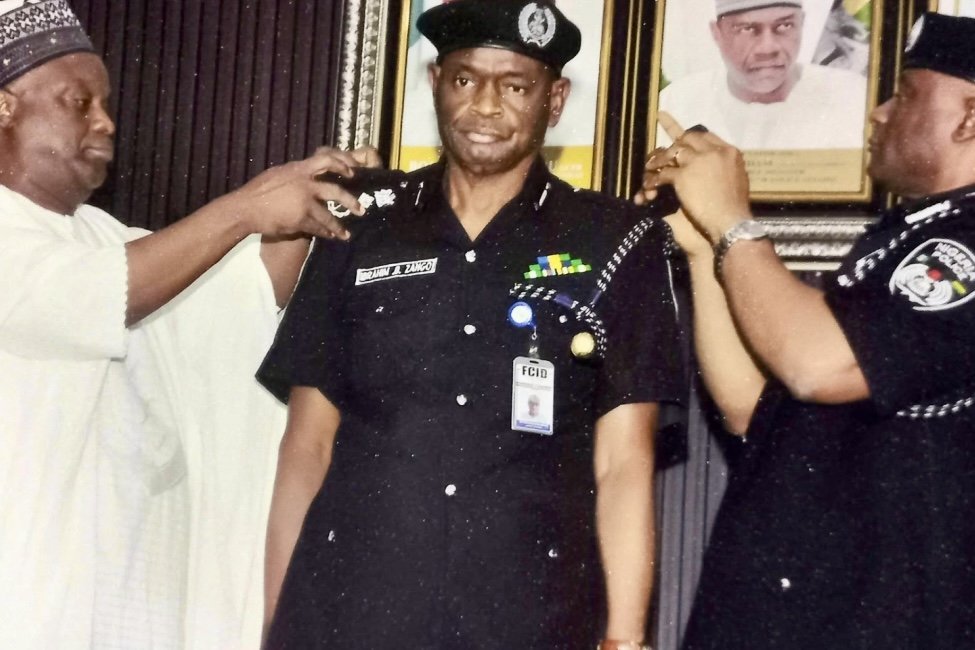
The case comes months after Zango’s elevation to the rank of Deputy Inspector-General.
The Police Service Commission announced on March 6, 2026, that Zango Ibrahim Baba was among the Assistant Inspectors-General promoted to DIG following a process that included consideration of seniority, service record, written examination and oral interview. At the time, he was serving as AIG in charge of the Department of Logistics and Supply at Force Headquarters.
He was subsequently assigned to the Department of Research and Planning.
Current Nigeria Police Force records list DIG Zango Ibrahim Baba as head of the Department of Research and Planning. The Force directory also lists DIG Kenechukwu Onwuemelie as head of the Force Intelligence Department and DIG Margaret Agebe Ochalla as head of the Force Criminal Investigation Department.
That organisational detail is significant because the April referral in Saleh’s petition was to the Force Intelligence Department for investigation, rather than to Zango’s present department.
It also means the recommended review of the Kaduna case can potentially be assessed independently of the department currently headed by the officer at the centre of the allegations.
What the report actually establishes
The police report does not establish that Zango unlawfully blocked Saleh’s accounts.
It does not establish that he ordered her harassment.
It does not establish that the alleged N200,000 payment was made to secure the release of her accounts.
And it does not establish the fraud allegations made by Zango against Saleh.
What it does establish, based on the investigation cited in the published report, is that Saleh made serious allegations, Zango denied them and presented counter-allegations, investigators identified the marital dispute as a major source of the conflict, and they nevertheless considered the account restrictions and handling of the FCID case sufficiently important to recommend further review.
For the Nigeria Police Force, the significance extends beyond one broken marriage.
The allegation directly engages the difficult line between legitimate police investigation and the potential misuse of institutional power in a private dispute.
The recommended independent review could therefore become the decisive next stage.
Until that review produces findings, the allegations against Zango and the counter-allegations against Saleh remain allegations rather than established facts.
Follow us on our broadcast channels today!
- WhatsApp: https://whatsapp.com/channel/0029VawZ8TbDDmFT1a1Syg46
- Telegram: https://t.me/atlanticpostchannel
- Facebook: https://www.messenger.com/channel/atlanticpostng