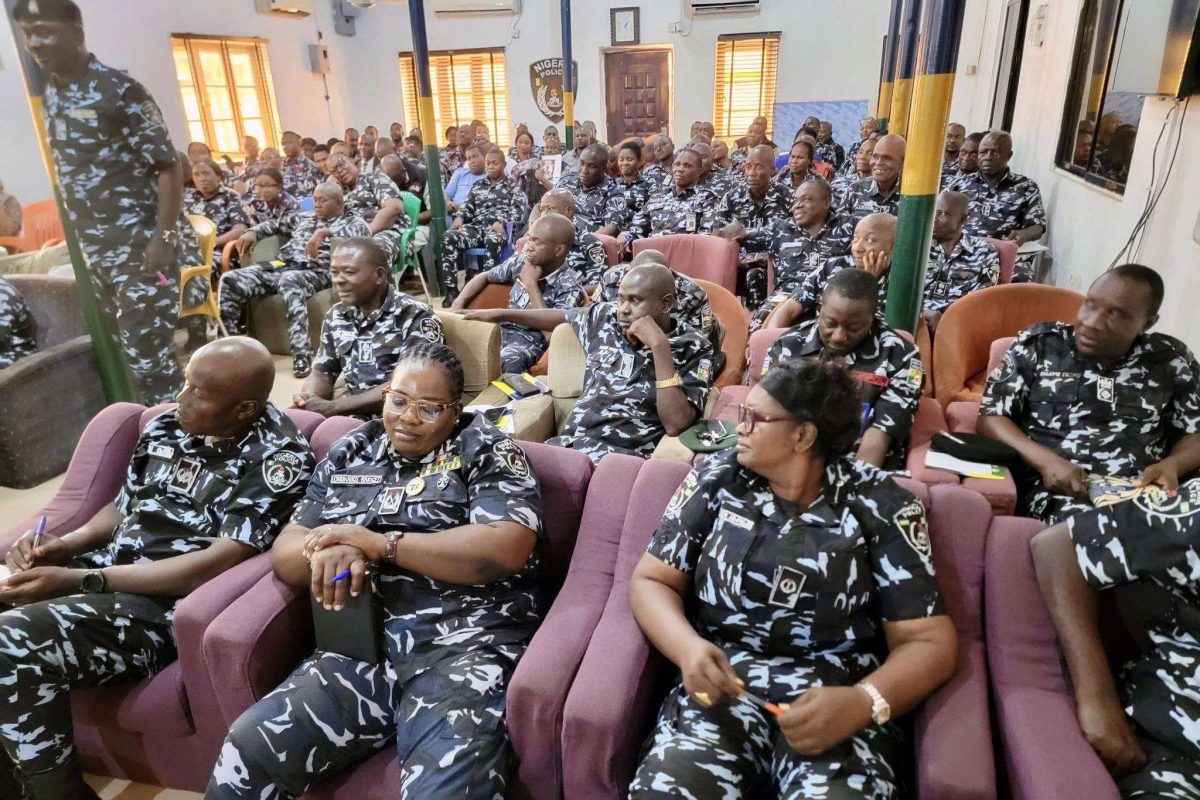
Female corporal reportedly separated from husband for months after Force Headquarters approved her move from Ebonyi to Ogun on compassionate grounds
A female police corporal in Ebonyi State has reportedly remained separated from her husband for months despite an inter-state transfer approved by Nigeria’s Inspector-General of Police, Olatunji Rilwan Disu, raising fresh questions over how transfer decisions issued by Force Headquarters are implemented at command level.
The corporal, identified as F/No. 075703 W/PC Ewono Nyama, married on December 27, 2025. According to information obtained by SaharaReporters and supplied to Atlantic Post, she was subsequently transferred from Ebonyi State Command to Ogun State Command after applying to reunite with her husband, who is based in Ogun State.
The reported transfer was approved on compassionate grounds on June 1, 2026.
Yet, sources within the Ebonyi Command allege that Nyama has not been released to proceed to her new posting.
The dispute now centres on a basic administrative question: why has an officer allegedly not been released after Force Headquarters approved her inter-state transfer?
Transfer Approved at Force Headquarters
According to the reported transfer signal, referenced CH:5550/WEL/FHQ/ABJ/VOL.150/53 and dated June 1, 2026, the Inspector-General approved Nyama’s movement from Ebonyi to Ogun.
The signal was reportedly signed by CP Betty Enekpen Otimenyin, Commissioner of Police in charge of Welfare at Force Headquarters, Abuja.
The document was addressed to the Commissioners of Police in Ebonyi and Ogun states, as well as the Department of Finance and Administration.
Its instruction was described as direct: the officer was to be warned and released to proceed accordingly.
SaharaReporters also reported that the earlier administrative process surrounding Nyama’s marriage had been documented in an Ebonyi Command signal referenced CH:3500/EBS/DFA/SHQ/VOL.7/247.
The significance of the June transfer approval is that it was not presented as a request still awaiting consideration. It was reported as an approved Force Headquarters decision.
Atlantic Post has not independently authenticated the transfer signal itself and is therefore treating its contents as reported rather than established independently.
Nearly Nine Months of Separation
Nyama reportedly returned to Abakaliki after her wedding leave in December 2025.
According to the account supplied to Atlantic Post, she has remained in Ebonyi since January 2026 while her husband has continued living in Ogun State.
By September 2026, the separation had lasted nearly nine months.
One source questioned why an IGP-approved compassionate transfer would allegedly remain unimplemented.
“If the IGP has approved her transfer to rejoin her husband, why would the Commissioner of Police refuse to release her?”
Another source described the prolonged separation as particularly troubling because the corporal had only recently married.
The sources alleged that the couple have largely maintained contact through video calls.
Alleged Attempts to See the CP
The matter reportedly escalated when Nyama sought to meet the Ebonyi Commissioner of Police, CP Hope Urunwa Okafor, to resolve the situation.
Sources alleged that the officer made several attempts to secure a meeting.
One account said Nyama eventually went to the Commissioner’s office with the Command’s Police Public Relations Officer, SP Joshua Ukandu, but was allegedly unable to meet the Commissioner.
The source claimed that the PPRO later informed her that the Commissioner had declined to release her.
Atlantic Post has not independently verified that account.
The Ebonyi Command did not publicly explain the alleged refusal in the material reviewed for this report.
Manpower Shortage Given as Alleged Reason
Sources familiar with the matter attributed the delay to an alleged manpower shortage within the Ebonyi Command.
According to one source, the Commissioner reportedly maintained that Nyama could not leave unless another police officer was posted to replace her.
That explanation, if accurately reported, introduces a second issue into the case: whether a command’s operational staffing difficulties can delay implementation of an already approved inter-state transfer.
The Nigeria Police Act gives the Inspector-General full command and operational control over the Police Force. It also expressly assigns the IGP responsibility for determining manpower distribution and for the welfare and conditions of service of police personnel. At the same time, a state Commissioner of Police exercises command and control over police personnel assigned to the state, subject to the Act.
The law therefore makes manpower a legitimate operational consideration. But the reported existence of an approved transfer raises a separate administrative question about who has final authority over its implementation and what procedure should be followed where a state command believes releasing an officer would weaken its staffing level.
The available material does not establish that the Ebonyi Commissioner personally cancelled, revoked or formally suspended the transfer.
That distinction matters.
What the Police Reform Framework Says
The issue comes as the Nigeria Police Force operates under an updated regulatory framework introduced in 2026.
The Federal Ministry of Police Affairs said the new Nigeria Police Regulations were gazetted in February 2026 under the Police Act and were designed to strengthen accountability, professionalism, service delivery, human-rights standards and gender-responsive policing.
The stated reform objective creates a wider public-interest dimension to the Nyama case.
A police force cannot function effectively without manpower. At the same time, an administrative system that approves transfers must have a clear mechanism for implementing, delaying, reviewing or cancelling them.
When those processes become unclear, junior officers may have little practical ability to challenge decisions taken by senior commanders.
That is the question raised by Nyama’s case.
The IGP’s Authority and the Command-Level Question
The Police Act states that the IGP is the head of the Nigeria Police Force and exercises full command and operational control over the Force and its departments and units. It also gives the IGP responsibility for the distribution of police manpower across the country.
The same framework gives Commissioners command and control over police in their respective state commands and requires them to perform duties delegated by the IGP.
Those provisions do not, by themselves, answer every procedural question surrounding an individual transfer.
They do, however, make the reported dispute one that should be capable of being resolved through the Force’s own administrative chain.
If the June 1 signal is authentic and remains valid, the Police Force can clarify whether it has subsequently been withdrawn, varied, suspended or overtaken by a later posting decision.
If no such action has occurred, the Force could also explain why the officer has reportedly remained in Ebonyi more than three months after approval.
Why the Case Matters Beyond One Officer
At first glance, the dispute may appear to be a personal matter between a junior officer and her command.
It is wider than that.
Police officers are subject to postings, transfers and operational demands across Nigeria. Decisions affecting their careers, family lives and welfare are therefore central to the credibility of the Force’s internal administration.
Section 9 of the Police Act specifically places the welfare and conditions of service of police personnel within the IGP’s functions.
The allegation in Nyama’s case is consequently not simply that a newly married officer wants to live with her husband.
It is that an application made on compassionate grounds was reportedly approved by the highest operational authority in the Force, yet the officer allegedly remains where she was serving.
That is an issue the police hierarchy can resolve with documentary clarity.
Police Response Still Outstanding
SaharaReporters reportedly contacted CP Hope Urunwa Okafor for clarification on why Nyama had allegedly not been released despite the reported IGP approval.
The publication also contacted the Ebonyi Command’s PPRO.
According to the report, neither the Commissioner nor the spokesperson responded to calls or text messages before publication.
Atlantic Post has likewise not established an official explanation from the Ebonyi Command for the alleged non-release.
That leaves several unanswered questions.
Was the June 1 transfer formally received and entered into the command’s records?
Was the transfer subsequently suspended or amended?
Was the officer officially instructed to remain in Ebonyi pending replacement?
If manpower shortage was the reason, was a replacement requested from Force Headquarters?
And, most importantly, has the Inspector-General’s approved transfer actually been implemented?
Until those questions are answered, the case remains an unresolved dispute between a junior police officer and the command in which she serves.
What began as a request by a newly married corporal to join her husband has now become a test of how clearly Nigeria’s largest law-enforcement institution translates approved personnel decisions into action.



