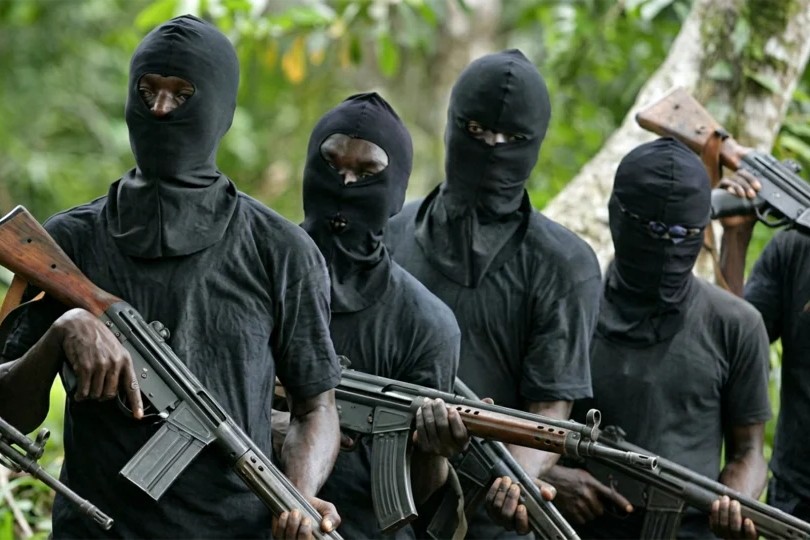
A disturbing video from north-west Nigeria has renewed fears that the state’s security architecture is not merely overstretched but dangerously compromised. In the clip published by SaharaReporters on 24 June 2026, police officers are seen at a checkpoint between Zamfara and Sokoto states appearing to wave through a large number of men described as bandits, while also directing and hailing them as they pass on motorcycles.
The report says a man filming the scene was heard warning in Hausa that “Bandits with their weapons are moving freely,” before another voice quickly told him, “Please keep quiet, why are you talking?”
The significance of the video goes beyond the optics of a lax checkpoint. It lands in a region already battered by mass kidnappings, village raids and recurrent accusations of security failures.
Reuters reported in January that Nigerian troops rescued 62 hostages in operations across Kebbi and Zamfara, while also describing the north-west as a zone hit by a surge in mass kidnappings by armed gangs hiding in forested areas.
More recently, Reuters reported in April that security forces launched a manhunt after another mass abduction in Zamfara, and in June it reported that dozens of villagers were abducted after being lured into a so called peace meeting.
That wider context matters because the new video suggests not just the presence of bandits on a road, but the possibility of a permissive security environment in a corridor that should be among the most heavily guarded in the country.
If the footage is authentic, it raises hard questions about discipline, infiltration, intimidation, or local arrangements that have blurred the line between law enforcement and criminal accommodation.
None of those possibilities is small. Each points to a deeper rot in a system that has struggled for years to protect rural communities across Zamfara, Sokoto, Katsina, Niger and neighbouring states.
This is also why the timing is politically explosive. Nigeria’s Senate on 24 June 2026 approved a bill to create state police forces, a major shift in the country’s centralised policing model.
AP reported that the reform is designed to decentralise law enforcement because the federal police have been stretched by escalating insecurity, particularly in rural areas where armed groups have operated with limited resistance.
The same report noted that critics fear abuse by governors, but supporters argue that the present system has failed to deliver security where it is needed most.
The viral checkpoint footage therefore arrives at a moment when the country is already debating whether Abuja can still monopolise the fight against insecurity.
The answer, judging from the north-west, increasingly looks bleak. AP reported that criminal groups and jihadis have killed tens of thousands of people and that the lack of police presence in vast rural areas has worsened insecurity.
Reuters likewise reported that military and security operations in the north-west remain ongoing, with troops repeatedly rescuing captives or engaging armed groups, yet the violence continues to regenerate itself.
Zamfara is particularly symbolic of that collapse. The state has long been the epicentre of banditry, and TheCable reported in 2021 that former governor Bello Matawalle said the state had backed out of dialogue with bandits because they had deceived the government.
In that report, Matawalle admitted that the state had once treated dialogue as the best option, before concluding that the men it negotiated with had not kept to the agreement.
That history of failed accommodation makes the latest video even more troubling, because it suggests that the border between negotiation, tolerance and complicity has never been clearly drawn.
There is also a broader pattern of instability that helps explain why a checkpoint scene can so quickly become a national scandal.
In June, The Guardian reported that armed bandits abducted 39 villagers in Zamfara after inviting them to a peace meeting, with police saying the victims were taken when a bandit kingpin arrived with members of his gang and forced them away.
The report described Zamfara as the centre of a long running security crisis in which armed groups carry out mass kidnappings, killings and village raids, while community level negotiations continue despite official warnings.
And the pressure on civilians is not only from bandits. In May, Reuters reported that Amnesty International said at least 100 civilians were killed in a Nigerian airstrike on a crowded market in Zamfara, adding to fears that residents are trapped between armed groups and forceful state responses.
Amnesty said villagers were increasingly suffering deaths from military raids and strikes, while the military maintained that its operations are intelligence led and targeted at militant positions.
The effect of such incidents is cumulative. They erode trust, deepen fear and make every checkpoint, patrol and clearance operation look suspect in the eyes of the public.
That is the real scandal exposed by the video. The issue is not only whether one checkpoint behaved badly. It is whether Nigeria’s security presence in the north-west has been normalised to the point where heavily armed criminal groups can move in daylight, on roads guarded by officers, while residents are left to guess who is controlling whom.
When a citizen filming the scene feels compelled to warn that bandits are moving freely, and another passenger tells him to stay silent, it suggests a climate of fear in which truth itself has become risky.
Until the police and the authorities named in the video provide a clear account of what happened, the footage will continue to stand as a brutal symbol of Nigeria’s north-west crisis. It is a crisis of impunity, a crisis of trust, and now, perhaps most damaging of all, a crisis of visible control.
Follow us on our broadcast channels today!
- WhatsApp: https://whatsapp.com/channel/0029VawZ8TbDDmFT1a1Syg46
- Telegram: https://t.me/atlanticpostchannel
- Facebook: https://www.messenger.com/channel/atlanticpostng