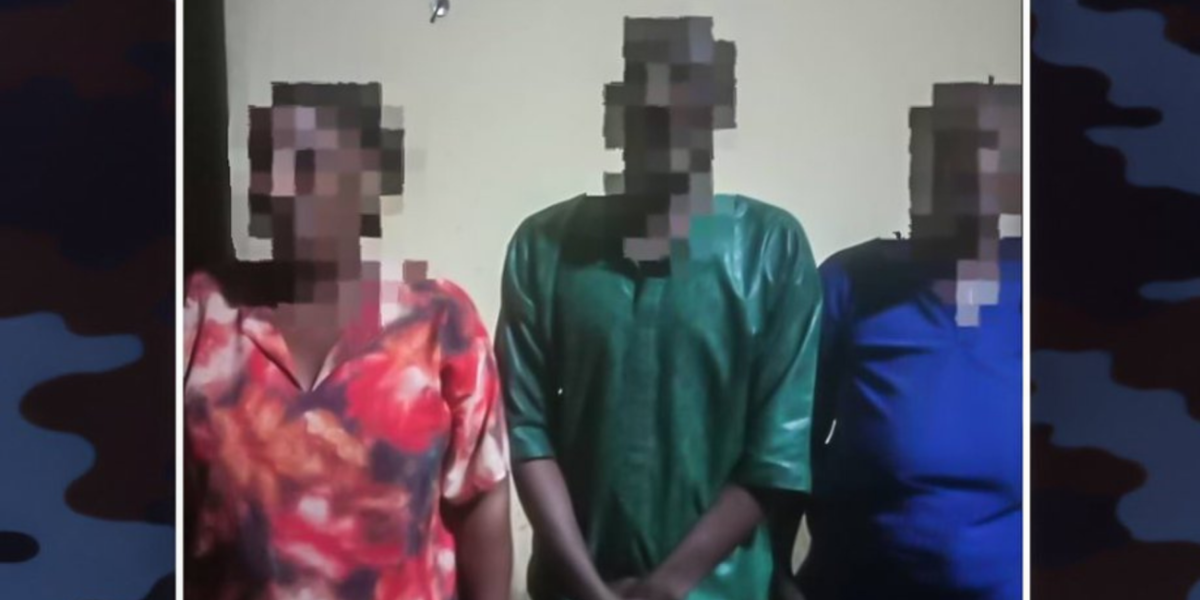
The rescue of a 15-year-old girl from a suspected human trafficking operation in Ogun State has exposed a disturbing investigation involving alleged cross-border recruitment, a migration corridor stretching from northern Nigeria to Libya, and claims that vulnerable victims were pressured to surrender their kidneys.
Three people are now in police custody. But the most troubling question is whether the operation uncovered an isolated trafficking arrangement or a wider criminal network exploiting vulnerable Nigerians for multiple forms of human exploitation.
The Ogun State Police Command confirmed on Sunday, November 29, 2026, that its Special Weapons and Tactics (SWAT) Unit had arrested three suspects during an intelligence-led operation at Ketu-Lusada.
The arrests took place on November 23 following intelligence reports about suspected trafficking activities in the area.
The suspects were identified as Atinuke Olanrewaju, 47; Kabiru Akorede, 49; and Oluwakemi Kanson, 39.
Police operatives conducted the operation under the supervision of the SWAT Officer-in-Charge, Superintendent Eneye Obeh.
According to the command’s spokesperson, DSP Oluseyi Babaseyi, preliminary investigations revealed an alleged arrangement involving the movement of victims from Nigeria through Sokoto State and the Niger Republic, with Libya reportedly identified as the intended destination.
Investigators are also examining alleged financial transactions associated with victim recruitment and claims that some individuals were pressured to sell their kidneys.
The rescued teenager has been placed under protective care.
The police said:
“The rescued minor is receiving the necessary protection, while appropriate steps are being taken to ensure her welfare and safety.”
Although the arrests represent an important intervention, the allegations introduce questions that extend beyond the immediate operation. Police must now establish who recruited the victims, how they were expected to be transported, who financed the arrangements and whether the alleged organ-sale scheme had connections to a wider criminal network.
Peoples Gazette Nigeria+2
The Sokoto-Niger-Libya Corridor: A Route Investigators Cannot Ignore
The geographical dimension of the investigation deserves particular attention.
The suspected movement of victims through Sokoto, Niger Republic and Libya is consistent with trafficking routes previously documented by Nigerian law enforcement and financial intelligence agencies.
An April 2025 report by the Nigerian Financial Intelligence Unit (NFIU), titled Money Laundering Typology Through Human Trafficking and Migrant Smuggling in Nigeria, identifies a route running from Sokoto through Niger Republic to Libya and onwards to Europe.
The report draws on information supplied by Nigerian agencies, including the National Agency for the Prohibition of Trafficking in Persons (NAPTIP), the Nigeria Immigration Service and INTERPOL.
More significantly, the NFIU documented a separate case received by NAPTIP in November 2022 involving two young girls recruited in Ibadan and transported through Sokoto, Kebbi and Niger Republic towards Libya.
Investigators uncovered an alleged financial arrangement involving an unlicensed Bureau de Change operator in Kano and contacts in Libya.
The report disclosed that the financial investigation identified substantial international transfers and more than ₦1.5 billion allegedly laundered through unregulated financial channels over two years.
This earlier case does not establish that the Ogun suspects are connected to the same network. It does, however, demonstrate why investigators should examine the alleged route as a potentially organised transnational operation rather than simply a local recruitment arrangement.
Nigeria Financial Intelligence Unit+1
Libya’s significance in Nigerian trafficking investigations is also supported by migration data.
A UK Home Office country assessment published in October 2026, citing International Organization for Migration data, reported that Libya accounted for 2,562 of 4,660 recorded returns of Nigerian trafficking victims from overseas and transit countries between 2017 and the first quarter of 2024.
That represented approximately 54 per cent of the recorded returns in the dataset.
The figures do not establish the scale of trafficking in 2026, but they demonstrate the historical importance of the Libya corridor in the exploitation of Nigerian victims.
GOV.UK+1
The Kidney-Sale Allegation Raises the Stakes
The most disturbing dimension of the Ogun investigation is the allegation that victims may have been pressured to sell their kidneys.
This introduces a potentially separate criminal dimension involving trafficking for organ removal.
There is an important distinction between consensual medical organ donation and trafficking for organ removal.
Under international anti-trafficking standards, exploitation involving organ removal can constitute human trafficking where recruitment or transportation involves deception, coercion, abuse of vulnerability or other prohibited means.
The United Nations Office on Drugs and Crime (UNODC) explains that victims may be recruited without being properly informed about the procedure, its medical consequences or the long-term effects on their health.
Consent obtained through coercion or exploitation of vulnerability does not make such conduct legitimate.
unodc.org+1
Nigeria’s Trafficking in Persons (Prohibition), Enforcement and Administration Act 2015 specifically criminalises recruitment for organ harvesting.
Section 20 provides for a minimum of seven years’ imprisonment and a fine of at least ₦5 million for relevant organ-removal offences.
The provision also covers the recruitment, transportation or accommodation of a person under 18 for the purpose of removing that person’s organs.
Buying and selling human organs, and involvement in such activities, are also criminalised under the section.
:+1
For investigators, the immediate challenge is to determine whether the kidney-sale allegation represents an actual element of the suspected trafficking operation or an unverified claim emerging from preliminary intelligence.
As of November 29, the police have not publicly established that any victim underwent an organ removal procedure.
Neither have they provided evidence identifying a medical facility, transplant broker, prospective recipient or financial beneficiary connected to the alleged arrangement.
It would therefore be premature to describe the arrests as proof of an established organ-harvesting operation.
Nevertheless, the allegation requires urgent investigation, particularly because the only publicly identified rescued victim is a child.
Following the Money Could Expose the Wider Network
One of the most important aspects of the police announcement is the reference to alleged financial transactions connected to victim recruitment.
That detail could prove critical.
Human trafficking operations often involve more than the individuals who physically recruit or transport victims. Financial intermediaries, travel facilitators, accommodation providers and overseas contacts may all play different roles.
Nigeria’s NFIU has identified several financial methods associated with trafficking and migrant-smuggling networks.
These include cash payments, international money transfer operators, informal financial channels, money couriers, multiple bank accounts and investments in property or other assets.
In one case documented in its 2025 report, investigators traced financial transactions involving an alleged trafficking arrangement through international transfers and an unlicensed currency exchange operator.
The report also highlights how suspicious payments and financial relationships can reveal connections between local recruiters and overseas facilitators.
Nigeria Financial Intelligence Unit+1
This creates several investigative priorities for the Ogun police.
Investigators need to establish whether money changed hands during the recruitment of the victims, whether payments were made through bank accounts or informal channels, and whether the suspects maintained communications with individuals outside Nigeria.
Phone records, recruitment messages, travel arrangements, financial transfers and relevant border-crossing records could help reconstruct the alleged operation.
Where evidence justifies it, investigators should also examine whether suspected overseas contacts had links to people facilitating organ procurement or exploitation.
Without that financial and communications investigation, arrests at the recruitment end of a trafficking chain may leave the people controlling the operation untouched.
Deceptive Overseas Employment Remains a Major Warning Sign
The Ogun investigation comes against a broader background of exploitation involving deceptive recruitment and migration opportunities.
A UK Home Office assessment updated in November 2026 identifies fraudulent employment advertisements, false offers of overseas jobs and deceptive immigration opportunities as recurring recruitment methods.
It also describes the increasing use of social media and messaging platforms to approach vulnerable individuals.
Recruiters may present themselves as legitimate employers, travel agents or intermediaries offering access to better-paying jobs abroad.
Victims may only discover the true nature of the arrangement after travelling, when they become vulnerable to threats, debt bondage, exploitation or restrictions on their freedom.
The same assessment identifies poverty, unemployment, limited educational opportunities and outstanding debts as factors that can increase vulnerability to trafficking.
GOV.UK+1
This is why the police commissioner’s warning about suspicious employment and travel offers is particularly relevant.
Nigerians seeking opportunities abroad should be able to distinguish legitimate recruitment from arrangements that conceal exploitative conditions.
An attractive overseas employment offer is not proof of a trafficking scheme. But demands for unexplained payments, secrecy about the employer, document confiscation, pressure to travel without verifiable arrangements and restrictions on contacting family members should raise serious concerns.
Nigeria’s Trafficking Challenge Goes Beyond Individual Arrests
The scale of the national problem makes the Ogun investigation particularly significant.
The US Department of State’s 2026 Trafficking in Persons Report retained Nigeria’s Tier 2 classification.
The designation means that the country does not fully meet the minimum standards for eliminating human trafficking, although it is making significant efforts.
According to the report, Nigerian authorities investigated 1,341 trafficking cases involving 1,367 suspects during 2025.
They prosecuted 94 suspects and recorded 97 convictions.
The government also identified 2,004 trafficking victims, comprising 893 victims of sex trafficking and 1,111 victims of forced labour.
However, the report recorded government assistance to 675 victims, down from 2,058 in the previous reporting period.
The figures point to two connected challenges: strengthening the investigation and prosecution of trafficking networks while ensuring that victims receive adequate protection and support.
ecoi.net+1
An arrest can disrupt an immediate threat, but it does not necessarily dismantle the entire criminal structure.
The real measure of success will be whether investigators can identify other victims, establish the alleged recruitment chain, trace the financial beneficiaries and secure evidence capable of supporting successful prosecutions.
What the Ogun Police Investigation Must Establish
The Ogun State Police Command has an opportunity to turn this rescue into a much wider investigation.
First, investigators must establish the circumstances surrounding the recruitment of the rescued teenager and determine whether other minors or adults were involved.
Second, the alleged kidney-sale arrangement requires independent verification. Investigators should establish whether anyone was approached for organ removal, whether medical intermediaries were involved and whether any payments or arrangements were made.
Third, the Sokoto-Niger-Libya route requires examination through cross-border intelligence cooperation, particularly with Nigerian immigration authorities and relevant counterparts in Niger Republic and Libya.
Finally, investigators must establish whether the financial transactions under examination connect the three suspects to additional recruiters, transporters or overseas facilitators.
The immediate welfare of the rescued teenager must remain central to the process. Her protection should extend beyond the initial police operation to appropriate medical assessment, psychological support, legal assistance and safeguards against intimidation or renewed exploitation.
The Commissioner of Police, Olubode Ojajuni, commended the SWAT operatives for their intervention and reaffirmed the command’s commitment to fighting organised crime.
He also urged residents to report suspicious recruitment arrangements, especially those involving deceptive employment opportunities and travel offers.
But the larger test lies ahead.
The rescue of one teenager is a significant achievement. The identification of three suspects is an important investigative starting point.
Neither should be mistaken for the dismantling of a trafficking network.
For Ogun State and Nigeria’s wider anti-trafficking institutions, the unanswered questions concern the people who recruited the victims, the money that financed their movement, the individuals awaiting them across borders and the disturbing possibility that human exploitation may have been linked to the illegal organ trade.
The most important outcome of this investigation will not be the number of arrests announced. It will be whether the authorities can reach the people behind the alleged operation before more vulnerable Nigerians disappear into the same network.
Follow us on our broadcast channels today!
- WhatsApp: https://whatsapp.com/channel/0029VawZ8TbDDmFT1a1Syg46
- Telegram: https://t.me/atlanticpostchannel
- Facebook: https://www.messenger.com/channel/atlanticpostng

Join the debate; let’s know your opinion.