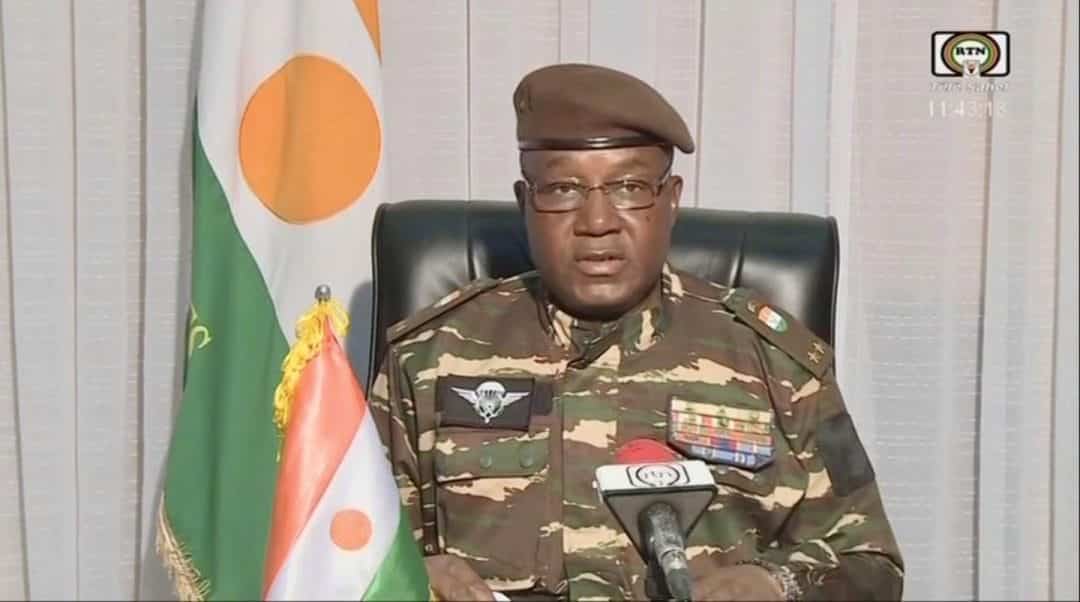
ABUJA, Nigeria — In a recent development that has sent ripples through the diplomatic corridors of West Africa, two prominent Northern Nigerian groups—the Arewa Youths Coalition for Peace and Political Development and the Northern Elders Progressive Group—have issued a stern demand for an apology from General Abdourahamane Tchiani, the Military Head of the Niger Republic. This demand follows allegations made by General Tchiani, accusing Nigeria of colluding with France to destabilise Niger.
The allegations, described by the Nigerian groups as “baseless” and “capable of overheating the polity,” have raised concerns about the potential strain on the historically cordial relations between Nigeria and Niger. The two nations share deep-rooted cultural, economic, and security ties, making any diplomatic friction particularly significant.
The Allegations and Immediate Reactions
General Tchiani’s accusations emerged during a Christmas Day interview, where he claimed that Nigeria was providing a base for French soldiers near Lake Chad and had established training camps for terrorists in Sokoto, Kebbi, and Zamfara states. These assertions were swiftly and categorically denied by the Nigerian government. National Security Adviser Nuhu Ribadu labeled the claims as “false” and “baseless,” emphasising Nigeria’s commitment to regional peace and stability.
Echoing the government’s stance, the Arewa Youths Coalition for Peace and Political Development and the Northern Elders Progressive Group convened their 8th joint meeting in Kaduna. In a communiqué released by the convener, Yusuf Abubakar, the groups expressed unwavering support for President Bola Ahmed Tinubu’s administration and its efforts to promote peace in the region. They condemned General Tchiani’s statements as “irresponsible and unpresidential,” demanding an immediate apology to prevent further diplomatic tensions.
Historical Context of Nigeria-Niger Relations
The relationship between Nigeria and Niger is characterised by shared cultural and historical ties, particularly among the Hausa-speaking populations that straddle the 1,608 km border. This boundary, a remnant of colonial demarcation, has often been described as artificial, cutting through ethnolinguistic groups with longstanding connections.
Historically, both nations have collaborated to address transnational threats, including terrorism and cross-border criminal activities. Niger has been a key ally for Nigeria in combating insurgent groups like Boko Haram and the Islamic State in the Lake Chad Basin. Any erosion of trust between these neighboring countries could jeopardize joint counter-terrorism efforts, potentially allowing extremist groups to gain a stronger foothold in the region.
Implications for Regional Security and Diplomacy
The allegations by General Tchiani, if left unaddressed, could have far-reaching implications for regional security. The Lake Chad Basin, already a hotspot for insurgent activities, relies heavily on the collaborative efforts of bordering nations to maintain stability. A diplomatic rift between Nigeria and Niger could disrupt coordinated military operations, intelligence sharing, and joint initiatives aimed at curbing terrorism.
Furthermore, such unfounded allegations risk inflaming public sentiment, potentially leading to xenophobia or retaliatory actions among the populace. The Northern groups have cautioned against fanning the embers of hatred, urging for responsible and patriotic discourse to safeguard national unity and respect.
Support for President Bola Ahmed Tinubu’s Administration
The Northern groups have reiterated their full support for President Tinubu’s administration, particularly lauding the ‘Fansan Yamma’ operation, which has reportedly made significant strides in addressing security challenges in the North West zone. They commend the government’s commitment to sustaining the fight against insecurity and emphasise the need for continued efforts to restore peace in troubled regions.
In their communiqué, the groups also called upon Northern political leaders, elites, and those in authority to unite in addressing the region’s challenges. They stress the importance of setting aside differences to collaboratively develop lasting solutions for the North’s socio-economic and security issues.
Conclusion
The demand for an apology from General Tchiani underscores the sensitivity of diplomatic relations in West Africa, where historical ties and contemporary security concerns are deeply intertwined. As Nigeria and Niger navigate this diplomatic impasse, the emphasis remains on dialogue, mutual respect, and a shared commitment to regional stability. The international community will undoubtedly watch closely, hoping for a resolution that reinforces, rather than undermines, the longstanding camaraderie between these two nations.
For a more in-depth analysis of the implications of General Tchiani’s allegations and the response from Northern Nigerian groups, readers can refer to the detailed report by The Nation.
Additionally, insights into the historical context of Nigeria-Niger relations are available in the comprehensive study by William F. S. Miles, titled “Hausaland Divided: Colonialism and Independence in Nigeria and Niger.”
For real-time reactions and discussions, viewers may find the following video informative:
Unpacking the Allegations and Analysing Their Implications
The allegations by General Abdourahamane Tchiani against Nigeria are as complex as they are incendiary. Claims that Nigeria is hosting French military personnel near Lake Chad and training terrorist groups in Sokoto, Kebbi, and Zamfara states demand a multi-faceted analysis. Beyond the immediate repudiation by the Nigerian government and Northern groups, these allegations expose deeper geopolitical, security, and diplomatic intricacies in the West African subregion.

General Tchiani’s Allegations: Context and Motivations
General Tchiani’s accusations come against the backdrop of the Nigerien coup in July 2023, which ousted President Mohamed Bazoum, a close ally of Nigeria and Western powers. Since taking power, Tchiani and his junta have faced mounting international pressure, including economic sanctions imposed by the Economic Community of West African States (ECOWAS), led by Nigeria’s President Bola Ahmed Tinubu.
The allegations could be interpreted as a strategic attempt by Tchiani to deflect attention from Niger’s domestic challenges. By painting Nigeria as a collaborator with France—a former colonial power with a contentious legacy in West Africa—Tchiani appears to be stoking nationalist sentiments to consolidate his junta’s grip on power. Such rhetoric aligns with the Nigerien junta’s broader narrative of resisting neo-colonialism while framing external powers as threats to sovereignty.
However, this tactic risks backfiring. Nigeria, with its substantial influence in ECOWAS and its leadership role in regional peacekeeping efforts, has historically been a stabilising force in West Africa. Casting Nigeria in a destabilising light undermines not only bilateral relations but also the collective security framework essential for combating terrorism and transnational crime.
The Baseless Nature of the Accusations
The Nigerian government’s swift denial of General Tchiani’s claims highlights the baseless nature of the allegations. National Security Adviser Nuhu Ribadu described the accusations as “irresponsible and provocative,” emphasising Nigeria’s commitment to regional stability. Indeed, Nigeria has long been at the forefront of counter-terrorism initiatives in the Lake Chad Basin, working alongside Chad, Cameroon, and Niger under the Multinational Joint Task Force (MNJTF).
The Northern groups’ alignment with the government’s position further underscores the implausibility of Tchiani’s claims. Their communiqué highlights the absurdity of suggesting that Nigeria, a nation grappling with its own security challenges, would facilitate terrorism within its borders. This strong rebuttal reflects a broader consensus within Nigeria against any attempts to question the country’s role as a peace-promoting power in the region.
Diplomatic Fallout: Strains in Nigeria-Niger Relations
The allegations have cast a shadow over the historically amicable relations between Nigeria and Niger. The two nations share more than a border; they share history, culture, and a common destiny in addressing shared challenges. From joint efforts to manage transboundary water resources to coordinated responses to insurgencies, the Nigeria-Niger partnership has been a cornerstone of regional stability.
However, General Tchiani’s rhetoric threatens to erode this partnership. By accusing Nigeria of hostile actions, he risks alienating a key ally at a time when Niger faces significant isolation on the international stage. The demand for an apology by Northern groups reflects widespread frustration within Nigeria, where Tchiani’s statements are seen as a betrayal of decades of camaraderie and mutual support.
The potential fallout is not merely symbolic. Deteriorating relations could have tangible consequences for cross-border trade, security cooperation, and development initiatives. For instance, the Kano-Daura-Katsina-Maradi rail line, a flagship project aimed at enhancing economic integration between Nigeria and Niger, could face delays or cancellations if tensions persist.
Regional Security at Stake
The Lake Chad Basin, already a hotspot for insurgency and terrorism, stands to suffer if the Nigeria-Niger relationship deteriorates further. Groups like Boko Haram and Islamic State West Africa Province (ISWAP) have thrived on the weaknesses of state borders, exploiting gaps in coordination between neighbouring countries. Any breakdown in trust between Nigeria and Niger could create a security vacuum, allowing these groups to expand their operations.
Moreover, the allegations risk fuelling misinformation that could be exploited by extremist groups. By framing Nigeria as a destabilising force, Tchiani inadvertently provides a narrative that insurgent groups could weaponise to recruit and radicalise individuals. This underscores the need for accurate information and responsible leadership in addressing shared security threats.
The Role of ECOWAS and International Stakeholders
As a leader within ECOWAS, Nigeria has a critical role in mediating regional disputes and maintaining peace. However, the allegations by Tchiani pose a unique challenge for ECOWAS, which has already faced criticism for its handling of the Nigerien coup. The bloc’s threats of military intervention have drawn mixed reactions, with some member states questioning the feasibility and morality of such action.
In this context, ECOWAS must tread carefully. While reaffirming its commitment to constitutional order in Niger, the bloc must also ensure that intra-regional tensions do not escalate further. This requires a nuanced approach that balances diplomacy with firm action against destabilising narratives.
International stakeholders, including the African Union, the United Nations, and Western powers, also have a role to play. While supporting Nigeria’s leadership in the region, they must avoid actions that could be construed as neo-colonial interference. This is particularly crucial given the sensitivities surrounding France’s historical role in West Africa and its current military presence in the Sahel.
Charting a Path Forward
The current diplomatic impasse between Nigeria and Niger underscores the fragility of regional stability in West Africa. As accusations and counter-accusations dominate the headlines, the need for constructive dialogue cannot be overstated. Both nations must prioritise their shared interests over divisive rhetoric, recognising that their destinies are intertwined.
For Nigeria, the path forward lies in maintaining its commitment to regional peace while addressing the domestic frustrations caused by Tchiani’s allegations. For Niger, an apology and a recalibration of its diplomatic strategy are essential steps toward mending ties with its most important neighbour.
Historical Ties and the Legacy of Cooperation
The bond between Nigeria and Niger transcends conventional interstate relations. Beyond sharing a 1,500-kilometre border, the two countries have deep cultural and historical ties. Communities along the border often consider themselves one people, with shared languages, traditions, and familial bonds. Over decades, this proximity has fostered collaboration in areas such as economic development, security, and resource management.
Notable examples of this partnership include the Multinational Joint Task Force (MNJTF), which has been instrumental in combating terrorism in the Lake Chad Basin, and transnational infrastructure projects like the Kano-Maradi rail line, designed to enhance trade and connectivity.
Unfortunately, General Tchiani’s allegations risk undermining this legacy. By accusing Nigeria of colluding with foreign powers to destabilise Niger, he disregards the decades of mutual support and cooperation that have defined bilateral relations. Such rhetoric not only strains diplomatic ties but also threatens to unravel ongoing joint initiatives aimed at fostering peace and development in the region.
Domestic Political Repercussions
In Nigeria, General Tchiani’s claims have sparked outrage across political and social spectrums. Northern groups like the Arewa Youths Coalition and the Northern Elders Progressive Group have vociferously condemned the allegations, framing them as an attack on Nigeria’s sovereignty and dignity. This sentiment resonates deeply in a country where national pride and regional leadership are integral to its identity.
For President Bola Ahmed Tinubu, the allegations present both a challenge and an opportunity. On one hand, they complicate his administration’s efforts to lead ECOWAS in addressing the crisis in Niger. On the other hand, Tinubu’s firm rebuttal and the widespread support from Northern groups bolster his domestic standing as a leader committed to defending Nigeria’s integrity and promoting regional stability.
In Niger, the domestic implications of Tchiani’s statements are equally significant. By framing Nigeria as a threat, Tchiani seeks to consolidate his junta’s hold on power by appealing to nationalist sentiments. However, this strategy risks alienating regional allies and exacerbating Niger’s diplomatic isolation.
Restoring Trust and Stability
The path to resolving the current diplomatic impasse lies in prioritising dialogue and mutual understanding. Nigeria and Niger must engage in high-level talks to address the allegations and reaffirm their commitment to regional stability. Mediated by ECOWAS or the African Union, such discussions could provide a platform for rebuilding trust and exploring avenues for deeper cooperation.
An official apology from General Tchiani, as demanded by the Northern groups, would be a significant first step. However, it must be accompanied by tangible actions to repair bilateral relations, such as joint security initiatives and confidence-building measures.
For Nigeria, maintaining a firm but constructive stance is crucial. By reaffirming its commitment to regional peace and emphasising its role as a stabilising force, Nigeria can counter the narrative of destabilisation while promoting a vision of shared prosperity and security in West Africa.
Conclusion: A Turning Point for Regional Diplomacy
The allegations by General Tchiani represent more than just a diplomatic spat; they are a litmus test for the resilience of Nigeria-Niger relations and the broader framework of regional cooperation in West Africa. By addressing these challenges with clarity and resolve, Nigeria has the opportunity to reinforce its leadership in the region and chart a course toward a more stable and united subregion.
Additional reports: Suleiman Adamu, Osaigbovo Okungbowa and Peter Jene, Atlantic Post Senior National Security, Political and National Affairs Correspondents, respectively.