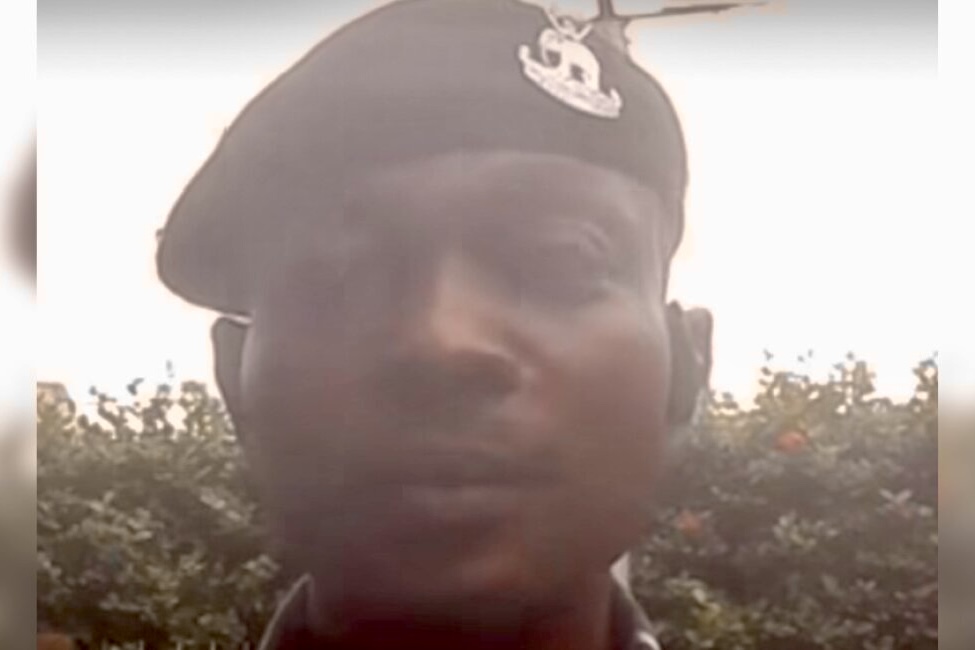
A serving inspector says hardship has pushed him towards suicidal thoughts and left him struggling to provide for his children. His account raises questions about police welfare, uniform procurement and whether official promises reach rank-and-file officers.
A serving Nigerian police inspector has disclosed that he contemplated suicide after years of financial hardship, alleging that he received only one uniform during more than two decades in the Nigeria Police Force.
Inspector Nkuje Samson, who said he joined the force in 2003, has appealed directly to President Bola Tinubu to intervene in what he describes as a deepening welfare crisis affecting officers and their families.
His account is more than a complaint about inadequate pay. It raises a difficult question for a government that depends on the police to confront violent crime, protect communities and maintain public order: what happens when the people expected to enforce the law struggle to afford the basic necessities of life?
In a video interview circulated online, Samson said the pressure had become emotionally overwhelming.
“I was even contemplating suicide. I was contemplating suicide. I said, no, I have another option. And the option is to call younger people like me to hear my view. If that can just relieve my depression,” he said.
The disclosure should be treated as a serious welfare concern, not merely another viral controversy involving the police.
Samson said he understood that speaking publicly could expose him to disciplinary action, a reduction in rank or confinement to barracks. Yet he argued that years of obedience to police regulations had not improved his circumstances.
“We’ve been obeying the regulations. We’ve not gone contrary to them. But for so long, that has not helped us,” he said.
His central grievance is that institutional discipline appears to demand more from officers than the welfare system delivers in return.
The Uniform Question That Demands an Answer
Samson’s most striking allegation concerns his uniform.
He said the only police uniform issued to him came during his training at the police college, with no subsequent issue after he graduated.
“I have, since over 23 years now, been given a uniform for once, which was when I was in the college. Ever since I graduated up to now, I’ve not been given another one,” he said.
If verified, the claim would raise questions about the Force’s procurement arrangements, distribution records and mechanisms for ensuring that officers receive the equipment required for their duties.
Uniforms are not a discretionary benefit for a police officer. They form part of the identification, presentation and operational requirements of a uniformed service.
Yet Samson said officers were expected to bear the cost of replacing their kits while meeting household expenses from what he described as inadequate earnings.
“The little money I have to pay my children’s school fees is where I feed myself, pay my transportation, pay house rent and buy my uniform. I cheat myself,” he said.
There is an important qualification to his allegation about how frequently uniforms should be supplied.
Samson said his understanding was that uniforms should be issued “quarterly, or three times a year”. Those are not identical intervals, and the precise rule he cited has not been independently established.
In March 2026, the Nigeria Police Force’s then-spokesperson, ACP Benjamin Hundeyin, said the Force’s Quartermaster Unit was responsible for providing personnel with a set of uniform annually. He also said officers could purchase additional kits themselves.
Separately, the Force announced in January 2025 that new kits and uniforms had been distributed to officers nationwide.
Those announcements do not establish whether Samson received the annual allocation or whether every command and officer benefited. They do, however, create a clear question for the police authorities: can they produce records showing what was procured, what was distributed, where it was delivered and which officers received it?
The issue is not settled by an announcement that uniforms have been distributed. It is settled by verifiable delivery records.
A Welfare Crisis Government Officials Have Acknowledged
Samson’s account emerges as the Federal Government reviews the conditions of service of police personnel.
On 4 August 2026, the Ministry of Police Affairs announced that a ministerial and stakeholder committee was reviewing police salaries, allowances, insurance, pension-related benefits and other welfare packages.
The ministry also identified inadequate accommodation as a major challenge affecting police personnel.
The exercise followed an earlier review meeting in July, which examined allowances and outstanding obligations involving pensions, death benefits, health benefits and other entitlements.
These official announcements establish that welfare concerns are already on the government’s policy agenda. They do not establish that the problems described by Samson have been resolved.
Nor does the creation of a committee guarantee that recommendations will translate into timely payments, decent accommodation or properly equipped officers.
The critical question is whether the review will produce measurable improvements at the level of individual personnel.
Will officers receive the benefits they qualify for? Will outstanding obligations be settled? Will accommodation be repaired or replaced? Will the Force publish clear standards for uniform provision and explain how compliance is monitored?
Without such measures, welfare reform risks becoming another cycle of meetings, announcements and promises.
Police Funding and the Missing Accountability Trail
The uniform allegation also revives questions about the relationship between police funding and conditions on the ground.
A historical budget submission published on the Nigeria Police Force’s own website provides useful context. In figures associated with the 2017 appropriation, the Force estimated that annual uniform and kit requirements for 298,735 personnel would cost approximately ₦14.58 billion. It reported that ₦1.7525 billion had been earmarked in the appropriation and warned that inadequate provision affected officers’ appearance.
Those figures relate to an earlier budget year. They should not be mistaken for the Force’s current uniform budget or evidence of present-day misappropriation. They nevertheless illustrate that the difficulty of funding police kits has featured in official records for years.
The funding question remains relevant.
In July 2026, the Senate approved approximately ₦403.1 billion in Nigeria Police Trust Fund budgets covering the 2025 and 2026 fiscal years. The allocations were associated with strengthening operational capacity through areas including equipment, infrastructure and training.
That approval must be understood in context. The total is not a dedicated uniform allowance for every serving officer, nor does approval alone establish how much money was released, spent or converted into completed projects.
The Force and relevant oversight institutions should therefore make it possible to distinguish between budgeted funds, actual releases, completed procurement and verified delivery.
If money has been approved for a particular purpose, the public should be able to determine whether that purpose was fulfilled. Where delivery falls short, the responsible institution should explain why.
There is no evidence in Samson’s account alone to establish that funds intended for his uniform or other welfare provisions were diverted or withheld by a particular official.
His question about where the money goes is therefore an allegation and a demand for investigation, not proof of financial misconduct.
The appropriate response is an auditable trail, not speculation.
When Providing for a Family Becomes a Struggle
For Samson, the welfare dispute is not an abstract argument over budget lines.
He said his earnings were insufficient to cover school fees, transport, rent, clothing and other household expenses. He also alleged that he sometimes relied on relatives to pay his children’s school fees.
He described walking with his children because he could not afford transportation.
“I want to walk almost a kilometre before I get into school. And whenever they are coming back, I want to do that because I don’t have money to pay for transportation,” he said.
The account raises questions about how lower-ranking officers manage family responsibilities when their earnings do not comfortably cover basic expenses.
It also brings the discussion of police morale into sharper focus.
An officer’s financial difficulties do not automatically make that person ineffective or corrupt. Equally, the financial pressure described by Samson should not be dismissed as a private problem that has nothing to do with institutional performance.
Police officers are entrusted with public authority, often under dangerous conditions. Their working environment, equipment, remuneration and access to support can affect their capacity to perform those duties effectively.
This is why welfare cannot be reduced to occasional gestures or the announcement of promotions. It requires predictable entitlements, functioning support systems and clear procedures for resolving grievances.
Samson also claimed that between 65 and 70 per cent of police officers retire or die without ever owning a car. That estimate has not been independently verified and should not be treated as an established statistic.
His own claim that he does not own a car, like his account of his uniform history, would require corroboration if it were to be used as evidence in a formal assessment of police welfare.
The Cost of Keeping Complaints Inside the System
A further concern is whether officers feel able to raise legitimate complaints without fear of retaliation.
Samson said regulations had discouraged personnel from speaking publicly about their circumstances. He warned that the culture of silence could not continue indefinitely.
“There are a lot of things going on in the system, but we are not allowed to come out to say it. But I think it’s high time we started coming out to say it because we cannot continuously die in silence,” he said.
His fear of disciplinary consequences is his account of the risks he believes he faces. No specific public response addressing his allegations was identified in the official material reviewed for this report.
Nevertheless, the tension between discipline and accountability deserves attention.
A disciplined police service needs rules governing conduct, confidential information and operational security. But those rules should not make it impossible to report genuine problems with equipment, allowances, accommodation or staff wellbeing.
The Force needs credible internal channels through which officers can report unmet entitlements and unsafe deployments without having to turn to social media as their only apparent route to an audience.
Such mechanisms should provide documented complaints, traceable responses, independent review where necessary and protection against retaliation for good-faith reporting.
A video going viral should not be the event that determines whether an officer’s complaint receives attention.
Operational Risks Extend Beyond the Barracks
Samson also described what he said were inadequate logistical arrangements for police deployments.
During the interview, the interviewer recounted reports concerning officers deployed to Bogu who allegedly spent nearly three weeks without food or allowances while operating in a dangerous environment. The interviewer said public attention following a video led to transportation being arranged.
That account was not independently verified in the material reviewed for this report. It should be investigated before being treated as an established incident.
If confirmed, however, it would raise questions about deployment planning, the provision of food and transport, the payment of operational allowances and the chain of command responsible for supporting personnel in the field.
Samson summed up his view of the problem bluntly.
“The reality on the ground is that anytime you are going to work here, you are on your own,” he said.
Operational welfare is not simply a matter of comfort. Personnel deployed into dangerous environments need reliable logistics and support to carry out their assignments safely and effectively.
The authorities should establish whether the alleged Bogu incident occurred, what provisions were made for the officers concerned and why any reported shortfall was not resolved through routine command arrangements.
The Complicated Question of Roadside Payments
Samson also addressed corruption allegations involving police officers who collect money from motorists.
He thanked private motorists, commercial drivers, motorcycle operators and tricycle riders for supporting police personnel, saying their help had enabled officers to survive difficult conditions.
At the same time, he denied personally collecting money from motorists.
“Though I don’t take money on the road, I’m not a corrupt officer. I’m a very noble officer,” he said.
He challenged anyone who had encountered him demanding a bribe to come forward with evidence.
His personal denial has not been independently verified. Neither should his description of officers’ wider financial difficulties be taken as proof that individual officers engage in extortion.
But his comments expose an uncomfortable institutional question: what happens when public servants come to depend on informal payments or assistance from people they are employed to serve?
Financial hardship can be relevant to understanding the pressures within an institution, but it does not excuse corruption or the abuse of public authority. Citizens must not be forced to finance routine policing through unlawful demands.
The appropriate response must address both sides of the problem: ensure that officers receive legitimate entitlements while investigating and sanctioning proven misconduct.
Welfare reform and anti-corruption measures should reinforce each other, not be treated as competing priorities.
What Tinubu and Police Leadership Must Establish
Samson appealed to Tinubu to hear directly from rank-and-file officers rather than relying exclusively on assurances from senior officials.
“The President is the father of the nation. He should never listen to anybody who comes to him with a smiling face on behalf of us. That person is there for his or her sake,” he said.
He also claimed to be speaking for the concerns of approximately 200,000 police officers. The interview provides no independent evidence that he was formally authorised to represent that number, so his assertion should not be treated as a verified collective mandate.
His allegations can nevertheless be examined on their own merits.
The Inspector-General of Police, the Ministry of Police Affairs, the Police Service Commission and the Nigeria Police Trust Fund should establish a verifiable picture of current personnel welfare.
That means clarifying the applicable uniform policy, publishing procurement and distribution records where appropriate, reconciling approved allowances with actual payments, examining accommodation conditions and investigating substantiated reports of inadequate operational support.
The institutions should also provide officers with accessible and confidential channels to report unmet entitlements and seek mental health support.
Most importantly, any review must have clear deadlines, assigned responsibilities and measurable outcomes.
Samson’s account does not prove that the entire Nigeria Police Force is experiencing identical conditions, nor does it establish that a particular official has diverted money or deliberately denied an entitlement.
It does, however, raise specific allegations that can be tested against personnel records, procurement documents, payment schedules and command reports.
That is where the investigation should begin.
The question is not whether one officer has embarrassed the institution by speaking out. It is whether the authorities can account for the basic provisions that officers are supposed to receive.
A police welfare programme should be judged not by the size of an announcement or the number of committees established, but by what reaches the person expected to wear the uniform, report for duty and protect the public.
For an inspector who says he has served for more than 23 years, the decisive evidence may be painfully simple: the uniform he received, the benefits paid to him and the support available when he needs help.
If those records support his account, the Force must explain the failure and correct it. If they contradict it, the authorities should publish the evidence.
Either way, the answer should be found in verifiable records and meaningful reform, not silence.
Follow us on our broadcast channels today!
- WhatsApp: https://whatsapp.com/channel/0029VawZ8TbDDmFT1a1Syg46
- Telegram: https://t.me/atlanticpostchannel
- Facebook: https://www.messenger.com/channel/atlanticpostng



Join the debate; let’s know your opinion.