By Editor
LAGOS, Nigeria — In an unprecedented crackdown on the growing drug menace in Nigeria, the National Drug Law Enforcement Agency (NDLEA) has made one of the largest seizures of illicit drugs in recent memory, with a street value of ₦14.9 billion. The agency’s operatives intercepted over 25 million opioid pills and 350,000 bottles of codeine-based syrup in multiple operations at Tincan Port, Lagos, setting off shockwaves through the law enforcement and public health sectors alike.

NDLEA seizes ₦14.9 billion opioids, arrests an octogenarian and community leader’s family members. 
NDLEA seizes ₦14.9 billion opioids, arrests an octogenarian and community leader’s family members. NDLEA seizes ₦14.9 billion opioids, arrests an octogenarian and community leader’s family members. 
NDLEA seizes ₦14.9 billion opioids, arrests an octogenarian and community leader’s family members. NDLEA seizes ₦14.9 billion opioids, arrests an octogenarian and community leader’s family members. 
NDLEA seizes ₦14.9 billion opioids, arrests an octogenarian and community leader’s family members.


This latest drug bust marks a significant milestone in Nigeria’s fight against the illegal drug trade but also underscores a disturbing and deepening crisis that is challenging the moral fabric of communities, fuelling violence, and eroding trust in local leadership.
Unpacking the Seizure: A Game-Changer or the Tip of the Iceberg?
On September 17 and 20, 2024, NDLEA operatives conducted a thorough examination of three flagged containers at the Tincan Port complex, an operation based on carefully processed intelligence. What they uncovered sent shivers down the spine of even the most seasoned narcotics officers. The first container, examined on the 17th, held a staggering 25 million pills of tapentadol—an opioid three times stronger than tramadol, with an estimated street value of ₦13.7 billion. This highly potent drug has long been feared for its devastating impact on both physical and mental health, fuelling addiction and psychosis across the country.
The other two containers, examined on September 17 and 20, revealed 175,000 bottles of Barcadin cough syrup with codeine and 175,000 bottles of CSC cough syrup with codeine, valued at ₦2.45 billion. The combined street value of the seizures stands at ₦14.9 billion, highlighting not just the financial stakes but the alarming scale of the drug crisis in Nigeria.
What is particularly striking about this bust is the logistics behind it. These shipments, hidden in plain sight, were monitored for weeks before the NDLEA moved in for the final sweep. The meticulous planning that went into this operation speaks volumes about the increasing sophistication of the drug trafficking networks operating within Nigeria. The use of large-scale container shipments to transport such vast quantities of narcotics paints a dire picture of the deep penetration of drug cartels into the country’s import-export system.
The Dark Web of Local Actors: Octogenarian Drug Dealer, Community Leader’s Family Caught in the Net
While the seizures at Tincan Port grabbed headlines, it was the arrests across Lagos and other parts of the country that truly painted a grim picture of the pervasiveness of drug trafficking in local communities. Among those arrested was an 80-year-old grandfather, Pa Aremu Shojobi, a veteran in the illicit drug trade. This octogenarian, arrested with 14 kilogrammes of cannabis at his home in Iyana Ipaja, Lagos, reportedly admitted to selling drugs for over 25 years.
Pa Shojobi’s confession is a sobering reminder of the entrenched nature of the drug trade in some communities, where individuals see no alternative but to engage in illicit activities, passing down this criminal enterprise through generations. His claim that he sourced his cannabis from Benin Republic and sold it to local customers for nearly two and a half decades is a testament to the deep-rooted supply chains and the extent of cross-border trafficking that is undermining Nigeria’s efforts to curb drug abuse.
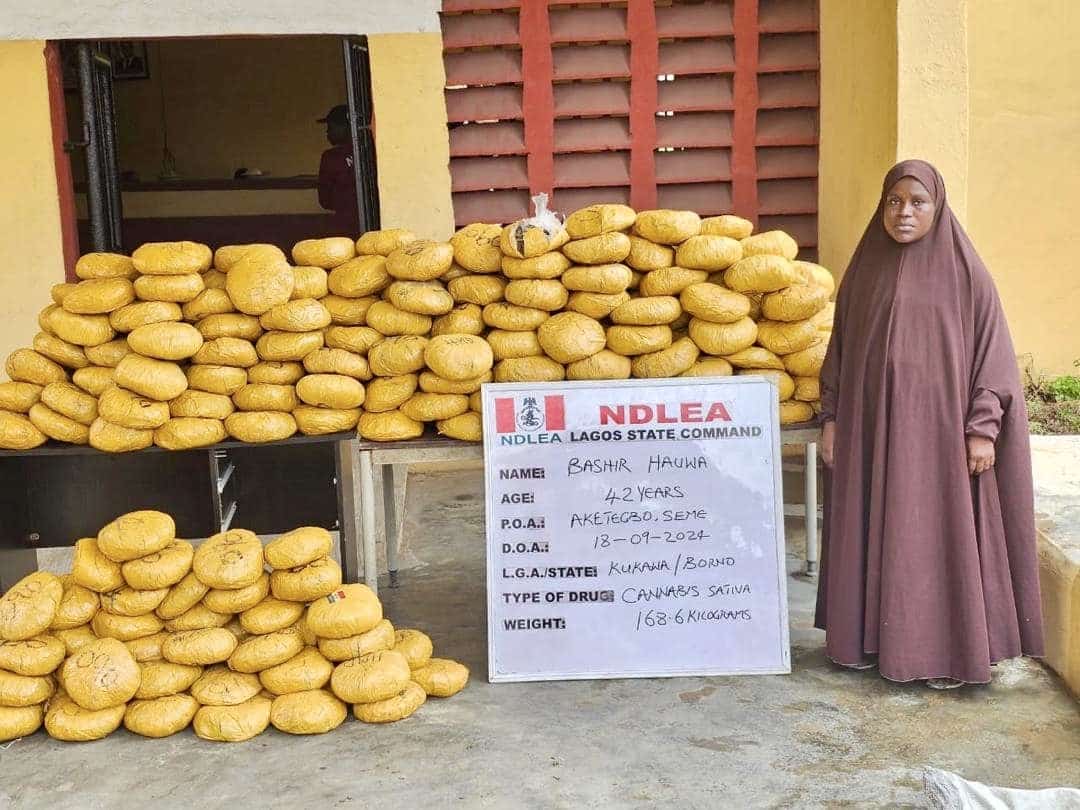
Even more scandalous was the arrest of the family members of a prominent community leader, Alhaji Bashir Mohammed Talba, the Sarkin Yamma of Badagry West LCDA. The NDLEA discovered 226 kilogrammes of cannabis hidden in two of his homes, implicating his two wives and son in the drug trade. Alhaji Talba himself remains at large, a fugitive from justice, but the arrest of his family members has sent shockwaves through the community.
This incident shines a harsh spotlight on the nexus between local leadership and criminality. The involvement of a well-respected community leader’s household in drug trafficking adds a layer of complexity to the fight against the drug trade. How deep does the rot go? How many more influential individuals are shielding or actively participating in this illicit business, profiting from the destruction of lives and communities?
The Cocaine Mule and The Shadowy Network of Drug Traffickers
Meanwhile, at the Mallam Aminu Kano International Airport (MAKIA) in Kano, another jaw-dropping incident took place. On September 15, 2024, NDLEA operatives arrested 38-year-old Okafor Ifeanyi Anthony, a drug mule who had ingested 76 wraps of cocaine, hoping to smuggle them into Iran via Doha. After being placed under observation for three days, Anthony excreted 1.267 kilogrammes of cocaine, underscoring the extreme lengths to which traffickers are willing to go to evade detection.
This arrest not only exposes the international dimension of Nigeria’s drug trafficking problem but also the grim reality that desperate individuals are being recruited to risk their lives in the deadly drug trade. With international drug syndicates using Nigeria as a transit point for narcotics bound for Europe, the Middle East, and beyond, the war on drugs has taken on global ramifications.
The Expanding Reach of the NDLEA: Nationwide Operations Continue to Yield Results
The NDLEA’s success in Kano was just one of several operations carried out across Nigeria in September 2024, each contributing to the growing tally of intercepted drugs and arrested traffickers. From Kogi State, where officers seized 700,000 pills of exol-5 en route to Kano and Kaduna, to Niger State, where 23-year-old Udemefuna Chibuike was caught with 49,000 tablets of tramadol and other drugs, it is clear that the agency is tightening the noose around traffickers.
In Rivers State, 213 kilogrammes of cannabis were intercepted on September 18, while Plateau State operatives arrested a major suspect, Jonathan Ali Abuttur, who had concealed 808 kilogrammes of cannabis in bags of sugar and fertiliser. Similar successes were reported in Kwara, with the arrest of Shaibu Musa and the seizure of 28 kilogrammes of cannabis. These arrests reflect a broad and sustained crackdown on narcotics across Nigeria, with the NDLEA pulling out all the stops to dismantle drug networks.
The War Against Drug Abuse (WADA) Campaign: Is Education Enough?
Alongside its operational successes, the NDLEA has intensified its public awareness campaigns through the War Against Drug Abuse (WADA) initiative. From schools in Kebbi, Katsina, and Enugu to markets and community centres in Lagos and Ogun State, the agency has been relentless in educating the public about the dangers of drug abuse.
However, the question remains: is education enough? Can sensitisation campaigns truly turn the tide against an epidemic that is being fuelled by entrenched economic disparities, corrupt local leadership, and international drug syndicates? The latest seizures and arrests are certainly a step in the right direction, but they also highlight the enormity of the challenge ahead.
The Bigger Picture: Corruption, Inefficiency, and the Blurred Line Between Law and Crime
The NDLEA’s operations reveal not just the severity of the drug problem but also the systemic issues that have allowed this crisis to fester. Corruption within the law enforcement agencies themselves, porous borders, and inefficiency in the judicial system have all contributed to a situation where traffickers continue to operate with relative impunity. The involvement of local leaders and the sheer scale of the illicit drug trade call into question the effectiveness of governance structures at both the state and federal levels.
The Nigerian government, through agencies like the NDLEA, must do more than just intercept drugs and make arrests. There needs to be a concerted effort to address the root causes of drug trafficking, from poverty and unemployment to corruption and the breakdown of community values.
Conclusion: A Nation at a Crossroads
As Nigeria grapples with its burgeoning drug crisis, the actions of the NDLEA provide a glimmer of hope. However, the road ahead remains perilous. The staggering volume of drugs intercepted, the arrest of influential individuals, and the involvement of international syndicates all point to a problem that transcends mere law enforcement. It is a crisis that demands a holistic response—one that includes not just the NDLEA but every arm of government, community leaders, civil society, and ordinary citizens.
The drug war in Nigeria is far from over, and the stakes have never been higher. Will the country rise to the challenge, or will the twin evils of drug abuse and trafficking continue to erode its moral and social foundations? Only time will tell.
With reporting from Peter Jene, Senior National Correspondent, Atlantic Post.