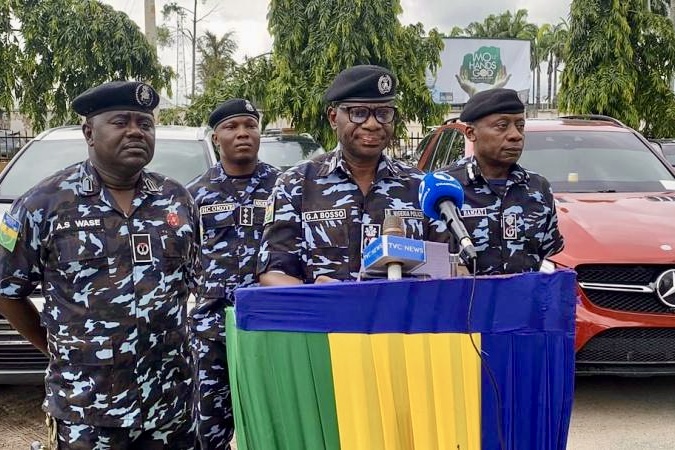
On 5 August 2025, Inspector-General of Police (IGP) Kayode Adeolu Egbetokun presided over a lavish ceremony at the Louis Edet House, Abuja, to decorate ACP Aliyu Shaba and CSP Sentome Obi as the 2023 and 2024 Police Officers of the Year.
In a detailed press release, the Force promised “doors of honour and recognition” to any officer demonstrating “hard-work, professionalism, excellence, and service discipline.”
Yet glaring absences in the public promotion list, whispers of behind-the-scenes deal-making, and a flagrant deviation from Nigeria’s federal character principle have plunged the Force into its worst internal crisis in decades.
A Ceremony Cloaked in Spin and Secrecy
DCP Olumuyiwa Adejobi’s press release proclaimed:
“These are not just promotions. They are public endorsements of excellence.”
Yet the same communiqué studiously omitted the names of 35 other officers quietly elevated under the IGP’s so-called accelerated-promotion policy.
SaharaReporters broke the story that the Police Service Commission (PSC) had, on 1 August 2025, approved 37 fast-track promotions at Egbetokun’s behest — only for an internal uproar to delay a full announcement.
The conspicuous absence of public vetting, transparent scoring metrics or even a consultative committee contradicts every precept of due process the IGP professes to uphold.
Why the secrecy? Insiders insist that the IGP’s hand-picked list overwhelmingly favoured officers from his own ethnic and personal circles.
One senior officer confided:
“This rushed list stinks of cronyism. We’re supposed to be building a professional Force, not a private club.”
Within a Force already ranked 140th out of 180 nations for public-sector integrity, such theatrics risk deepening cynicism among both officers and citizens.
Anatomy of a “Merit-Based” Promotion
On paper, the accelerated-promotion policy was straightforward: any officer winning “Police Officer of the Year” twice in consecutive years — or securing two IGP Recognition Awards — could be recommended for immediate elevation by the PSC.
In practice, however, merit has been a convenient euphemism:
ACP Aliyu Shaba spent three years as Chief Superintendent of Police (CSP) before his 2023 award and December-2023 promotion to Assistant Commissioner of Police.
CSP Sentome Obi rose after two consecutive awards, becoming CSP effective 31 December 2024.
Yet Bukola Kuti, a fast-tracked female officer, leapfrogged peers after barely six months as CSP, despite having no substantive front-line duties.
“She handles domestic contracts, not crime scenes,” sniffed one veteran officer. “But she’s joined the IGP’s inner circle — and suddenly she’s ACP.”
The meteoric rise of 30 Yoruba officers (out of 37) has fuelled widespread allegations of ethnic bias, in stark breach of the federal character principle enshrined in the 1979 Constitution.
Historical Echoes of Sectarian “Meritocracy”
Nigeria’s police promotions have a long history of political meddling and ethnic tilt:
2007: IGP Sunday Ehindero’s South-East-centric promotions sparked official calls to fortify PSC independence.
2014: President Jonathan froze PSC promotions during the Boko Haram crisis, only to retrospectively rubber-stamp them — undermining merit-based norms.
2011: IGP Mohammed Abubakar piloted an “Officer Scorecard” system, only for entrenched patronage networks to suffocate it within two years.
None of these episodes matched the brazen combination of secrecy and sectionalism now confronting Egbetokun.
When the PSC signed off on his list without public scrutiny, it betrayed its constitutional mandate to insulate promotions from executive caprice.
Ethnic Imbalance: A Fractured Force
Nigeria’s diversity is supposed to be mirrored in its national institutions. Yet under Egbetokun:
- Yoruba officers account for over 80% of special promotions (30 out of 37).
- Igbo representation is limited to CSP Sentome Obi and possibly one other.
- Northern groups (Hausa, Nupe, Tiv, Kanuri, etc.) are almost entirely excluded.
The fallout has been predictable. Demoralised officers speak of a “provincial police force” and openly question the IGP’s commitment to national cohesion.
“You can’t preach reform on meritocracy then peddle ethnicity in promotion,” said one Deputy Commissioner.
Institutional Impact: Corruption and Morale in Freefall
The police operate under life-and-death stakes; when promotions appear rigged, two corrosive effects ensue:
Demoralisation. Seasoned officers withdraw from proactive crime-fighting.“Why risk your life on major operations if your sacrifice only props up cronies?” lamented an anonymous DCP.
Corruption. Officers turn to bribes and political patronage to secure advancement. Nigeria’s 2024 Corruption Perceptions Index score of 26 (rank-140/180) underlines a public sector already mired in graft.
A 2023 Lagos State survey found 67% of respondents distrusted police anti-corruption efforts — only exacerbated by the latest scandal.
Public confidence crumbles when citizens see rank as transactional. Extortion at checkpoints, botched kidnap rescues and other scandals are magnified when officers view promotion as a pay-to-play enterprise.
International Comparisons: Lessons in Transparency
Globally, leading police services employ robust safeguards:
United Kingdom: The College of Policing’s Fast-Track National Assessment Centre evaluates candidates through psychometric tests, situational-judgement exercises and structured interviews, all overseen by independent external assessors — with results benchmarked against a national Competency and Values Framework.
Canada: The Civilian Review and Complaints Commission (CRCC) provides independent oversight of the RCMP, reviewing complaints and auditing disciplinary and promotion processes to ensure impartiality.
Ghana (2022): Introduced a point-based promotion system, publishing annual scores based on service years, training, commendations and conduct — a model Nigeria abandoned in 2011 when patronage networks struck back.
By contrast, Nigeria’s last serious benchmark attempt in 2011 lasted barely two years before political interlopers killed it.
The absence of transparent scoring matrices, external observers or public accountability has opened the door to sham “meritocracy.”
Reform Proposals: Pie in the Sky or Within Reach?
Voices in the National Assembly and civil society urge urgent overhauls:
Statutory Amendments to bar the IGP from overriding PSC recommendations without documented appeals.
Judicial Review allowing officers to challenge promotions in court within 30 days of PSC approval.
Civil Society Oversight granting NGOs (e.g., CLEEN Foundation, Police Reform Organisation) observer status at promotion deliberations.
Yet political realities bite hard: the executive loathes ceding ground; security chiefs demand loyalty; and legislators fear rocking the boat.
Voices from the Ranks: Whistle-Blower Testimonies
Despite a climate of fear, leaks persist:
A Senior Superintendent bitterly observed:“We risk our lives, file commendations — but an IGP aide strides past us all.”
A Commissioner of Police bemoaned dashed leadership training opportunities, allocated instead to PSC cronies.
Junior officers report pension-calculation delays — ostensibly to divert funds to Abuja pageantry.
Such accounts, while hard to independently verify, paint a Force fracturing under self-interest.
The Road Ahead: Can Egbetokun Salvage His Reform Mandate?
IGP Egbetokun arrived at the helm vowing to professionalise the Force, inheriting a service marred by corruption and low morale.
Early community-engagement forums and high-profile crime crackdowns won cautious praise. But credibility now rests on transparent promotion:
Publish the Full List. Disclose names, ranks, years of service and award records.
Open an Objections Period. Allow PSC, civil society and internal committees to review and, if need be, challenge promotions.
Enforce Federal Character Quotas. Limit any region to no more than 30% of special promotions — a modest nod to Nigeria’s diversity.
Absent such measures, Egbetokun risks leaving a legacy not of reform, but of partisan cronyism that will further erode public trust in Nigeria’s premier law-enforcement agency.
Conclusion: Meritocracy or Myth?
As Nigeria battles insurgencies, banditry and piracy, the integrity of its Police Force is non-negotiable. Promotions should honour gallantry and dedication — not ethnic solidarity or personal affinity.
The 5 August ceremony will be more than a media photo-op; it will publicly affirm whether the IGP truly believes in merit or merely mythologises it for headline-grabbing optics.
“These are public endorsements of excellence,” asserts DCP Adejobi. Yet unless every deserving officer — regardless of origin or insider status — sees that endorsement, the declaration will ring hollow across the very ranks the IGP claims to uplift.
Only time — and transparent action — will reveal whether Nigeria’s top cop stands for genuine reform or succumbs to the biases he once vowed to eliminate.
Follow us on our broadcast channels today!
- WhatsApp: https://whatsapp.com/channel/0029VawZ8TbDDmFT1a1Syg46
- Telegram: https://t.me/atlanticpostchannel
- Facebook: https://www.messenger.com/channel/atlanticpostng