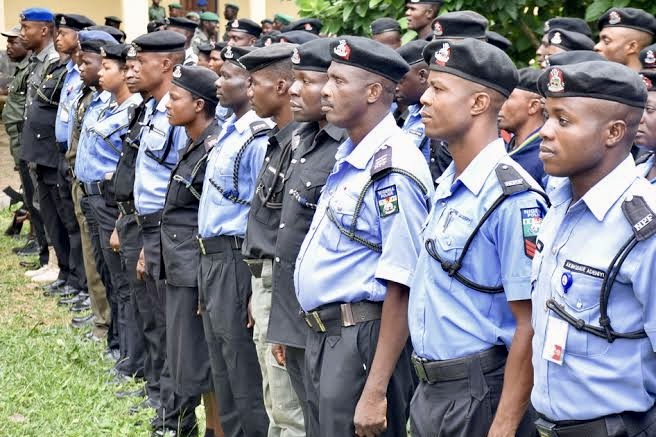
A viral Katsina video has opened a fresh credibility battle in Nigeria’s North West, but the latest police explanation does more than deny collusion. It places the spotlight on a long running security practice in which police operatives, local vigilantes and registered hunters work together in a corridor where real bandit attacks have repeatedly cost lives.
In its statement, the Nigeria Police Force said the men in the clip were “not bandits” but “duly recognised members of the Vigilante Group of Nigeria” and registered hunters moving to a designated operational area in Musawa and Matazu local government areas.
That clarification is important because the video landed in a state where the line between genuine security support and public suspicion is already razor thin.
Katsina has been hit by repeated armed attacks this year, including the 5 April assault in Matazu in which suspected bandits killed two civilians and a police officer, and the 31 May attack along the Karaduwa Matazu road in which two occupants were abducted and the driver was injured.
In both cases, the police said tactical teams and local response units were mobilised urgently to the scene.
The police version of the viral clip is blunt. “For the avoidance of doubt,” the statement said, “the individuals featured in the video are not bandits.” It added that the scene captured “a routine interaction” between a police officer and security volunteers proceeding to support operations against criminality, and it described the bandit narrative as “false, malicious, and intended to mislead the public.”
The Force also warned that anyone spreading false information capable of undermining peace and security could face legal action.
That warning is not happening in a vacuum. The North West has become a theatre of repeated abductions, rural raids and road ambushes that have forced security agencies to lean heavily on community structures.
Reuters reported in January that 62 hostages were freed in northwest operations, while separate Reuters and local reports in March, May and June showed how attacks continue to regenerate in Katsina and surrounding states despite ongoing police and military operations.
In one June incident, police in Katsina said they foiled a kidnapping attempt and rescued nine victims on the Katsina Kankara route.
This is why the police explanation cannot simply be read as a public relations response to a difficult clip. It must be measured against the reality on the ground.
In earlier Katsina operations, police said joint teams involving the police, military, the Katsina State Community Watch Corps and local vigilantes were deployed to confront armed assailants, including during the April Matazu attack where an officer was killed.
That history shows that volunteer security structures are not an accident in Katsina. They are part of the state’s operating model against banditry.
But the same history also explains why the viral clip triggered such alarm. In a region where bandits have repeatedly attacked roads, villages and police formations, any image of armed men moving freely past a checkpoint can rapidly become symbolic.
That is especially true when the public has fresh memory of repeated killings, kidnappings and reprisal attacks, including the March Katsina violence in which Reuters reported that a vigilante patrol killing three suspected bandits triggered a deadly reprisal that left at least 18 people dead.
The deeper question is therefore not only whether the men in the video were bandits. It is whether the police have done enough to explain why such a sensitive movement was not communicated more clearly to the public in advance, especially in a state where trust is fragile and fear travels faster than facts.
The Force says the clip was distorted, but the burden now is on the authorities to show how community security volunteers are identified, supervised and integrated into operations, so that routine collaboration does not look like tolerated criminal movement on a public road. That is a credibility issue as much as a security one.
The timing is politically significant too. On 24 June 2026, AP reported that Nigeria’s Senate approved a bill allowing states to create their own police forces, a major reform designed to decentralise law enforcement in response to rising insecurity.
Supporters argue that state police could improve intelligence and response time, while critics fear political abuse. The Katsina video will likely strengthen the case of those who say the current centralised model is too slow, too opaque and too detached from local realities.
For now, the police have drawn a firm line. Their position is that the viral clip was miscaptioned, the men were community security volunteers and hunters, and the public should rely on official channels rather than social media outrage.
Yet the incident still leaves the Force with a larger challenge. In a state where officers have died in bandit attacks, where joint operations with vigilantes are common, and where every roadside encounter can ignite national suspicion, transparency is no longer optional. It is part of the security response itself.
Follow us on our broadcast channels today!
- WhatsApp: https://whatsapp.com/channel/0029VawZ8TbDDmFT1a1Syg46
- Telegram: https://t.me/atlanticpostchannel
- Facebook: https://www.messenger.com/channel/atlanticpostng