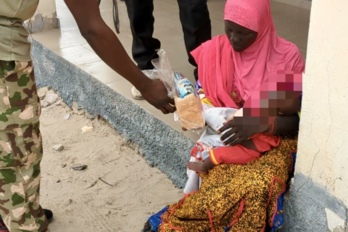
A woman identified as Falmata Bakwai, said to be the wife of an Islamic State West Africa Province fighter, has surrendered to troops of Operation Hadin Kai in Kukawa Local Government Area of Borno State with her two-month-old baby, in a development that once again exposes the strain inside extremist enclaves around the Lake Chad axis.
The surrender, first reported through intelligence sources and counter-insurgency channels, took place at Cross Kauwa at about 10:15 a.m. on 26 June, according to the account cited by security analyst Zagazola Makama.
Sources said Bakwai fled the ISWAP enclave at Dogon Chuku while her husband and other fighters were away from the camp. During preliminary questioning, she reportedly said she escaped because of “worsening living conditions” inside the enclave, especially “acute shortages of food and other basic necessities”.
That detail is important because it suggests the group’s internal logistics are under severe stress, not merely that one woman made a personal choice to walk out.
The woman and her infant have since been placed in quarantine and are receiving medical care in line with established military procedure, while debriefing continues and arrangements are being made to move her to the Headquarters of Sector 3, Operation Hadin Kai and the Multinational Joint Task Force, for further investigation and profiling.
The military says the case is being handled as part of a wider intelligence picture rather than as an isolated surrender.
The wider significance of the surrender becomes clearer when set against the tempo of recent military activity in the North East. On 11 June, The Punch reported that the Nigerian Army confirmed the killing of a high-profile ISWAP commander, Mohammed Khalifa, and the surrender of two senior commanders, Ismail Mohammed and Abu Umar, to troops in Borno.
The military said the men were “currently in military custody” and undergoing profiling and debriefing, while the spokesman, Lt.-Col. Haruna Sani, described the development as proof that “sustained offensive operations” were working.
The same military narrative has been repeated across multiple theatres in the North East in recent weeks. Anadolu reported on 3 June that troops operating under Operation Hadin Kai neutralised about 50 terrorists in Borno, including a senior ISWAP figure described by the military as part of the group’s Shura Council.
The report also said the offensive followed a precision air strike in the Lake Chad region, underscoring the combination of air power, ground patrols and intelligence-led strikes that now appears to be squeezing insurgent mobility in Kukawa and surrounding corridors.
That pressure appears to be producing a pattern that security analysts have watched for years: when camps lose access to food, movement and reinforcements, internal collapse often begins with family members, couriers and lower-value associates before reaching the leadership circle.
In this case, the claimed escape route from Dogon Chuku, the presence of a very young infant, and the reported shortage of basic supplies point to a camp under visible strain.
The report also comes just days after military claims of rescuing captives in the Kukawa axis, including women and children held in ISWAP-controlled areas, which reinforces the image of a terror network being disrupted from the outside and hollowed out from within.
There is also a broader propaganda battle at work. For ISWAP, every surrender is a morale problem because it challenges the group’s aura of control. For the military, every defection or escape is evidence that the insurgency can be pressed into retreat without a total battlefield defeat.
Operation Hadin Kai has repeatedly framed its campaign as a relentless effort to “disrupt terrorist networks” and compel fighters to abandon the field, while the army’s own public statements have described declining morale and shrinking freedom of movement among insurgents as the pressure mounts.
Yet the human story here is just as important as the military one. A mother with a two-month-old baby does not flee a fortified enclave lightly. Whether she was a willing spouse, a coerced dependent or simply trapped inside a collapsing system, her surrender is another reminder that the insurgency’s war machine is sustained not only by guns and ideology but also by women, children, logistics and fear.
Once any one of those pillars starts to fail, the terror structure becomes less stable, more penetrable and far easier to unravel. That is why this surrender should be read not as a routine incident, but as another crack in ISWAP’s command ecosystem in Borno.
Follow us on our broadcast channels today!
- WhatsApp: https://whatsapp.com/channel/0029VawZ8TbDDmFT1a1Syg46
- Telegram: https://t.me/atlanticpostchannel
- Facebook: https://www.messenger.com/channel/atlanticpostng



