The 2027 presidential contest has entered a more combustible phase, with the Independent National Electoral Commission (INEC) beginning the public display of the personal particulars, academic credentials and statutory declarations submitted by President Bola Tinubu and Vice President Kashim Shettima.
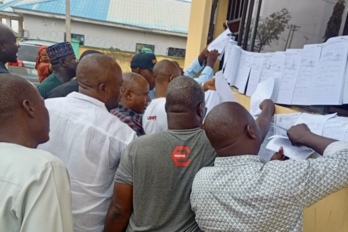
The exercise, carried out through Form EC9 at INEC offices nationwide, is not a mere administrative ritual. It is the first formal opening of the paper trail that can be examined, challenged and, where necessary, taken to court.
INEC said Form EC9 contains “the credentials, personal particulars and affidavits submitted by candidates sponsored by political parties.” The commission’s Lagos office in Sabo-Yaba and local government offices in the relevant constituencies have been designated for inspection, with the display intended to allow parties, nominees and members of the public to verify the claims made by candidates ahead of the election season.
Under Section 29(3) of the Electoral Act 2022, INEC is required to publish the personal particulars of candidates within seven days of receiving them, while Section 29(4) to (6) gives any person the right to request certified copies and empowers an aggrieved aspirant to challenge false information in court.
That legal point is important. Some early reports have loosely described the publication window as 21 days, but the text of the Electoral Act 2022 is clear: the Commission shall publish the particulars within seven days of receipt. The distinction is not cosmetic. In a season when credential disputes can become political weapons, the timeline determines how quickly allegations may harden into litigation.
Tinubu’s Form EC9 is already attracting the most attention. According to the documents displayed by INEC, the President listed a Bachelor of Science degree in Business Administration from Chicago State University, awarded with honours on 22 June 1979.
LlHis NYSC discharge certificate shows service in Oyo State from December 1982 to November 1983. The work history filed in the form lists Mobil Nigeria Limited from 1983 to 1992, the Lagos State Government from 1999 to 2007, and the Federal Government of Nigeria from 2023 to date.
The most striking entry, however, is that the years for his primary and secondary school attendance were entered as “0000,” with only the university qualification carrying a specific year. His date of birth is listed as 29 March 1952, his birthplace as Lagos, and his occupation as “politician.”
Shettima’s file, by contrast, presents a fuller educational chronology stretching back to primary school. The record shows that he attended Lamisula I Primary School between 1972 and 1978, finishing second out of 22 pupils in his final year, with English, History and Religious Knowledge among his strongest subjects.
His WAEC result at Government Secondary School, Potiskum, dated June 1983, showed six credits and passes, including distinctions in Religious Knowledge and Economics. He later obtained a Second Class Upper Division degree in Agriculture from the University of Maiduguri in August 1989, followed by a Master of Science in Agricultural Economics from the University of Ibadan. His NYSC discharge records show service from October 1989 to October 1990.
The contrast between the two files is already shaping the political conversation. Tinubu’s form appears sparse in the early schooling section, while Shettima’s is unusually detailed.
That contrast does not by itself prove wrongdoing; however, it will almost certainly fuel public debate, opposition scrutiny and, potentially, fresh legal or media pressure over how the forms were completed and what any blanks or omissions might mean in an election cycle where trust in the process is already fragile. That is an inference, but it is one grounded in the structure of the documents now in public view.
This latest display also lands against a backdrop of renewed certificate controversy. In June, the Centre for Reform and Public Advocacy (CFRPA) petitioned INEC to clarify Tinubu’s eligibility for the 2027 race, specifically over the academic records previously submitted to the commission.
BusinessDay reported that the group said questions arising from the Chicago State University material could undermine public confidence if left unanswered. The fresh EC9 display now gives that debate a new surface area and a new legal timetable.
The wider electoral calendar is also moving. According to the revised timetable reported by major outlets, campaigns for the presidential and National Assembly elections are scheduled to begin on 19 August, tightening the space between document publication and full political mobilisation. In practical terms, INEC has opened the first major public test of the 2027 contest before campaigning begins in earnest.
For APC, the exercise is especially sensitive because the party has already formally retained Shettima as Tinubu’s running mate for the 2027 election. That decision was confirmed when the APC submitted the Tinubu-Shettima nomination forms to INEC in July, ending months of speculation about whether the President would alter the ticket. The public display of EC9 now shifts the focus from ticket confirmation to ticket verification.
The key question is no longer simply who the APC has chosen, but what the submitted paperwork will now endure under public inspection. INEC has made the legal route clear: if anyone believes a candidate supplied false information or forged credentials, the law permits the filing of a suit. In a country where electoral suspicion often begins with documents and ends in courtrooms, the EC9 display is not background noise; it is the opening scene.
Follow us on our broadcast channels today!
- WhatsApp: https://whatsapp.com/channel/0029VawZ8TbDDmFT1a1Syg46
- Telegram: https://t.me/atlanticpostchannel
- Facebook: https://www.messenger.com/channel/atlanticpostng