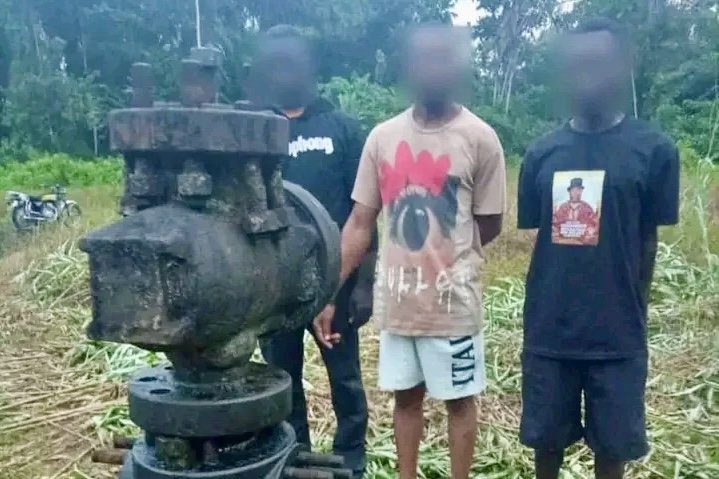
Police have arrested three people over alleged tampering with a capped oil wellhead in Otuabagi, Bayelsa State. But questions about the well’s ownership, regulatory status and security remain unanswered, exposing the wider challenge of protecting Nigeria’s ageing oil infrastructure.
Police in Bayelsa State have arrested three people over alleged tampering with a capped oil wellhead in Otuabagi, Ogbia Local Government Area, in an incident that raises questions extending beyond the immediate investigation.
The arrests may help authorities establish who was allegedly involved in the incident. But they have yet to explain a more fundamental issue: who is responsible for securing and maintaining the oil facility, and what safeguards were in place to prevent unauthorised access?
The Bayelsa State Police Command confirmed the arrests on Saturday, November 14, 2026, following a report about the alleged interference with the wellhead.
Three people were arrested, while another three reportedly escaped before security operatives arrived.
The arrested individuals were identified as Simeon Joshua Ezeke, Pere Thankgod and Gift Elijah.
The three people named by police as having fled are Richard Johnbull, Ken and Nabhel Moses.
According to the police, operatives attached to the Ogbia Police Division responded alongside members of the community’s Community Development Committee and apprehended the suspects.
The police spokesperson, DSP Musa Muhammed, said:
“Following a report received by the police on November 12, 2026, at about 7:35am, operatives attached to Ogbia Division, in collaboration with the Community Development Committee, swiftly mobilised to the location, where three suspects were apprehended.”
Muhammed added:
“Tools suspected to have been used in the act were also recovered, while efforts are ongoing to apprehend the fleeing suspects.”
The command confirmed that an investigation had commenced to establish the circumstances surrounding the alleged interference and determine the involvement of everyone connected with the incident.
The unanswered questions behind the arrests
While the police have confirmed the arrests and recovery of suspected tools, several important details remain undisclosed.
The police statement did not identify the specific oil well, its registered operator, the company responsible for maintaining it or the regulatory status of the facility.
It also did not disclose the nature of the recovered tools, whether the wellhead sustained damage, or whether investigators established any attempt to extract crude oil.
There is an important distinction between alleged interference with an oil installation and a proven attempt to steal petroleum resources.
At this stage, the police have not established publicly whether the incident involved attempted oil theft, deliberate sabotage, equipment theft or another form of unauthorised interference.
Neither have they disclosed whether the facility was subjected to a technical inspection to establish its physical condition and determine whether its safety barriers remained intact.
These are not minor omissions.
A capped oil well is not necessarily a permanently abandoned oil well. Its regulatory status, integrity and maintenance obligations must be established through technical records and the appropriate regulatory approvals.
Without those details, the public knows that arrests have been made but has little information about the precise nature of the threat to the facility.
Otuabagi: Where Nigeria’s oil story began
The location makes the incident particularly significant.
Otuabagi occupies an extraordinary place in Nigeria’s petroleum history. It was here that crude oil was discovered in commercial quantities in January 1956, marking the beginning of the country’s transformation into a major oil-producing nation.
The historical significance of the community was reinforced by an Ogbia High Court consent judgment reported in March 2024, which recognised Otuabagi as the host community of Nigeria’s first commercial oil well.
The judgment also resolved a long-running dispute over the location of the proposed Oloibiri Museum and Research Centre, directing that the project be sited in Otuabagi, where the historic discovery took place.
The Oloibiri oilfield comprised 21 wells distributed across Otuabagi, Otuogidi and Opume communities.
However, the police have not established that the wellhead involved in the latest incident is any of those historic wells.
That distinction is important. The present investigation concerns a capped oil wellhead in Otuabagi, not a confirmed attack on Nigeria’s first commercial oil well.
Nevertheless, the history of petroleum operations in the area provides an important context for understanding the risks associated with ageing oil infrastructure.
The legacy of abandoned wells and environmental risks
A 2023 investigation by the Bayelsa State Oil and Environmental Commission, titled An Environmental Genocide: Counting the Human Cost of Oil in Bayelsa, Nigeria, documented the consequences of decades of petroleum exploration and inadequate environmental management.
Its findings on the historic Oloibiri oilfield are particularly relevant.
The report stated that production in the oilfield ceased in the late 1980s, yet crude oil continued leaking from some drilling locations into surrounding vegetation and waterways.
It also highlighted the consequences of poorly managed decommissioning, noting that wellheads had been capped without adequate decommissioning measures.
The findings illustrate an important distinction: securing the visible equipment at an oil well does not necessarily establish that the underlying well has been permanently and safely abandoned.
The current Otuabagi incident has not been linked to those historical leakages, and there is no evidence that the well under investigation is leaking.
But the history strengthens the case for demanding clear information about the condition, ownership and maintenance of every legacy petroleum asset in the area.
A facility that is no longer producing oil does not automatically cease to present operational or environmental risks.
What Nigeria’s petroleum laws require
Nigeria’s Petroleum Industry Act 2021 provides a legal framework for protecting petroleum installations and ensuring that wells and other facilities are properly decommissioned.
Section 228(2)(b) prohibits the unlawful removal, destruction or damage of facilities used for petroleum operations.
Section 229 provides that violations attract penalties prescribed under relevant regulations, while requiring affected operations to remain suspended until damage, alterations, malfunctions or safety issues have been rectified.
More importantly, Nigeria introduced an updated regulatory framework in March 2026 through the Nigerian Upstream Petroleum Decommissioning and Abandonment Regulations.
The regulations distinguish between a suspended well and an abandoned well.
A suspended well is one in which drilling or production operations have temporarily ceased. Permanent abandonment, by contrast, involves the plugging and abandonment of the well.
Operators are required to obtain the necessary approval from the Nigerian Upstream Petroleum Regulatory Commission (NUPRC) before suspending or abandoning wells.
The regulations also establish requirements for monitoring, maintaining and managing abandoned wells and decommissioned sites.
They further require NUPRC to maintain a public database of upstream petroleum installations, structures and pipelines, including their status, with annual publication on its website.
The framework is significant because responsibility for decommissioning does not simply disappear when an oil licence or lease expires, is surrendered or revoked.
The regulations preserve obligations on the relevant licensee or lessee, subject to the provisions governing transferred interests.
Consequently, identifying the company or entity responsible for the Otuabagi wellhead should be an essential part of the investigation.
The question is not merely who attempted to interfere with the installation. It is also whether the facility was properly secured, whether its status was documented and whether the responsible operator fulfilled its regulatory obligations.
Infrastructure protection cannot end with arrests
Reacting to the arrests, the Commissioner of Police, Bayelsa State Command, CP Ajao Adewale, warned residents against interfering with public infrastructure.
He said:
“The public is cautioned against tampering with, damaging or interfering with public infrastructure and other valuable assets.”
The commissioner described protecting critical infrastructure as a collective responsibility and urged residents to report suspicious activities promptly.
The collaboration between the police and Ogbia’s Community Development Committee demonstrates the importance of local participation in identifying and reporting threats to valuable assets.
But community vigilance cannot replace the formal responsibilities of petroleum operators, security agencies and regulators.
The police must establish what happened at the site, preserve the recovered evidence and identify the specific offences supported by the investigation.
NUPRC should also establish the well’s regulatory status and the identity of the responsible operator. A technical inspection should determine whether the wellhead was damaged, whether its pressure-control barriers remain intact and whether any environmental or public safety assessment is necessary.
These steps would turn the arrests into an opportunity to address the wider problem of protecting vulnerable petroleum infrastructure.
The bigger test for Bayelsa and Nigeria
Nigeria’s oil infrastructure is an important national economic asset. Its protection is directly connected to production security, environmental safety, public revenue and the wellbeing of communities living alongside petroleum installations.
But security cannot be measured solely by the number of arrests made after suspected interference has occurred.
It must also be measured by the ability of authorities and operators to prevent unauthorised access, maintain reliable asset records, monitor abandoned facilities and respond quickly to threats.
For Otuabagi, a community whose land occupies a central place in Nigeria’s petroleum history, the latest incident raises a particularly uncomfortable question.
After decades of extracting wealth from the ground beneath its communities, can Nigeria demonstrate that the oil infrastructure left behind is properly protected and accounted for?
The police have three people in custody and are pursuing three others.
The investigation must now establish what happened at the wellhead, who was responsible for the facility and whether the alleged interference compromised its integrity.
Until those questions are answered, the arrests represent an important security development, but not a complete account of what happened.
For a community at the beginning of Nigeria’s oil story, the real test is whether the country has learnt how to protect the legacy that extraction leaves behind.
Follow us on our broadcast channels today!
- WhatsApp: https://whatsapp.com/channel/0029VawZ8TbDDmFT1a1Syg46
- Telegram: https://t.me/atlanticpostchannel
- Facebook: https://www.messenger.com/channel/atlanticpostng

Join the debate; let’s know your opinion.