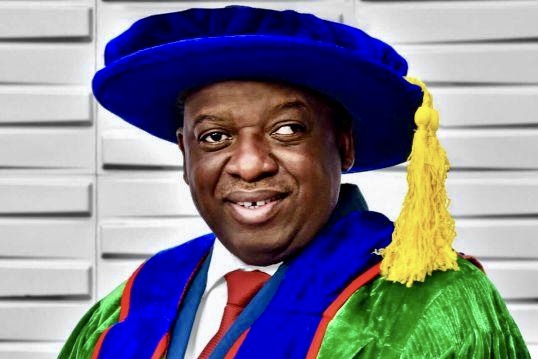
Prof Joshua Ogunwole says officers arrived at his Ekiti residence with a warrant. The record still does not show who issued it, what offence it cites or why Lagos command handled the operation.
Ado-Ekiti, Nigeria — Before sunrise on Wednesday, a dispute that had been simmering inside the Federal University Oye-Ekiti appeared to cross a new line.
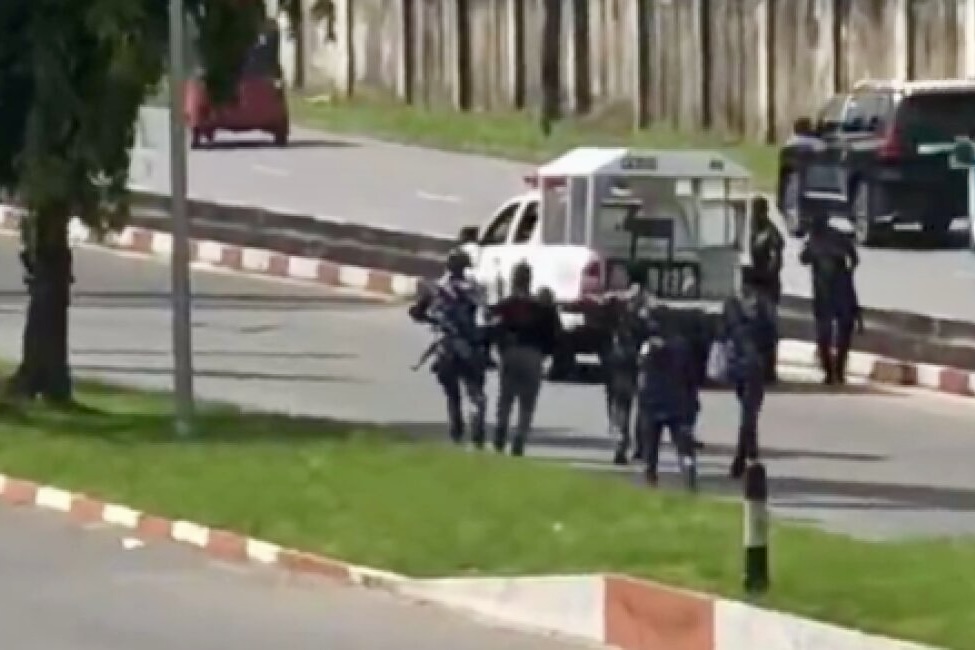
Police officers arrived at the official residence of the university’s Vice-Chancellor, Professor Joshua Olalekan Ogunwole, at about 6:10am, according to Ogunwole himself. Within a short time, staff and students were gathering outside the residence, and an operation that appeared set to end with the Vice-Chancellor being taken away instead ended with the police team leaving the premises.
The immediate drama was striking.
The bigger story is the chain of unanswered questions behind it.
Why did a university dispute end with an early-morning police operation at the home of the institution’s chief executive?
Who obtained the warrant the officers said they were carrying?
What offence or allegation was specified?
Why was the operation reportedly handled by officers attached to the Lagos State Police Command, even though Ogunwole lives and works in Ekiti State?
And was the required legal procedure for executing a warrant issued in one state but carried out in another followed?
Those questions matter because the law does not treat an arrest warrant as a blank cheque. It provides procedures governing the cause of arrest, access to counsel and the execution of warrants outside the state where they were issued.
What happened at dawn
Ogunwole told journalists at his residence that the police arrived shortly after he had gone to bed at about 3am.
He said his children alerted him after noticing security personnel around the house.
The Vice-Chancellor said he initially refused to come out because he was uncertain whether the men were genuine police officers and wanted to know why they had come.
According to his account, the officers later said they had a warrant.
Ogunwole said he insisted that he should first be told the basis for the proposed arrest.
“Somebody of my calibre would not run away anywhere. Rather than surrounding my house, there are other better approaches to invite me,” he said.
The stand-off drew staff and students to the residence. Vanguard, Leadership and other contemporaneous reports said academic and non-academic staff, including members of ASUU, NAAT and NASU, mobilised after news of the police presence spread. The accounts agree that the police did not leave with Ogunwole.
Ogunwole later told workers that the incident would not derail his plans for the university.
“This is a passing phase. FUOYE will rise beyond the current resistance of the forces of darkness,” he said.
The university’s Director of Public Affairs and Communication, Dr Sunday Saanu, went further, describing the police action as “mischievous”.
Saanu said Ogunwole had previously honoured a police invitation and later instructed his lawyers to represent him.
“Thereafter, the Vice-Chancellor instructed his lawyers to represent him. It was therefore shocking to see the police at the Vice-Chancellor’s residence, saying they needed him,” Saanu said.
The warrant is now the central unanswered document
The most important missing piece in the public account is the warrant itself.
Ogunwole says the police told him they had one.
The published reports reviewed by Atlantic Post do not identify the court that issued it, the date, the case number or the precise allegation for which the warrant was issued.
That omission is significant.
Under the Ekiti State Administration of Criminal Justice Law, a warrant is required to contain necessary particulars, identify the person to be arrested and state concisely the offence or matter for which it was issued. The same law provides that, before an arrest, the person should ordinarily be informed that a warrant exists unless there is a reasonable basis for withholding that information to prevent escape, resistance or rescue.
The law also protects a person arrested by requiring that the cause of arrest and certain legal rights be communicated, including the right to remain silent until consultation with a lawyer and the right to consult counsel before answering questions or making a statement.
None of that establishes that the officers acted unlawfully.
It does establish the questions that should now be answered.
The Lagos question is more complicated than it looks
At first glance, the reported use of Lagos officers to execute an operation in Ekiti appears to raise a straightforward jurisdictional issue.
The legal picture is more complicated.
Nigeria does not yet have a functioning system of separate state police forces. The Nigeria Police Force remains a national institution under Section 214 of the Constitution. The 2026 State Police constitutional amendment is still going through the approval process in the 36 State Houses of Assembly. As of this week, the proposed amendment had not become a constitutional system of operational state police forces.
So references to the “Lagos State Police Command” do not mean a Lagos-owned police force travelling into Ekiti. They refer to the Lagos command structure of the Nigeria Police Force.
That distinction matters.
It means the mere fact that officers came from Lagos does not, by itself, establish that they had no authority to operate in Ekiti.
Yet there is another legal question.
The Ekiti State Administration of Criminal Justice Law contains specific provisions on the execution of warrants outside the state where they were issued. Section 365 provides for a warrant issued in one state to be endorsed by a magistrate in the state where the person is located before it is executed there. A properly endorsed warrant can then authorise execution in that other state.
That creates a precise issue for investigators.
Was the alleged warrant issued in Lagos or by a Lagos court, and if so, was it properly endorsed for execution in Ekiti?
The public accounts available so far do not answer that question.
Until the warrant and its originating process are produced, declaring the operation either lawful or unlawful would go beyond the evidence currently available.
The earlier Osun arrest story does not hold up
There is another important correction to the narrative supplied to Atlantic Post.
The report that Ogunwole was previously detained after the August 15 Osun State governorship election is not supported by the evidence reviewed.
Ogunwole was the INEC Returning Officer who declared the Osun governorship result. Shortly afterwards, reports circulated claiming that he had been arrested and detained in Abuja.
FUOYE publicly denied that claim, saying Ogunwole had travelled to Abuja for university business and had not been arrested, detained or invited by the police or another security agency. Independent fact-checkers subsequently found no evidence that he had been detained.
Indeed, FUOYE later published a further account showing Ogunwole back at work after his Abuja and Lagos engagements.
He was quoted dismissing the earlier allegation as fabricated fiction.
That history is important because it means the August claim should not be presented as an established previous detention.
The Wednesday operation is a separate event and should be reported on its own evidence.
The petition trail leads back into FUOYE’s internal conflict
Ogunwole linked the new police action to a petition allegedly associated with his predecessor, Professor Abayomi Sunday Fasina, and a former Faculty of Law dean, Dr Olufunke Kehinde Adeola.
The name is worth correcting.
FUOYE’s own records identify the law academic as Dr Olufunke Kehinde Adeola, currently listed as Acting Dean of the Faculty of Law. Contemporaneous reports on Wednesday also identify her as Dr Kehinde Adeola.
Ogunwole said the dispute arose from an audio recording that had allegedly been leaked, after which university management asked those involved to appear before an investigative committee.
He said the matter later reached court and that he had also petitioned the Inspector-General of Police over what he described as threats to his life and workplace.
He maintained that he remained available to honour a lawful invitation.
The background is itself contentious.
Fasina’s tenure as FUOYE Vice-Chancellor became embroiled in allegations arising from a leaked audio recording and claims of sexual harassment involving a female staff member. Fasina denied wrongdoing. A university committee later cleared him of the sexual-harassment allegation, while SSANU rejected the process and sought further intervention. Separate court proceedings followed.
Those earlier allegations should not be confused with proof of wrongdoing by any individual. They do, though, help explain why the present petition dispute is more than a routine police complaint.
It sits inside a much longer institutional conflict.
The more disturbing possibility is institutional spillover
Universities are designed to resolve disputes through management structures, disciplinary processes, councils, unions and the courts.
Police intervention can become necessary when an allegation involves a criminal offence.
The unresolved issue at FUOYE is where that line has been drawn.
Ogunwole’s supporters say the matter is already before the courts and that the police should not be used as a substitute for institutional dispute resolution.
Those making or supporting the petition would be entitled to argue the opposite if they believe a criminal offence has been disclosed and investigated properly.
The public cannot determine that question from competing allegations alone.
That is precisely why the documentation matters.
A petition is not a conviction.
A police invitation is not a finding of guilt.
A warrant is not proof that an allegation is true.
And opposition from university staff does not, by itself, establish that a police operation was improper.
What Atlantic Post has established
The contemporaneous accounts establish that police officers arrived at Ogunwole’s residence around 6:10am, that the Vice-Chancellor questioned the basis for the arrest, that officers said they had a warrant, that university staff and students mobilised and that the police did not take Ogunwole away.
The same accounts establish that Ogunwole linked the action to a petition involving figures connected to the former university administration and a dispute over an audio recording.
Atlantic Post has not independently established the allegation that officers threatened to shoot the Vice-Chancellor’s guard dogs or that they forced their way into the compound. Those details appeared in the SaharaReporters account supplied for this report but were not independently corroborated in the other contemporaneous reports reviewed.
Atlantic Post has also found no evidence supporting the claim that Ogunwole was previously detained after the Osun election. Available evidence points the other way.
The critical missing evidence remains the warrant.
Until its contents, issuing authority and legal route into Ekiti are disclosed, the most important part of this story is not whether one side won Wednesday’s confrontation.
It is why a university dispute reached a stage where armed police officers appeared at a Vice-Chancellor’s residence before dawn, and whether every step taken on both sides can withstand scrutiny under the law.
That is the question now hanging over FUOYE.
Follow us on our broadcast channels today!
- WhatsApp: https://whatsapp.com/channel/0029VawZ8TbDDmFT1a1Syg46
- Telegram: https://t.me/atlanticpostchannel
- Facebook: https://www.messenger.com/channel/atlanticpostng

Join the debate; let's know your opinion.