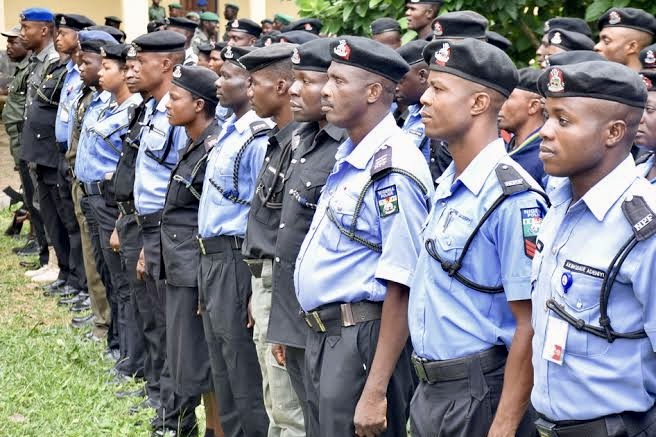
Abuja. In a high profile exercise at the Muhammadu Buhari Cantonment, Giri, the National Centre for the Control of Small Arms and Light Weapons destroyed 1,316 illicit firearms recovered from terrorists, bandits and other violent groups.
The operation, held under the supervision of the Office of the National Security Adviser, was presented as proof that Nigeria is taking the battle against arms proliferation seriously.
At face value the spectacle was convincing. Weapons were first burned and then the metal remnants were smelted to prevent re-entry into circulation.
Military chiefs, senior police officers, security leaders and international partners watched as crates of rifles, pistols and assorted small arms were reduced to slag.
The director general of the centre, retired DIG Johnson Kokumo, framed the exercise as more than theatre. He said the destruction demonstrated transparency and accountability and aligned with Nigeria’s regional and international obligations.
But an investigation must ask hard questions. Destroying recovered weapons is necessary. It is not, by itself, sufficient. The destruction of 1,316 weapons is a tactical gain.
The strategic problem remains the steady flow of weapons into and within Nigeria, driven by porous borders, systemic leakage from government arsenals and a lucrative illicit market that links traffickers across the Sahel and the Gulf of Guinea.
Recent academic analysis points to supply and demand forces and weak border control as central drivers of small arms proliferation in Nigeria.
Context matters. The NCCSALW was established in 2021 to provide a focal point for arms control and disarmament across the federation and beyond.
Since that inception the centre says it has eliminated over 13,230 obsolete, unserviceable and illicit weapons, a tally the agency uses to underline progress.
The figure suggests repeated, sustained action, but the arithmetic of insecurity is stubborn.
Weapons recovered and destroyed sit alongside fresh seizures, voluntary surrenders and the constant stream of arms that arrive through smuggling routes and corrupt complicity.
Legal reforms have given the centre heft. President Tinubu signed the Control of Small Arms and Light Weapons Act, which proponents say strengthens the legal framework for seizure, prosecution and destruction.
The Act and recent institutional reforms are useful. They, however, do not remove the endemic problems that let weapons flow from legal stocks to criminal hands, nor do they automatically speed up prosecution of traffickers and their enablers.
The law must be matched by budgetary commitment, forensic capacity and diligent prosecution.
Transparency is a selling point in the government narrative. Officials insist that consignments intercepted at ports such as Onne and Lagos are subject to legal process before destruction to ensure chain of custody and to avoid the appearance of summary disposal.
That caveat matters. Prosecuting smugglers and those who facilitate diversion from legitimate stockpiles provides deterrence. Public spectacle without follow through risks turning a necessary public safety exercise into symbolic politics.
There are disturbing flashes already visible within the system. Former security officials and investigators have repeatedly flagged leakage from government arsenals as a problem.
The National Security Adviser has in the past publicly observed that some illicit arms originate from corrupt elements inside security agencies.
If that is correct then an arms destruction ceremony becomes only a partial solution unless it is accompanied by internal accountability, tighter inventory control and aggressive criminal referrals.
Practical reforms would include much sharper cargo monitoring at ports and airports, better forensic markings and ballistic tracing of weapons, and systematic auditing of government armouries.
Regional cooperation is essential. Nigeria cannot seal its borders alone. It must expand intelligence sharing and coordinated interdiction with neighbours while supporting UN and AU disarmament mechanisms that reduce the market for illicit arms across West Africa.
The NCCSALW has signalled partnerships and zonal offices as progress points. The next step is to convert those offices into operational nodes that disrupt smuggling networks rather than simply host ceremonies.
For the public the message is simple but incomplete. Yes, the government is destroying weapons that should not be in circulation. Yes, this reduces the immediate risk that those particular firearms will be reused. But citizens should demand to know what happens next.
Who supplied the consignments seized at ports and airports. Who in the chain of custody enabled diversion. How many prosecutions have followed past destruction exercises.
Without answers the exercise risks being a comforting image rather than the start of a decisive campaign to choke off supply, prosecute traffickers and dismantle the networks that arm criminals.
The destruction of 1,316 weapons should be a headline and a beginning. To make it a turning point the government must combine law reform with forensic capacity, prosecutorial zeal and regional operational cooperation.
Otherwise the cycle will repeat and the visual drama of smelting will substitute for a full frontal assault on the business that keeps Nigeria insecure.
Follow us on our broadcast channels today!
- WhatsApp: https://whatsapp.com/channel/0029VawZ8TbDDmFT1a1Syg46
- Telegram: https://t.me/atlanticpostchannel
- Facebook: https://www.messenger.com/channel/atlanticpostng