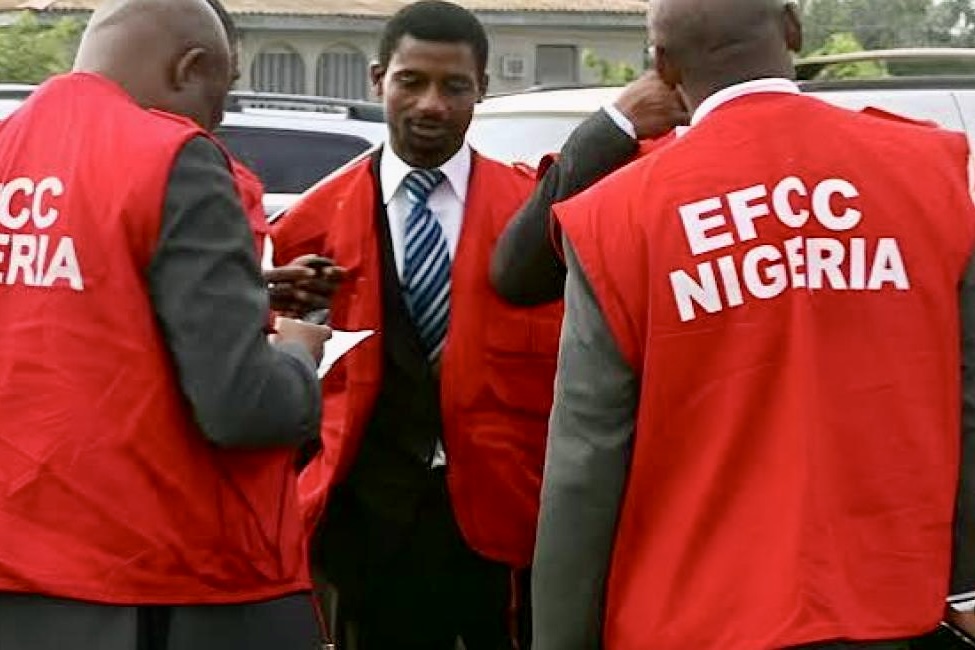
The Economic and Financial Crimes Commission’s reported decision to place a Post-No-Debit restriction on the Osun State Government’s statutory allocation account has triggered an explosive confrontation with Governor Ademola Adeleke’s administration just 10 days before the state’s governorship election on 15 August 2026.
Officially, the state says the move is an act of political sabotage. On the other side, the anti-graft agency says the action is part of an ongoing investigation.
According to reports published on Wednesday, the affected account is domiciled with First Bank and was placed under a Post-No-Debit status by the EFCC. Premium Times reported that the restriction hit an account used for official transactions, including salary payments, while noting that the commission had not publicly disclosed the reason for the action at the time of filing.
Vanguard carried a similar report, saying the account was frozen “10 days to election” and that a source close to the governor confirmed the development.
The Osun State Government had earlier gone on the offensive, accusing the EFCC of preparing to freeze the state’s accounts and those of senior officials.
In a statement on the official state website, Governor Adeleke said the alleged plan, if true, amounted to “the height of lawlessness” and was intended to “paralyse government activities ahead of the August 15th governorship election.”
The statement also insisted that the anti-graft agency had “no legal powers” to freeze a state government account.
Adeleke doubled down in comments reported by The PUNCH, challenging EFCC chairman Ola Olukoyede to explain why the account was frozen and describing the move as a blow to the rule of law.
He said the action was taken “without any court order” and warned that federal agencies must not trample on the constitutional rights of subnational governments.
He also told journalists that he had instructed the state Attorney-General to challenge the restriction at the Federal High Court in Osogbo.
That legal fight matters. The 2022 Money Laundering (Prevention and Prohibition) Act, as published by the National Assembly-linked PLAC repository, allows a competent authority to place a stop order on a suspicious transaction or account for a period “not exceeding 72 hours” and provides that the Federal High Court may then order the funds or account to be blocked.
In other words, the law recognises a temporary restraint, but also builds in a court-supervised route for any longer blockade.
That detail also creates a sharper question than the political noise alone: if the EFCC’s intervention is purely investigative, where is the legal bridge between a temporary restriction and a durable freeze?
The leaked letter cited in the reports reportedly referred to Section 38 of the EFCC Act and Section 24 of the 2022 money laundering law. But the money-laundering statute’s freezing language sits in Section 7, while Section 24 deals with the power to demand and obtain records. That discrepancy deserves close scrutiny.
The EFCC is not without precedent in this area. In 2022, the Court of Appeal was reported to have upheld the commission’s power to place even state government accounts on Post-No-Debit for 72 hours for investigation, without a court order.
That ruling, however, does not answer the separate question of how long a restriction may lawfully remain in force without judicial backing.
That legal distinction is the heart of the present dispute. Osun’s lawyers are arguing that the commission cannot simply shut down a state’s main purse on the eve of a governorship poll, while the EFCC is leaning on statutory investigation powers and the anti-money laundering framework.
The state says governance will be paralysed if salary and allocation channels are blocked; the commission says it is carrying out an investigation. At this stage, both claims are colliding in public, while the public has yet to see a full judicial explanation on the merits of the restriction.
The timing is politically combustible. INEC has scheduled the Osun governorship election for 15 August 2026, and the campaign atmosphere has already been tense, with recent reports pointing to fresh accusations and counter-accusations over violence, intimidation and federal influence.
In that climate, any move affecting a state government’s cash flow is bound to be read not just as a financial investigation, but as a power play.
What happens next will determine whether this becomes a routine anti-corruption enforcement action or another bruising chapter in Nigeria’s long-running battle over federal power, state autonomy and election-season policing.
For now, the facts that are clear are stark enough: the account is restricted, the governor is in open revolt, and a major legal fight is now underway only days before voters go to the polls.
Follow us on our broadcast channels today!
- WhatsApp: https://whatsapp.com/channel/0029VawZ8TbDDmFT1a1Syg46
- Telegram: https://t.me/atlanticpostchannel
- Facebook: https://www.messenger.com/channel/atlanticpostng