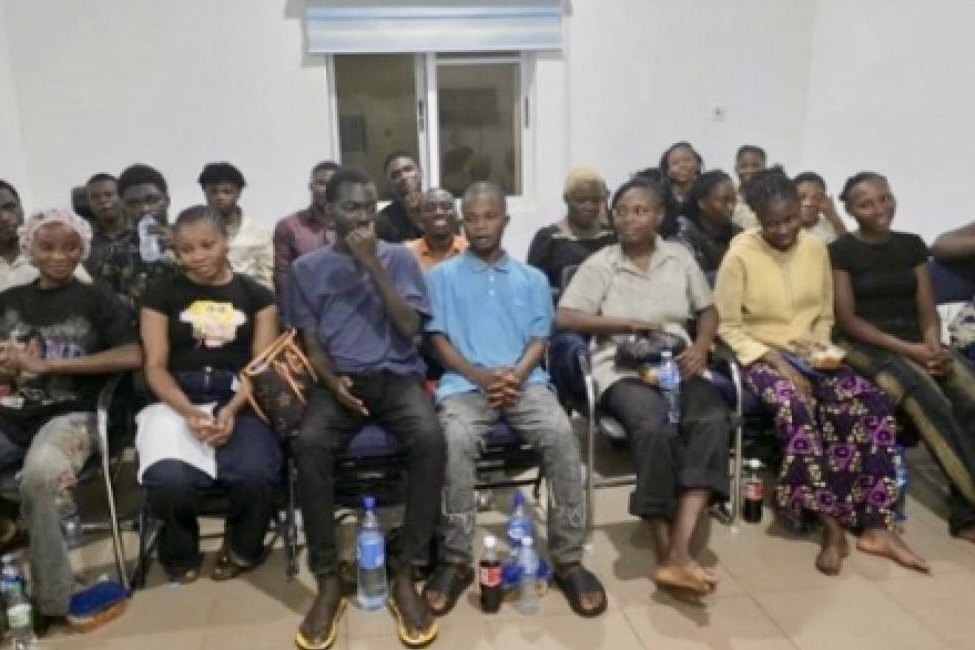
BAUCHI, Nigeria — What began as a family’s desperate journey from Adamawa State to Bauchi to recover their 16-year-old daughter has developed into a far more consequential confrontation involving the police, a child-protection agency, competing religious claims and a fundamental question of parental authority.
At the centre of the controversy is Jennifer, a minor whose parents say they travelled to Bauchi after being invited by the state police command and after assurances that they would be able to take responsibility for their daughter.
Instead, according to the account supplied to Atlantic Post and attributed to SaharaReporters, Friday’s meeting at the Bauchi State Police Headquarters ended without Jennifer being returned to her family.
The reported sequence of events is striking.
The Commissioner of Police, after reviewing the matter, was said to have directed that Jennifer be released to her parents. An Assistant Commissioner of Police was reportedly instructed to facilitate the release.
But the release did not happen.
Representatives of a Da’awah group allegedly intervened and objected to Jennifer being handed over to her parents, arguing that the teenager’s safety should first be determined through a judicial process. Following the disagreement, Jennifer was reportedly transferred temporarily to the Bauchi State Agency for Orphans and Vulnerable Children, known as BASOVCA, pending another review.
That has left the parents where they started; in Bauchi, separated from their daughter and pleading for a resolution.
“We travelled from Adamawa to Bauchi because we were called and because we wanted to take responsibility for our daughter,” one of the parents was quoted as saying.
The parents also reportedly said their other children had remained at home while both parents stayed in Bauchi to pursue the matter.
“We are appealing for a peaceful and lawful resolution. Our other children are at home waiting for us,” they said.
The unanswered question is no longer simply where Jennifer should stay.
It is whether a dispute involving the religious identity and welfare of a minor can be settled by competing adults and institutions without transparent judicial scrutiny, and whether a private religious organisation can effectively frustrate the implementation of a police directive concerning a child.
Those questions deserve urgent answers.
Allegations of abduction, conversion and family separation
Jennifer’s case has generated concern because her parents allege that she was taken from a Christian rehabilitation centre in Bauchi and subsequently placed under the influence or custody of individuals associated with an Islamic Da’awah group.
According to the account provided, Jennifer had been introduced to Islam during a family visit roughly two months earlier. Her mother, Saratu Daniel, allegedly became concerned after learning that her daughter had converted and subsequently took her to the Bishara Dole Christian rehabilitation centre.
Saratu later alleged that a man identified as Abubakar, who had presented himself at the centre as a Christian convert, removed Jennifer from the facility and handed her over to the Da’awah group without the family’s consent.
Those are serious allegations.
They are allegations nonetheless.
No court has, on the material independently located by Atlantic Post, established that Jennifer was abducted or forcibly converted. The same caution applies to claims about the conduct of individuals linked to the Da’awah group.
That distinction matters, particularly in an atmosphere in which accusations involving Christianity, Islam, minors and alleged institutional bias can rapidly become combustible.
Reverend Mohammed Mohammed of Bishara Dole Ministry, according to the material supplied for this report, confirmed the incident and called for an independent investigation.
He also alleged that an Islamic preacher, Adam Ashaka, circulated a video accusing the ministry of child molestation. Mohammed described the allegation as a smear campaign intended to discredit the centre and provide justification for retaining Jennifer.
Those counter-allegations also require independent verification.
The proper response to allegations of child abuse is investigation, evidence and due process — not rival narratives circulated through social media.
Why BASOVCA matters
Jennifer’s reported transfer to BASOVCA introduces another layer of official responsibility.
BASOVCA is a state agency established to deal with vulnerable children. Bauchi State’s Ministry of Women Affairs currently lists a Child Protection Law among the state’s legal and policy frameworks for safeguarding children and vulnerable groups.
That means placing a minor in the custody of a government child-protection body should not be viewed simply as an administrative parking arrangement.
The central issue should be the child’s welfare, safety, legal status and family circumstances.
It should also be temporary and accountable where there is no established judicial basis for denying a lawful parent access to a child.
The federal Child Rights Act provides a framework under which courts can make custody and access orders based principally on the welfare of the child and the circumstances of the parents. It also gives courts power to determine questions surrounding custody and the child’s upbringing.
The legal position becomes particularly sensitive when religion enters the argument.
Religion is constitutionally protected — but so is the rule of law
Nigeria’s Constitution protects freedom of thought, conscience and religion. Section 38 expressly recognises the freedom to change one’s religion or belief and to manifest one’s faith.
The same constitutional provision also contains a specific safeguard concerning religious instruction in educational settings, stating that a person attending a place of education should not be required to participate in religious instruction or ceremonies relating to another religion where such instruction is not approved by the parent or guardian.
That creates an exceptionally delicate legal and ethical terrain when the person at the centre of the dispute is 16.
The Constitution protects individual religious liberty. Child-protection law, however, recognises that minors are not situated identically to adults when questions of custody, upbringing and welfare arise.
The answer cannot responsibly be determined by either side simply asserting that its own interpretation of religion or parental authority is automatically decisive.
That is precisely why an independent court, where the facts are contested, can be indispensable.
Bauchi’s child-protection framework raises the stakes
The controversy also comes at a time when Bauchi State has strengthened its formal child-protection framework.
The state Ministry of Women Affairs identifies the Bauchi State Child Protection Law as part of the legal foundation for safeguarding children.
Recent reporting on a separate Bauchi teenager, Faith Barnabas, has also put renewed attention on the state’s handling of cases involving alleged religious conversion, parental custody and BASOVCA. In that case, lawyers and civil-society groups have invoked the Bauchi Child Protection Law, the federal Child Rights Act and constitutional protections relating to liberty, family life and religion.
The Faith Barnabas matter is not the same case as Jennifer’s, and Atlantic Post has found no evidence that the two incidents should be legally conflated.
But the parallel is significant.
Both cases have raised questions over what happens when a minor’s religious identity becomes entangled with disputes involving family custody and state institutions.
It is precisely at that intersection that institutional transparency becomes essential.
The police have a difficult explanation to provide
If the account of Friday’s meeting is accurate, one of the most important questions for the Bauchi State Police Command is straightforward:
If the Commissioner of Police directed that Jennifer be released to her parents, under what authority was that directive not implemented?
If the directive was provisional and subject to a legal or child-protection assessment, that should be clearly explained.
If officials believed there was credible evidence that returning Jennifer to her parents would expose her to harm, that evidence should form part of a properly documented safeguarding process.
And if the objection came principally from representatives of a religious group, the command should explain what legal authority allowed that objection to halt the implementation of an official police decision.
The public is entitled to know whether the dispute was resolved through law or through influence.
There is a difference.
The Da’awah group’s safety argument also requires scrutiny
The reported objection from the Da’awah representatives is that Jennifer’s safety could be compromised if she were simply handed back to her parents and that the matter should instead go before a court.
On its face, that argument is not inherently unreasonable.
A child-protection authority can legitimately intervene where credible evidence suggests a minor faces abuse, coercion, exploitation or other danger.
But such a position raises an equally important question:
What evidence of danger was presented?
Was there an allegation against the parents?
Was there a documented safeguarding assessment?
Did police investigators identify a specific threat?
Was Jennifer herself interviewed privately by trained child-protection professionals?
Was a social-welfare assessment conducted?
Was she represented or assisted in expressing her own wishes independently of the adults surrounding her?
Those are the questions that matter.
Without transparent answers, the public is left with competing claims and an increasingly troubling impression that a vulnerable teenager’s future is being determined outside a clearly visible legal process.
Jennifer’s wishes must not disappear beneath the adult dispute
There is another voice at the centre of this case which must not be lost: Jennifer’s.
Whatever her religion, family background or circumstances of arrival in Bauchi, she is a human being, not a trophy in a religious contest.
The appropriate authorities must establish what Jennifer actually wants, whether she has been subjected to pressure by any side, whether she feels safe, and whether her views are being expressed freely.
The investigation should therefore not be reduced to one question — whether the teenager is Muslim or Christian.
The more important questions are:
Was she taken away without lawful authority?
Was she coerced?
Was she abused?
Was she protected?
Was she denied access to her parents?
And is her present custody lawful and in her best interests?
These questions should be capable of being answered with documents, interviews, forensic evidence and court records, not rumours.
A child cannot be allowed to become a battleground
Nigeria has repeatedly seen disputes over alleged conversions of minors escalate into broader religious controversies.
The danger is obvious.
Once Christianity and Islam become the dominant framing of a child-custody dispute, every procedural error can be interpreted as evidence of religious persecution, while every intervention by officials can be portrayed as institutional bias.
That is how a child-protection problem becomes a communal security problem.
Bauchi authorities therefore have an obligation to act with exceptional restraint.
The state’s National Human Rights Commission framework recognises freedom of religion as a protected right while emphasising that religious exercise must operate within the law and without infringing on the rights of others.
That principle should guide this case.
The parents’ plea is about more than taking Jennifer home
Jennifer’s parents say they are asking for an opportunity to discharge their parental responsibilities.
“We are asking for calm, transparency and due process. We want our daughter and our family to be protected,” they reportedly said.
That appeal deserves to be tested against the law rather than accepted or rejected on sentiment.
Parents do not automatically win every custody dispute simply because they are parents. Equally, a religious organisation does not automatically acquire authority over a minor simply because it claims concern for that child’s safety.
Where there is a genuine dispute, the law must decide.
And where a child’s safety is genuinely at risk, the state must protect her.
But protection cannot become indefinite separation without legal accountability.
The questions Bauchi authorities should answer
For Jennifer’s case to move beyond accusation and counter-accusation, the Bauchi State Police Command, BASOVCA and other relevant authorities should publicly clarify:
Whether Jennifer is currently in BASOVCA custody; the legal basis for that custody; whether a court order exists; whether the Commissioner of Police actually directed her release to her parents; whether any criminal investigation has been opened into the alleged removal of Jennifer from the rehabilitation centre; whether the teenager has been interviewed privately by child-protection professionals; whether her parents have been granted access to her; and whether any credible allegation of abuse against the parents has been established.
The authorities should also clarify whether the Da’awah representatives are witnesses, complainants, custodians, advisers or simply interested parties.
Those distinctions are not technicalities.
They determine who has lawful standing to influence what happens next.
What should happen next?
The safest route may be neither an immediate handover nor indefinite institutional custody.
It should be a transparent, child-centred process.
First, Jennifer should be kept safe from intimidation by every side.
Second, trained child-protection professionals should independently assess her welfare and freely expressed wishes.
Third, police should establish, through evidence, how she came to be separated from her family and whether any criminal offence occurred.
Fourth, where custody remains disputed, the appropriate court should determine the matter.
Fifth, the authorities should publish enough information to reassure the public that no religious group, political actor or private organisation is being permitted to operate above the law.
This is particularly important because Bauchi stakeholders have previously warned that the state’s child-protection framework faces enforcement problems, including bureaucratic delays, weak evidence gathering and slow investigations.
Those institutional weaknesses become far more dangerous when the disputed case involves religion.
A test of the state’s credibility
Jennifer’s case is now bigger than one family.
It is becoming a test of whether Nigeria’s institutions can protect a child without turning a religious disagreement into a confrontation between communities.
If Jennifer was genuinely in danger in her parents’ custody, authorities must establish that through evidence.
If she was unlawfully removed from her family, the state must establish that too.
If she has voluntarily changed her religious beliefs, that fact should not be distorted or denied.
And if she has been coerced, manipulated or isolated, those responsible must face the law.
The worst possible outcome would be for every institution involved to defend its position while the child at the centre of the dispute remains in limbo.
For now, Jennifer is reportedly still not back with the parents who travelled from Adamawa to take her home.
That leaves the central question hanging over Bauchi:
Who, under Nigerian law, is ultimately responsible for deciding where a 16-year-old child belongs when family, religion, police authority and child protection collide?
The answer must come from the law, not from whichever side shouts loudest.
Follow us on our broadcast channels today!
- WhatsApp: https://whatsapp.com/channel/0029VawZ8TbDDmFT1a1Syg46
- Telegram: https://t.me/atlanticpostchannel
- Facebook: https://www.messenger.com/channel/atlanticpostng