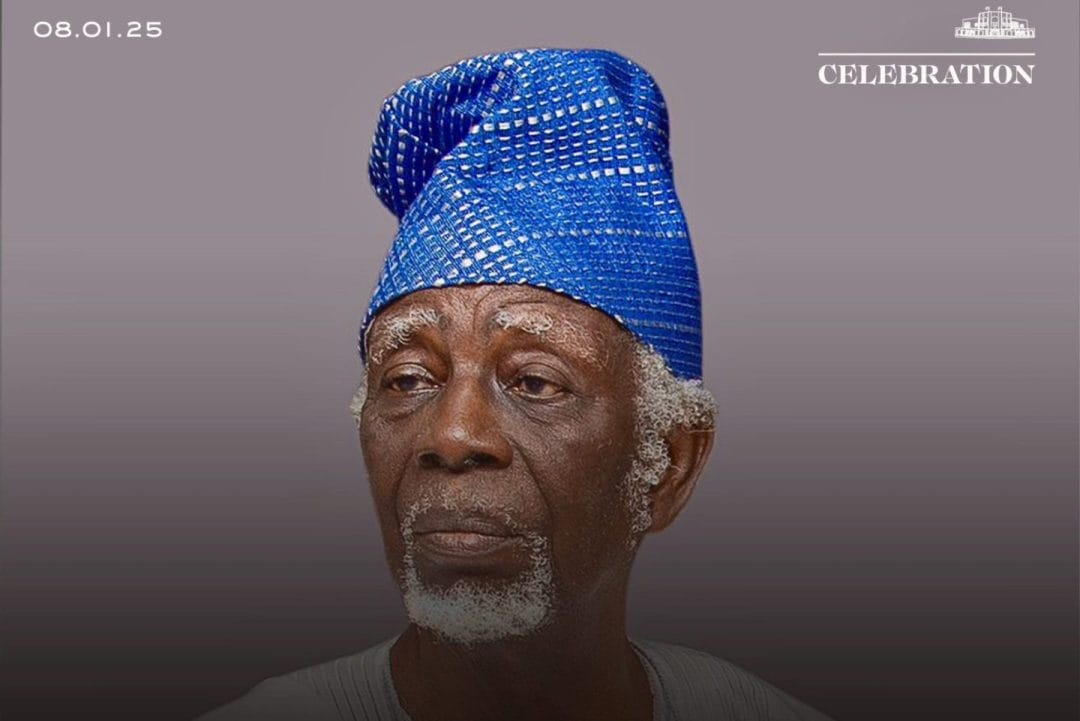
President Tinubu honours Frank Aig-Imoukhuede, the cultural icon and FESTAC ’77 visionary, for his groundbreaking contributions to Nigeria’s arts and literary legacy.
ABUJA, Nigeria — President Bola Ahmed Tinubu’s recent tribute to Frank Abiodun Aig-Imoukhuede on his 90th birthday underscores the profound impact of this cultural luminary on Nigeria’s artistic and literary heritage. Born on January 8, 1935, in Edunabon, Osun State, Aig-Imoukhuede’s multifaceted career has been a testament to dedication, creativity, and unwavering service to the nation.
Early Life and Education
Frank Aig-Imoukhuede’s lineage is steeped in a rich heritage that combines nobility, creativity, and a commitment to public service. His ancestry traces back to Oba Ozolua the Great, a 15th-century ruler of Benin, reflecting a lineage of royalty and integrity. This noble heritage was complemented by a familial dedication to education and the arts, notably through his father’s creation of the popular Yoruba children’s song, “Iwe Kiko, L’ai Si Oko.”
His formative years were marked by academic excellence and athletic prowess. At Igbobi College (1950-1954), he distinguished himself as a member of the college cricket team, earning school colours. This passion for sports continued at the University College Ibadan, where he graduated with a BA in English (Hons) in 1961.
During his university years, he was an active member of both the cricket and hockey teams, earning several international caps. His leadership qualities were evident as he led university processions alongside contemporaries like Wole Soyinka. Aig-Imoukhuede’s early foray into the arts was marked by his protest against the marginalisation of Nigerian students in university plays, leading him to write, direct, and act in original productions. Notably, his was the first play penned by a Nigerian to be staged by the university’s Arts and Theatre group.
Pioneering Journalism
In 1961, Aig-Imoukhuede broke new ground by becoming the first Nigerian university graduate to join the Daily Express newspaper. His entry into journalism was a significant milestone, setting new standards for storytelling and journalistic excellence in Nigeria. His visionary approach and commitment to truth-telling resonated with a nation on the cusp of post-colonial transformation, inspiring a generation of journalists to pursue integrity and depth in their reporting.
Cultural Leadership and FESTAC ’77
Aig-Imoukhuede’s transition from journalism to cultural administration marked a pivotal chapter in Nigeria’s cultural history. Appointed as the nation’s first Cultural Officer in 1971, he swiftly rose to become the Principal Cultural Officer by 1975. During this period, he played a crucial role in supervising Nigeria’s entries and exhibitions in the Second World Black and African Festival of Arts and Culture (FESTAC ’77). As Director of the National Council for Arts and Culture from 1975 to 1988, he coordinated state arts councils and the annual National Festival of Arts (NAFEST), fostering a vibrant cultural ecosystem that celebrated Nigeria’s rich artistic diversity.
FESTAC ’77, held in Lagos, was a monumental event that showcased the artistic and cultural heritage of the black world. Aig-Imoukhuede’s leadership in organising this festival not only elevated Nigeria’s cultural identity but also positioned the country as a central hub for African and black diaspora cultural expressions. The festival’s success was a testament to his organisational acumen and deep commitment to cultural preservation and promotion.
Literary Contributions
Beyond administration, Aig-Imoukhuede’s literary works have left an indelible mark on Nigerian literature. His collection, “Pidgin Stew and Sufferhead,” published in 1982, is celebrated for its authentic portrayal of the Nigerian experience, capturing the nuances of Pidgin English and the socio-economic realities of the time. Through his poetry, he bridged generational and cultural gaps, offering a voice to the marginalised and fostering a deeper appreciation for Nigeria’s linguistic diversity.
Advocacy and Legacy
Aig-Imoukhuede’s commitment to Nigeria’s cultural heritage extended beyond his official capacities. Even in retirement, he remained a vocal advocate for the preservation and revitalisation of cultural institutions. His opposition to the sale and concession of the National Arts Theatre in Lagos underscored his dedication to safeguarding Nigeria’s cultural landmarks. He envisioned the theatre as a vibrant centre celebrating Nigeria’s cultural diversity and promoting artistic innovation, reflecting his lifelong commitment to cultural development.
Honors and Recognitions
In recognition of his invaluable contributions, Aig-Imoukhuede has been honoured with several awards, including the Officer of the Order of the Niger (OON). His leadership roles extended to various national and international committees, such as the Nigerian Film Censors Board, the National Directorate of Social Mobilisation (MAMSER), and the National Commission for Museums and Monuments, among others. His influence has been instrumental in shaping policies and initiatives that have advanced Nigeria’s cultural and artistic sectors.
A Family’s Tribute
The impact of Aig-Imoukhuede’s legacy is profoundly felt within his family. His granddaughter, in a heartfelt tribute, expressed how his stories unveiled a Nigeria rich with beautiful traditions, many of which are often overlooked. She emphasised the importance of remembering and celebrating these traditions, noting that his works serve as vital repositories of Nigeria’s cultural heritage. Her reflections highlight the personal and generational influence of Aig-Imoukhuede’s dedication to cultural preservation.
President Tinubu’s Tribute
President Bola Ahmed Tinubu’s tribute to Frank Abiodun Aig-Imoukhuede on his 90th birthday is not merely a congratulatory statement but a profound recognition of the legacy this cultural titan has built. Tinubu’s remarks encapsulate the nation’s collective appreciation for a man whose life’s work has left an indelible mark on Nigeria’s cultural identity.
Reviving Nigeria’s Global Cultural Stature
Aig-Imoukhuede’s relentless advocacy for Nigeria’s cultural diplomacy cannot be overstated. His leadership in international cultural forums amplified Nigeria’s voice on the global stage, ensuring the nation was not just a participant but a key influencer in global cultural narratives.
Through initiatives like FESTAC ’77, Aig-Imoukhuede bridged the gap between Africa and its diaspora, fostering unity and a shared appreciation of black heritage. The festival’s resounding success under his stewardship demonstrated Nigeria’s potential to lead Africa’s cultural renaissance.
President Tinubu’s acknowledgment of Aig-Imoukhuede’s international contributions highlights the critical importance of cultural diplomacy in reshaping global perceptions of Nigeria. By leveraging arts and culture, Aig-Imoukhuede not only elevated Nigeria’s status but also laid a foundation for future generations to build on.
Literary Legacy as a Mirror of Society
Frank Aig-Imoukhuede’s literary works, including Pidgin Stew and Sufferhead, serve as time capsules of Nigeria’s socio-political realities. His use of Pidgin English as a literary medium was revolutionary, capturing the voices of everyday Nigerians while chronicling their struggles and triumphs.
Tinubu’s homage to Aig-Imoukhuede’s literary achievements underscores the power of storytelling in preserving history. In a nation often fractured by its diversity, Aig-Imoukhuede’s writings have acted as a unifying force, celebrating Nigeria’s multiplicity while addressing its complexities.
A Call to the Next Generation
In urging Nigeria’s youth to draw inspiration from Aig-Imoukhuede’s life, Tinubu’s statement serves as a clarion call. The President’s challenge to younger generations to emulate Aig-Imoukhuede’s dedication, innovation, and patriotism is both timely and necessary in a nation grappling with socio-economic challenges.
Aig-Imoukhuede’s career is a testament to the transformative power of passion and resilience. His ability to transcend boundaries—be it in journalism, cultural administration, or literature—offers a blueprint for aspiring leaders in all fields.
Tinubu’s Vision of Cultural Rebirth
This tribute also aligns with Tinubu’s broader vision for cultural revival in Nigeria. By celebrating Aig-Imoukhuede’s legacy, the President signals a renewed commitment to investing in the arts, preserving cultural landmarks, and fostering a deeper appreciation of Nigeria’s heritage.
Aig-Imoukhuede’s life story, as recounted by Tinubu, is a testament to the limitless possibilities that arise when talent meets opportunity. It is a reminder of the wealth of untapped potential within Nigeria’s cultural sector, waiting to be harnessed for national development.
Conclusion: Celebrating a National Treasure
As Frank Aig-Imoukhuede celebrates his 90th birthday, his legacy continues to inspire. Tinubu’s heartfelt tribute is not just a recognition of past achievements but a call to action—a reminder that the preservation and promotion of culture are essential to national identity and progress.
In honoring Aig-Imoukhuede, Tinubu not only celebrates a life well-lived but also sets a benchmark for what it means to serve one’s nation with excellence. Nigeria owes a debt of gratitude to this cultural icon, whose contributions will resonate for generations to come.
As the nation reflects on Aig-Imoukhuede’s monumental impact, it must also look forward, ensuring that his legacy is not just remembered but expanded upon. Tinubu’s statement is a fitting tribute to a man who embodies the best of Nigeria—a true national treasure.
Additional report: Omonigho Macaulay
Atlantic Post Arts, Culture and Entertainment Reporter