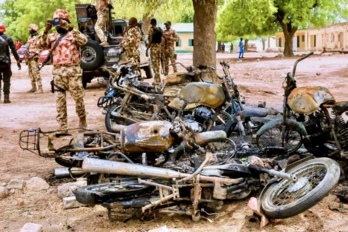
Nigeria and the United States have delivered one of the most dramatic counter-terrorism blows of 2026, after a joint operation in the Lake Chad Basin reportedly killed Abu-Bilal Al-Manuki, also known as Abu-Mainok or Abu-Bilal al-Minuki, a senior Islamic State figure long tracked by Western and Nigerian security services.
President Bola Ahmed Tinubu confirmed the strike in a State House statement on 16 May 2026, saying the operation dealt “a heavy blow” to the ranks of the Islamic State and killed the wanted commander alongside several of his lieutenants.
The presidential statement was unusually forceful. Tinubu described the raid as “a daring joint operation” carried out by the Nigerian Armed Forces working closely with the Armed Forces of the United States, and he praised what he called a “significant example of effective collaboration in the fight against terrorism.”
He also extended public gratitude to Donald Trump, thanking him for “leadership and unwavering support” in the operation.
That framing is important. Abuja is not just announcing a victory on the battlefield. It is portraying the attack as evidence that Nigeria’s security architecture now depends more on intelligence-driven collaboration with Washington, particularly in the unstable Lake Chad theatre where Islamic State West Africa Province and its affiliated cells have frequently taken advantage of challenging terrain, porous borders, and broken local security lines.
While AP stated that the operation struck deep within area long thought to be reinforced by ISWAP-linked troops, Reuters said the target was killed during a complicated mission in the Lake Chad Basin.
Trump moved quickly to amplify the success, saying on Truth Social that American and Nigerian forces had “flawlessly executed a meticulously planned and very complex mission” to eliminate what he called “the most active terrorist in the world.”
Reuters and Fox News both carried that line, while AP reported that Trump’s version of events described the target as ISIS’s second-in-command globally.
Because the deceased commander was not an unidentified militant, his identify is crucial. Abu-Bilal al-Minuki was named a senior ISIS leader and a Specially Designated Global Terrorist by the U.S. Treasury’s Office of Foreign Assets Control in 2023.
According to the AP, analysts view him as ISWAP leader Abu Musab al-Barnawi’s deputy, while other reports claim he had a crucial role in ISIS financing and planning networks. Because of this, the strike is more than just a symbolic victory. It is a direct attack on a person involved in operational coordination, logistics, and command.
The operation also reflects a broader and increasingly visible U.S. footprint in Nigeria’s anti-terror campaign. Reuters reported that the United States had previously deployed drones and about 200 troops to Nigeria for intelligence and training support, with Nigerian officials insisting the Americans were operating in a non-combat role.
That context suggests the Lake Chad strike may be the clearest public sign yet that the partnership has matured from advisory support into a more closely integrated targeting relationship.
For Tinubu, the timing is politically potent. Nigeria remains under pressure over insecurity in the north-east, Fulani militia violence, kidnapping networks, banditry and the lingering threat from jihadist cells.
By putting the operation in the open and associating it with U.S. cooperation, the presidency is sending a message that the federal government wants to be seen as proactive, internationally connected and willing to pursue high-value militant targets beyond the optics of routine military communiqués.
For Trump, the announcement also fits a larger pattern of hard-edged foreign policy messaging. Reuters noted that the president had previously been critical of Nigeria’s handling of religious violence, yet on this occasion he publicly thanked Nigeria for the partnership.
That gives the operation a layered political meaning: it is both a battlefield success and a moment of strategic diplomacy, with each side using the outcome to reinforce its own security narrative.
Still, the battle is far from over. Tinubu’s closing words were not a victory lap so much as a warning. He said he looked forward to “more decisive strikes” against terrorist enclaves across the country. That line suggests Abuja knows the killing of a senior leader does not end an insurgency.
In the Lake Chad Basin, militant groups often regenerate through dispersed cells, local alliances, smuggling routes and ideological succession. One elimination can disrupt operations. It does not end the war.
Even so, this is a major psychological blow to ISIS-linked networks in West Africa. A commander once protected by distance, terrain and secrecy has now been reached by a joint operation between Abuja and Washington.
For Nigeria, it is a statement of intent. For the United States, it is proof that its intelligence and military support in the region still has teeth. And for the militants hiding in the Lake Chad Basin, it is a reminder that their safe havens may not be safe for much longer.
Follow us on our broadcast channels today!
- WhatsApp: https://whatsapp.com/channel/0029VawZ8TbDDmFT1a1Syg46
- Telegram: https://t.me/atlanticpostchannel
- Facebook: https://www.messenger.com/channel/atlanticpostng



