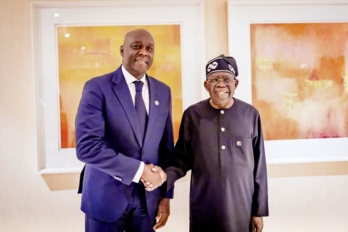
International Finance Corporation (IFC) Managing Director Makhtar Diop announced on 14 May 2026 that IFC would immediately deploy a high-level mission to Nigeria to design “scalable investment structures” unlocking private capital in critical sectors.
The announcement came during a sidelines meeting at the 13th Africa CEO Summit in Kigali, Rwanda, where Mr. Diop led an IFC delegation including Africa Regional VP Ethiopis Tafara and Dahlia Khalifa, Director for Nigeria.
The team signalled strong interest in energy, housing and livestock projects. According to Nigeria’s State House, Diop said IFC sought “modalities for collaboration” in those sectors.
IFC praised President Bola Tinubu’s recent reforms—particularly fuel subsidy removal and exchange-rate unification—as “courageous and transformative,” sending “a strong signal to international investors”.
At the meeting, Mr. Diop lauded President Tinubu’s bold moves on subsidy cuts. In Diop’s words: “President Tinubu, you have been so courageous in removing the subsidy… President Tinubu took the bull by the horns”.
Tinubu reaffirmed Nigeria’s commitment to harnessing private capital. He urged African pension funds to evolve into “strategic development finance instruments” for funding infrastructure and productive project projects, and called on leaders to mobilise continental institutional savings for energy transition and long-term growth.
The President also stressed decentralised power systems and stronger transmission networks to attract investors: “If you want Africa to leapfrog, then energy transmission and decentralisation are important. The funding gap is there, and we must work together,” he said.
The summit meeting further explored financing frameworks. Officials discussed using local-currency bonds, swap facilities and institutional investors (like pension funds) to deepen infrastructure funding.
Mr. Diop noted that local-currency financing lines and partnerships with Nigerian banks (for example, Access Bank) could facilitate cross-border trade and regional market integration
He concluded that Africa’s development hinges on a collective “African Renaissance” driven by strong regional champions and institutions.
Nigeria’s Reform Context and Investor Sentiment
Nigeria’s economy has seen seismic shifts under President Tinubu. The removal of fuel subsidies (in mid-2023) and exchange-rate reforms have ended chronic market distortions.
These measures have mixed effects: they reduce fiscal burdens but fuel short-term inflation. Nonetheless, investor agencies have taken note.
For example, Fitch Ratings affirmed Nigeria’s credit at ‘B’ with a stable outlook in April 2026, highlighting falling debt ratios amid reforms. Market reports show Nigeria Eurobond yields have eased from crisis levels, signalling growing confidence.
Foreign capital flows are also beginning to respond: within weeks of subsidy removal, sovereign bond spreads tightened and Nigeria’s currency (naira) began stabilising.
Economic analysts say Tinubu’s policies have improved transparency. As one expert put it, (paraphrasing) “By unifying rates and lifting subsidies, Nigeria is finally pricing in its true costs — a painful but necessary adjustment that will reassure investors over time.”
Funds managers now watch for further signals: the IFC mission itself reflects international backing. Domestically, business leaders praise clarity.
In the housing and infrastructure sector, officials cite the Nigeria–IFC PPP agreement (February 2026) which leverages IFC advisory for $14.2bn annual projects. This continuity in policy has kept large institutional funds interested.
Opportunities in Energy and Infrastructure
Nigeria still grapples with a chronic power shortfall: an estimated 85 million people (nearly half the population) lack reliable electricity.
The IFC–Norfund partnership announced on 29 April 2026 aims to bridge this gap. In that initiative, IFC committed roughly $83.2m (with concessional financing) to scale solar mini-grids and off-grid power across rural Nigeria.
Under the program, five renewable-energy companies will build 315 hybrid mini-grid sites, ultimately connecting 2.9 million people.
IFC Africa chief Ethiopis Tafara stressed that “access to electricity is fundamental to jobs and economic growth,” and that a mix of investment and partnerships can scale proven solutions.
Sanyade Okoli, Special Adviser to the President on Finance, echoed this, noting that “closing Nigeria’s electricity access gap requires solutions that are scalable, sustainable, and aligned with national priorities”.
These initiatives reflect IFC’s broader “Mission 300” drive to expand access in underserved regions.
In practical terms, private companies are seeing immediate impact. For instance, Darway Coast (a Nigerian solar firm) reports that IFC funding will allow it to expand mini-grid networks, noting “access to reliable electricity allows us to expand our operations and create jobs”.
Overall, experts warn Nigeria’s high diesel dependence is costly: reliable solar or gas-fired grids could cut business costs nationwide. The IFC envoy’s interest in Nigeria’s energy sector thus aligns with existing programmes.
It suggests a pipeline for financing grid expansion, transmission projects or even renewable IPPs, complementing Tinubu’s push for decentralised power.
Livestock: Nigeria’s Untapped Agribusiness
The announcement gives a major boost to Nigeria’s livestock plans. The country has a vast but underdeveloped livestock economy. The Federal Government is already championing a $50 billion private-sector investment program to transform the sector.
This initiative (backed by industry and government) aims to more than double livestock’s contribution – roughly $32bn today – to about $74bn over the next decade.
Minister Idi Mukhtar Maiha, Nigeria’s Livestock Minister, says the future depends on “bold, private sector-led investment” across the value chain.
He asserted, “We see the private sector not just as participants, but as the primary drivers of this economic revolution”.
In practice, this covers everything from modern ranching and feed production to meat processing and cold chains. Maiha also pledged to de-risk projects: the government is strengthening animal health systems, improving data, and guaranteeing a stable policy regime to attract buyers.
Agriculture analysts note Nigeria currently imports large volumes of meat and dairy. Developing local capacity could slash import bills and create rural jobs.
IFC’s mission is likely to explore financing for ranches, abattoirs or integrated farms. Examples might include equity investments in large-scale ranching or loans for feed mills. The IFC’s interest dovetails with AU initiatives: the Africa-wide livestock market is projected to hit $100bn by 2034.
If IFC channels capital into Nigeria’s chain (e.g. via private equity or agribusiness funds), it would kickstart these sector goals.
Housing and Urban Development
Nigeria faces a massive housing deficit – on the order of 15–20 million units – driven by rapid urbanisation and high construction costs.
The Tinubu administration has launched a “Renewed Hope” housing agenda to build affordable homes and upgrade cities. Officials say Public-Private Partnerships (PPPs) and institutional finance must play a central role.
As the Housing Ministry noted in April 2026, “private investment is critical to bridging Nigeria’s estimated housing deficit”, since government budgets alone are insufficient.
The Renewed Hope Program includes new cities, estates and mortgages to attract developers, but analysts flag key bottlenecks: limited long-term credit, high material costs and land-titling delays still constrain supply【.
The IFC’s engagement in housing could take several forms. It might involve credit lines to mortgage lenders (to deepen home loans), technical assistance for affordable housing projects, or co-financing of mixed-use developments.
In general, sector experts say leveraging pension funds is essential: with over ₦40 trillion in pension assets, Nigerian funds could finance large construction projects if yielded returns, but so far they stick to government bonds.
MNigerian business leaders welcomed the news. A senior banker (speaking off the record) noted that any mission to Nigeria signals confidence: “IFC isn’t here to lose money. They’ll ensure projects have bankable models and guarantees.”
Housing developers see opportunity: a Lagos-based real-estate CEO commented, “IFC’s involvement could unlock funding for affordable estates. They know how to structure deals to meet both social and commercial goals.”
IFC’s mission “exploring scalable structures” suggests looking at innovative bonds or swap instruments in naira to fund housing. Indeed, Tinubu himself urged African pension funds to become “development finance instruments” for such infrastructure.
Longtime observers say the IFC announcement reflects growing co-operation between Nigeria and multilateral financiers. For example, Nigeria signed a PPP pipeline deal with IFC in February 2026, and in March the World Bank approved a $1.25bn loan to support reforms.
Local financial executives note that these steps, combined with the subsidy shift, have brought Nigeria into better standing with global investors.
Policy Dialogue and Expert Views
Livestock industry experts are also optimistic. Jani Ibrahim, president of NACCIMA (Chambers of Commerce), has called the livestock program “a critical step” that could yield jobs and foreign exchange. He noted, “Governments create enabling environments, but businesses innovate, invest, scale and sustain growth” – echoing the IFC’s private-sector focus,
In energy, offshore investors say Nigeria’s scale needs deep pockets: international renewables funds are watching the IFC–Norfund mini-grid scheme as a proof-of-concept.
Key Takeaways
- Investment mission details: IFC will dispatch a team to Nigeria for energy, housing and livestock projects, following a meeting between IFC MD Diop and President Tinubu.
- Reform backdrop: Diop praised Tinubu’s removal of the petrol subsidy and unifying the naira rate, calling them “courageous” moves that boost investor confidence.
- Tinubu reiterated Nigeria’s openness to private capital (including pension fund investments) and stressed mobilising African savings to close infrastructure gaps.
- Livestock sector: Nigeria recently launched a $50bn private-sector programme to expand livestock output from $32bn to $74bn. The Livestock Minister urged bold private investment across ranching, dairy and leather chains. IFC interest here could fund ranches, feedlots or processing facilities.
- Energy access: IFC and partners are already funding off-grid solar for rural Nigeria. An $83m initiative will deploy 315 mini-grids (reaching 2.9m people). IFC Africa VP Tafara said electricity access is “fundamental to jobs and economic growth”. This mission may link that work to on-grid projects or transmission upgrades.
- Housing finance: Nigeria’s housing shortfall (~15–20m homes) demands huge capital. The government’s Renewed Hope housing scheme emphasises PPPs to leverage private funds. Pension and local-currency bond structures will be needed, as Tinubu urged institutional funding for long-term projects..
- Institutional push: Conversations included local-currency bonds and swap lines to manage currency risk and tap pension pools for infrastructure. IFC sees partnering with Nigerian banks (e.g. Access Bank) as key to regional integration. This builds on Nigeria–IFC agreements signed earlier in 2026 on PPP pipelines.
The IFC’s planned mission underscores Nigeria’s drive to involve global capital in its development plans. By combining national reforms (subsidy cuts, FX unification, PPP frameworks) with targeted support (housing schemes, energy access programmes, livestock initiatives), Nigeria aims to present credible investment opportunities.
As IFC’s Makhtar Diop noted, a shared “African Renaissance” requires strong institutions and collaboration– and Nigeria is positioning itself to be a focal point of this vision.
SEO Title (UK English, IFC to send Nigeria mission for livestock, energy & housing investment
SEO Description ( IFC’s Makhtar Diop meets Nigeria’s Tinubu, vows investment mission in livestock, housing and energy. Report details Nigeria’s reforms, sector opportunities.