Breaking news update: The Supreme Court condemns Rivers State Governor Fubara’s demolition of the Assembly Complex and his unconstitutional actions, ordering an immediate resumption of legislative functions. Our comprehensive analysis examines the implications for governance, rule of law, and democracy in Rivers State.
ABUJA, Nigeria — In a landmark decision that has sent shockwaves through Nigeria’s political landscape, the Supreme Court has unequivocally denounced the actions of Rivers State Governor Siminalayi Fubara, including his violent demolition of the Rivers State House of Assembly Complex.
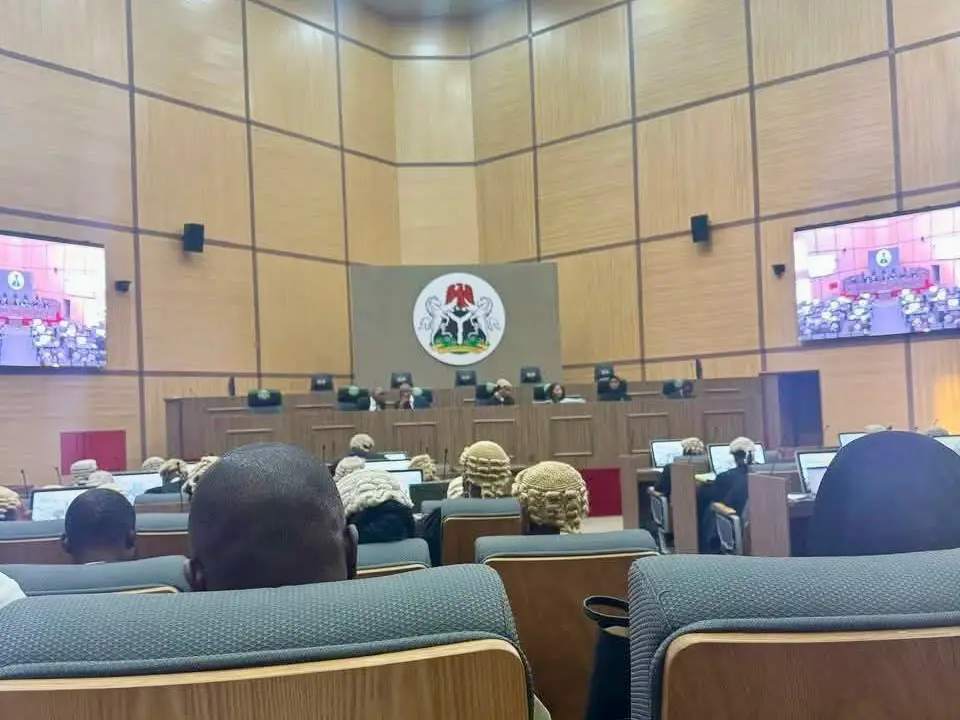
The Apex Court, in a resounding verdict delivered over one hour and thirty-six minutes, has ordered the immediate resumption of Martin Amaewhule and 26 other unlawfully excluded members of the Rivers State House of Assembly.
This dramatic ruling not only nullifies Fubara’s reckless attempts to thwart legislative processes but also described Fubara’s violent demolition of the Assembly Complex as an indiscipline bordering on the excessive use of executive might.
A Deliberate Assault on Democracy
The Supreme Court’s judgement lays bare the authoritarian impulses underlying Governor Fubara’s actions. At the heart of the controversy is the governor’s decision to present the 2024 state budget to a makeshift, four-member Assembly—an assembly that represented a mere 12.5% of the geographical entity of Rivers State.
The court has categorically ruled that such a fractional representation cannot, under any circumstances, constitute a quorum for legitimate legislative business.
The deliberate attempt to conduct legislative sessions in secrecy not only violates procedural norms but also undermines the very essence of democratic accountability and transparency.
Justice Emmanuel Agim, delivering the lead judgment, was unequivocal in his criticism. He noted that Fubara’s actions were driven by a palpable fear of impeachment, a sentiment that, while perhaps understandable in a volatile political environment, cannot justify an attack on the legislature.
By engaging in acts of brigandage—refusing to allow elected representatives to perform their constitutional functions—the governor has plunged the state into a governance crisis.
The Apex Court’s ruling makes it abundantly clear that the rule of law is sacrosanct and that any attempt to circumvent constitutional provisions will be met with the full force of judicial scrutiny.
The Demolition of the Assembly Complex: A Symbol of Executive Overreach
Perhaps the most sensational aspect of the ruling is the condemnation of the demolition of the Rivers State House of Assembly Complex. The court described this act as a blatant abuse of executive power, an indelible stain on the record of Governor Fubara.
In an era when public institutions are expected to be bastions of democracy and law, the deliberate destruction of a legislative building symbolises an assault on the democratic process itself.
Such a move, the court argued, is an affront to the ideals of representative governance and effectively nullifies the voices of 28 constituencies that now find themselves deprived of effective representation.
Justice Emmanuel Akomaye, whose incisive legal reasoning underpinned the dismissal of Fubara’s cross-appeal, characterised the governor’s actions as an “act of brigandage and dictatorship.”
This strong language reflects not only the legal but also the moral outrage that the decision has incited. It is a clarion call to all public officials: the democratic process must be upheld, and any deviation from constitutional mandates will be rigorously challenged by the judiciary.
Implications for Governance and the Rule of Law
The ramifications of this decision extend far beyond the immediate political turmoil in Rivers State. By ordering Martin Amaewhule to resume his position as Speaker and reinstating the full complement of elected lawmakers, the Supreme Court has reaffirmed the fundamental principle that government is a collective endeavour.
The removal of local government chairmen elected in the recent October 2024 elections further underscores the court’s commitment to ensuring that all facets of the state’s governance adhere strictly to the rule of law.
This ruling sends a powerful message across Nigeria: no public office or individual is above the law. It is a stark reminder that executive overreach, no matter how cloaked in political expediency, will be dismantled in the face of constitutional imperatives.
For the citizens of Rivers State, this decision represents a moment of hope—a judicial vindication that paves the way for the restoration of democratic norms and the proper functioning of government.
A Call for Accountability and Transparent Governance
As Nigeria grapples with its ongoing challenges of corruption, political instability, and executive dominance, the Supreme Court’s decision in Rivers State stands as a testament to the resilience of the country’s constitutional framework.
It is incumbent upon all stakeholders—politicians, civil society, and the electorate—to hold public officials accountable and to demand that governance be conducted with the utmost transparency and respect for the law.
Critics of the ruling argue that while judicial intervention is necessary, it must be complemented by broader reforms in political accountability.
The demolition of the Assembly Complex, for instance, is not an isolated incident but a symptom of a wider malaise that afflicts governance structures across the nation.
There is a pressing need for institutional reforms that can prevent such abuses of power in the future and restore faith in the democratic process.
Conclusion: A Turning Point for Rivers State and Beyond
In conclusion, the Supreme Court’s decisive intervention in the Rivers State governance crisis marks a turning point. Governor Fubara’s attempt to sideline the legislature and resort to undemocratic measures has been met with a judicial rebuke of historic proportions.
The order for Martin Amaewhule and his colleagues to resume their legislative duties is not merely a restoration of political order—it is an emphatic endorsement of the rule of law and democratic principles in Nigeria.
As this landmark ruling reverberates throughout the corridors of power, it is incumbent upon all citizens and political actors to reflect on its broader implications. The path forward must be one of accountability, transparency, and unwavering commitment to democratic ideals.
The Supreme Court’s ruling in Rivers State is a potent reminder that the integrity of a nation’s governance depends on the relentless pursuit of justice and the steadfast defence of constitutional rights.