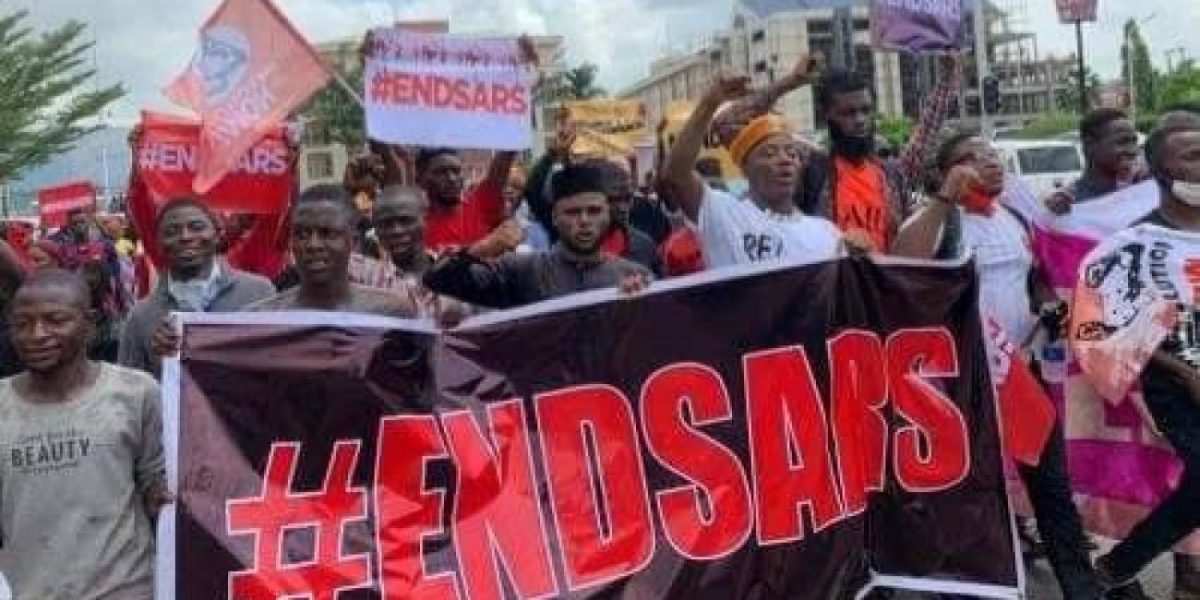
Six years after the #EndSARS protests shook Nigeria, police have again used tear gas to disperse a memorial at Lekki Toll Gate. The disruption raises fresh questions about peaceful assembly, police reform and the unresolved findings surrounding the 2020 shootings.
Six years after Nigerian youths took to the streets demanding an end to police brutality, a memorial to those protests has been disrupted by the very institution whose abuses helped ignite the movement.
Police officers fired tear gas at a gathering at the Lekki Toll Gate in Lagos on Tuesday, 20 October 2026, dispersing activists, journalists and other participants who had assembled to commemorate victims of the #EndSARS protests. Among those affected were Gbadebo Rhodes-Vivour, the Lagos State governorship candidate of the African Democratic Congress (ADC), and Funso Doherty of the Nigeria Democratic Congress (NDC).
The gathering, organised by the Enough is Enough (EiE) movement, was intended to honour those who died during the nationwide protests against police brutality in October 2020. The planned wreath-laying ceremony was disrupted before participants could lay the wreaths, according to reports by TheCable and other Nigerian news organisations.
The immediate question is why police chose tear gas to disperse a commemorative gathering. The larger question is whether six years of promised reforms have fundamentally changed how Nigerian authorities respond when citizens assemble at a site associated with alleged security force abuses.
Tuesday’s incident does not, by itself, establish that the officers involved committed a specific criminal offence. But it demands a clear public explanation of the legal grounds for the operation, the threat officers believed they faced and why the memorial could not proceed peacefully.
A Memorial That Has Become a Test of Police Reform
The Lekki Toll Gate is not an ordinary public gathering point. Its significance is inseparable from the night of 20 October 2020, when soldiers opened fire on protesters during the #EndSARS demonstrations.
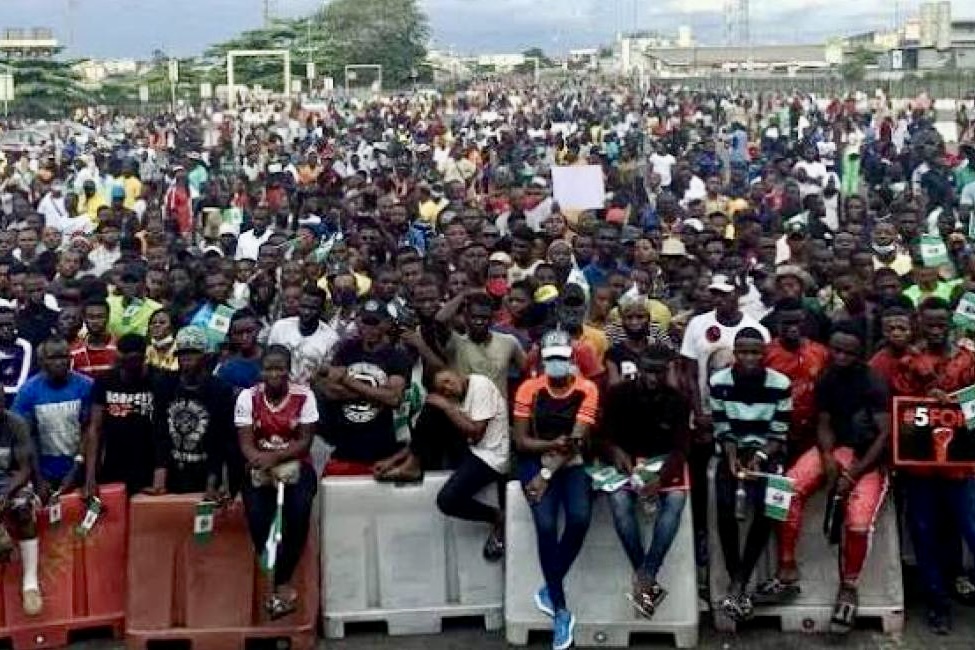
Thousands of young Nigerians had joined the protests to demand an end to abuses associated with the now-disbanded Special Anti-Robbery Squad (SARS). Their grievances included allegations of torture, extortion, unlawful arrests and extrajudicial killings.
The shootings at Lekki became a defining moment in that confrontation. The events triggered national and international outrage, while questions about casualties, the conduct of security personnel and the handling of evidence continued to divide public officials and campaigners.
Amnesty International said its investigation, based on eyewitness accounts, video footage and hospital records, confirmed that Nigerian security forces killed at least 12 people at Lekki and Alausa in Lagos on 20 October 2020. The organisation called for an independent investigation and accountability for suspected perpetrators.
The Lagos State Judicial Panel of Inquiry subsequently examined the Lekki incident as part of its investigation into police brutality and related abuses.
Its findings became the subject of a major dispute. The panel listed nine deaths at the toll gate and four other people as missing and presumed dead. The Lagos State Government later rejected key parts of the findings, including the panel’s conclusion concerning nine deaths at the location.
The differences between the panel’s findings, the government’s position and Amnesty International’s independently documented figures make careful reporting essential. The casualty figures concern different investigations and, in Amnesty’s case, deaths at two Lagos locations. They should not be presented as interchangeable totals.
What remains undeniable is that the Lekki shootings left a serious accountability dispute that has never disappeared from Nigeria’s public life.
Six Years Later, the Same Confrontation?
The events of 20 October 2026 are not the first time police have used tear gas to disperse an #EndSARS anniversary gathering at Lekki Toll Gate.
In October 2021, officers fired tear gas during a memorial procession. The then Lagos Commissioner of Police, Hakeem Odumosu, said officers were dispersing people he described as “miscreants”, rather than the participants in the memorial procession.
In October 2024, police again dispersed an anniversary gathering and arrested some demonstrators. The then Lagos Commissioner of Police, Olanrewaju Ishola, argued that the protesters had not notified his office of their intention to hold the event. He said they had not written to the command and described the proposed gathering as illegal.
Tuesday’s disruption therefore sits within a documented pattern of confrontations between police and people seeking to commemorate the protests.
The recurring question is whether the authorities have developed a lawful, transparent and proportionate way to manage such gatherings, or whether dispersal has become the default response whenever the public seeks to revisit an uncomfortable chapter of the country’s security history.
To answer that question, the Lagos State Police Command must explain what happened before the tear gas was fired. Did the organisers receive a formal warning? Was the gathering subject to a specific, lawful restriction? Did officers identify a credible threat to public safety? Was an alternative location offered, and were less intrusive measures considered?
The reports available at the time of writing do not provide answers to these questions.
The absence of those answers matters. Public confidence depends not simply on whether police officers are deployed, but on whether their decisions can withstand independent scrutiny.
The Law Protects Peaceful Assembly. What Justified the Tear Gas?
Nigeria’s Constitution provides an important starting point for evaluating the operation.
Section 40 guarantees the right to assemble freely and associate with others. Section 39 protects freedom of expression. These rights are subject to the lawful restrictions recognised under Section 45, including measures reasonably justifiable for public safety and public order.
The courts have also addressed police attempts to make permission a condition for public demonstrations.
In Inspector-General of Police v All Nigeria Peoples Party, the Court of Appeal in 2007 dismissed the Inspector-General’s appeal against a ruling that struck down statutory provisions requiring police permits for rallies and processions. The judgment emphasised that public safety concerns should not become a pretext for suppressing fundamental rights.
That precedent does not prevent the police from taking lawful action against violence or a genuine public safety threat. It does, however, make it inadequate to justify suppressing a gathering merely by asserting that the organisers failed to obtain police permission.
The central issue in Lekki is therefore not whether police have responsibilities for public order. They do. It is whether the force used on Tuesday was necessary, proportionate and supported by a lawful operational decision.
Available reports describe a planned memorial and wreath-laying ceremony. They do not provide evidence of violence by participants before officers deployed tear gas. The Lagos State Police Command must clarify whether officers identified a specific threat, what instructions they received and whether they attempted to resolve any concerns without dispersing the gathering.
The initial report supplied for this investigation stated that attempts to obtain comments from the command’s spokesperson, SP Abimbola Adebisi, were unsuccessful.
Without an official explanation, important questions remain unanswered.
The Government’s Dispute Over the 2020 Shootings Remains Relevant
The disagreement over the original Lekki shootings is essential to understanding why the memorial remains sensitive.
In November 2021, the then Minister of Information and Culture, Lai Mohammed, rejected the judicial panel’s conclusions. He said the Federal Government rejected “the notion that our soldiers and policemen massacred innocent Nigerians at Lekki”. The government questioned the report’s evidence and disputed its casualty conclusions.
The Lagos State Government subsequently released a White Paper rejecting key findings concerning the deaths at the toll gate. The panel’s conclusions and the government’s response thus remain in tension with the independent findings published by Amnesty International.
This disagreement is not a reason to abandon the search for answers. It is precisely why transparent evidence, credible investigations and clearly explained official decisions matter.
Amnesty International’s assessment following the 2020 shootings was unequivocal about the principle involved: “Opening fire on peaceful protesters is a blatant violation of people’s rights to life, dignity, freedom of expression and peaceful assembly.”
That statement concerned the use of lethal force in 2020, not Tuesday’s use of tear gas. The two incidents must not be treated as equivalent. But both raise the question of how security agencies distinguish legitimate public-order operations from disproportionate interference with peaceful assembly.
Six Years of Reform Promises Under Scrutiny
The latest incident comes as the Rule of Law and Accountability Advocacy Centre (RULAAC) warns that the structural problems exposed by #EndSARS remain unresolved.
In a statement marking the sixth anniversary, its Executive Director, Okechukwu Nwanguma, questioned whether the disbandment of SARS and subsequent reforms had fundamentally changed police practices.
“The central question six years after #EndSARS is therefore not whether reforms were announced, but whether policing has become more lawful, professional, humane and accountable,” the organisation said.
RULAAC argued that implementation of judicial-panel recommendations remained fragmented and inadequate, particularly in criminal accountability, institutional reform, rehabilitation and redress for victims.
It also questioned how many former SARS officers had been investigated, disciplined, dismissed or prosecuted, and whether redeployed personnel had undergone effective retraining and supervision.
“Redeployment is not accountability, and changing the name of a police unit is not institutional reform,” the organisation maintained.
These are allegations and accountability concerns advanced by a civil society organisation, not proof that every claim of police abuse has been substantiated. They nonetheless identify practical questions that the authorities should be able to answer through published records and measurable results.
How many recommendations from the judicial panels have been implemented? How many victims have received compensation? What disciplinary action has followed substantiated complaints? What safeguards now exist to prevent a repetition of the abuses that prompted the protests?
These are more meaningful measures of reform than announcements about reorganised units or new directives.
Tuesday’s incident adds another question: what operational standards govern the police response to peaceful commemorations of events involving alleged misconduct by security agencies themselves?
What the Police and Lagos Authorities Must Explain
The immediate priority is an independent, evidence-based review of the operation at Lekki Toll Gate.
The Lagos State Police Command should publish an account of why the memorial was dispersed, whether officers issued warnings, what threat assessments informed the decision and what rules governed the use of tear gas. It should also clarify reports that participants were injured or struggled to breathe during the dispersal.
Available footage from the gathering should be preserved alongside officers’ operational logs, deployment instructions and any relevant recordings. Any complaint of excessive force should be investigated impartially, with disciplinary or criminal proceedings pursued where the evidence warrants them.
The organisers should also be given an opportunity to provide their own account, including any correspondence with the authorities and evidence of what happened before the dispersal.
Such a review would protect the rights of participants while allowing legitimate public-safety concerns to be examined. It would also help distinguish operational mistakes from deliberate attempts to suppress lawful assembly.
The wider task falls to the Federal Government, state governments, police leadership, oversight institutions and the courts. Reform must be measured by compliance with the law, the handling of complaints, implementation of judicial findings and the availability of remedies for victims.
RULAAC captured the obligation in its anniversary statement: “Nigeria owes victims and their families more than remembrance. It owes them truth, justice, effective remedies and guarantees of non-recurrence.”
Lekki’s Unfinished Accountability Test
The #EndSARS movement forced Nigeria to confront allegations of police brutality and contributed to the disbandment of SARS. Six years later, the demand for accountability remains a test of whether institutional change has gone beyond words.
The use of tear gas at the 2026 memorial does not settle the disputed facts of the 2020 shootings. Nor does it, without further evidence, establish the criminal liability of individual officers.
But the disruption has created a new and immediate accountability question: why did a gathering intended to remember victims have to end in a police dispersal?
A democratic state must be able to protect public safety without treating remembrance, dissent and demands for justice as threats in themselves.
The people who gathered at Lekki were seeking to commemorate a painful chapter of Nigeria’s history. The authorities now have an opportunity to explain their actions transparently, investigate any allegations of excessive force and demonstrate that the right to peaceful assembly is respected in practice.
Six years after #EndSARS, the measure of reform will not be how often officials promise change. It will be whether citizens can assemble peacefully, ask difficult questions and remember the dead without being forced to run for safety.

Join the debate; let’s know your opinion.