Nigeria faces a critical constitutional crisis with two opposing visions: The Patriots, led by Chief Emeka Anyaoku, advocate for a gradual reform to draft a people’s democratic constitution, while NINAS, under Tony Nnadi, demands an immediate overhaul of the 1999 Constitution. These contrasting approaches highlight profound divisions in governance and aspirations for the nation.
ABUJA, Nigeria — In a dramatic unfolding of Nigeria’s ongoing constitutional crisis, two competing visions for the nation’s future are emerging from the corridors of power. On one side, The Patriots—a group of eminent Nigerians led by former Commonwealth Secretary-General Chief Emeka Anyaoku—are urging President Bola Tinubu to convene a national constituent assembly to draft a people’s democratic constitution.
On the other, the Nigerian Indigenous Nationalities Alliance for Self-determination (NINAS), spearheaded by Tony Nnadi, has launched a radical Five-Point Proposition calling for an immediate transition from the military-imposed 1999 Constitution to a new constitutional order.
The clash between these two camps not only exposes deep-seated divisions over the nation’s governance model but also raises critical questions about Nigeria’s ability to manage its diverse, pluralistic society.
The Patriots’ Vision: A People’s Democratic Constitution
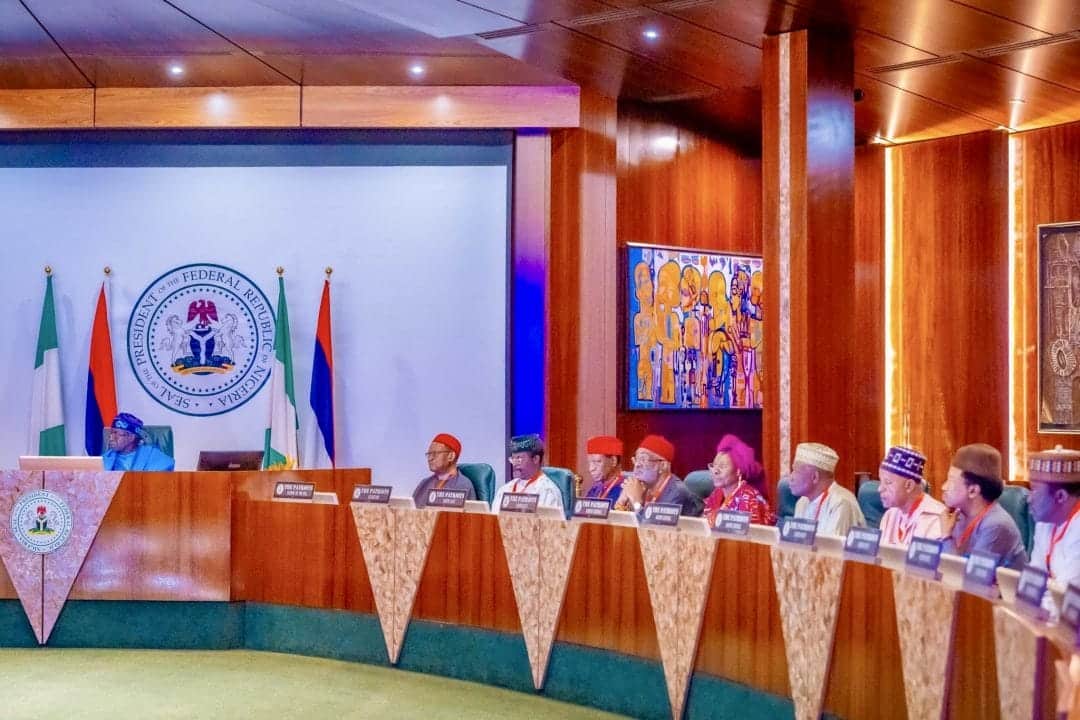
In a high-profile move that has captured national attention, The Patriots recently confirmed plans to meet with both the Senate and the House of Representatives in April. This follows a crucial meeting with President Tinubu at the Presidential Villa in Abuja on August 9, 2024, where the group laid bare its demands for sweeping constitutional reforms.
With a roster of influential figures such as Tanko Yakasai, Olusegun Osoba, and Obiageli Ezekwesili, The Patriots contend that the current 1999 Constitution is a “warped” document—fashioned in an era of corruption and ill-suited to address the manifold challenges of hardship, corruption, and insecurity that plague Nigeria today.
Chief Emeka Anyaoku and his cohorts argue that Nigeria, as a pluralistic nation, requires a constitution that not only recognises but also safeguards the rights and aspirations of its diverse communities. Their proposal includes the formation of a constituent assembly composed of directly elected individuals from all 36 states and the Federal Capital Territory, operating on a non-partisan basis.
The assembly would work alongside constitutional lawyers drawn from across the country to draft a document that reflects the lessons of Nigeria’s historical constitutions—the 1963, 1979, 1989, and 1993 versions—as well as the insights from the 2014 National Conference. Central to their approach is the demand for a national referendum, ensuring that the final document carries the unequivocal consent of the Nigerian people.
This blueprint for change has been presented not merely as a political manoeuvre but as a moral imperative. In Anyaoku’s own words, the new constitution must be “of the people” and must serve as the foundation for genuine federalism—a model that, he argues, has preserved nations like India and Canada from the perils of disintegration.
The Patriots’ stance resonates with many Nigerians who feel that the status quo is both unsustainable and inherently unjust, yet their measured approach contrasts sharply with the more radical prescription offered by NINAS.
NINAS’ Five-Point Proposition: A Call for Immediate Transition
Tony Nnadi and the NINAS camp offer a starkly different narrative. In a bold rejoinder to the established order, NINAS’s Five-Point Proposition has been heralded by its proponents as the only viable mechanism to halt the state capture of Nigeria and to steer the country away from an impending constitutional and socio-political collapse.
According to this proposition, the fundamental choice facing Nigeria is binary: either sacrifice the discredited 1999 Constitution to save the union, or sacrifice the union in a desperate bid to cling to a failed constitutional framework.
The NINAS proposition is built on five core demands:
Acknowledgement of Constitutional Grievances: The federal government must formally recognise the myriad issues inherent in the 1999 Constitution—a document NINAS deems not only fraudulent but also a primary driver of Nigeria’s deep-rooted structural malaise.
Decommissioning the 1999 Constitution: NINAS calls for an immediate and unequivocal rejection of the military-imposed constitution, which it accuses of entrenching corruption and favouring a minuscule elite.
Suspension of Further Elections under the Current Constitution: The proposition warns that continuing to operate under the 1999 framework will only exacerbate Nigeria’s political instability, particularly in the lead-up to the disastrous 2023 Presidential Election and the uncertain prospects of the 2027 cycle.
Invitation to Constituent Peoples for Transitioning Modalities: The government should formally invite Nigerians to engage in a process to determine the future constitutional framework—ensuring that every ethnic and regional voice is heard.
A Time-Bound Two-Stage Transition Process: The transition should commence with regional referendums allowing constituent components to either reaffirm their commitment to the union or opt out, followed by a distillation of the terms of union at a national level.
For NINAS, Tony Nnadi and his supporters, this five-point framework represents not only a corrective measure but also a radical reimagining of Nigerian governance. It is a call for decisive, immediate action—a stark contrast to the incremental and consultative approach favoured by The Patriots.
A Constitutional Reckoning on the Horizon
The juxtaposition of these two approaches lays bare a fundamental divide in Nigeria’s constitutional debate. While The Patriots’ strategy is rooted in a gradual, consensus-driven process that seeks to incorporate a broad spectrum of historical and legal precedents, NINAS’s proposition is unyielding and demands an immediate severance from a constitution that many believe has long outlived its legitimacy.
Critics of the current regime argue that The Patriots’ method, though democratic in intent, risks perpetuating the very system of elitist patronage and political manoeuvring that has long undermined Nigerian governance.
In contrast, NINAS’s radical stance, with its uncompromising demands for decommissioning the 1999 Constitution and halting electoral processes, strikes at the heart of a system seen by many as fundamentally corrupt and irreparably flawed.
Both approaches, however, share a common vision: a Nigeria that is truly reflective of its people’s aspirations, where constitutional provisions do not merely serve the interests of the few but offer a genuine platform for democratic participation and national unity.
As debates intensify on the national stage, the coming months will prove critical in determining which path—gradual reform or immediate revolution—will steer Nigeria towards a more stable, prosperous future.
The Road Ahead
For now, the nation watches with bated breath as President Tinubu navigates these competing constitutional visions. With economic reform still at the forefront of his agenda, the challenge remains to balance immediate fiscal imperatives with the long-term goal of establishing a constitution that can adequately address Nigeria’s complex socio-political realities.
Whether through the measured deliberations of a constituent assembly or the sweeping, transformative agenda of NINAS, one thing is clear: Nigeria stands at the precipice of a constitutional reckoning that could redefine the very nature of its union.
As the debate intensifies, stakeholders from all corners of the federation must ask themselves—what kind of Nigeria do we want to inherit? The answer to that question will not only shape the future of Nigerian governance but will also determine the nation’s ability to harness its vast potential in an increasingly complex global landscape.