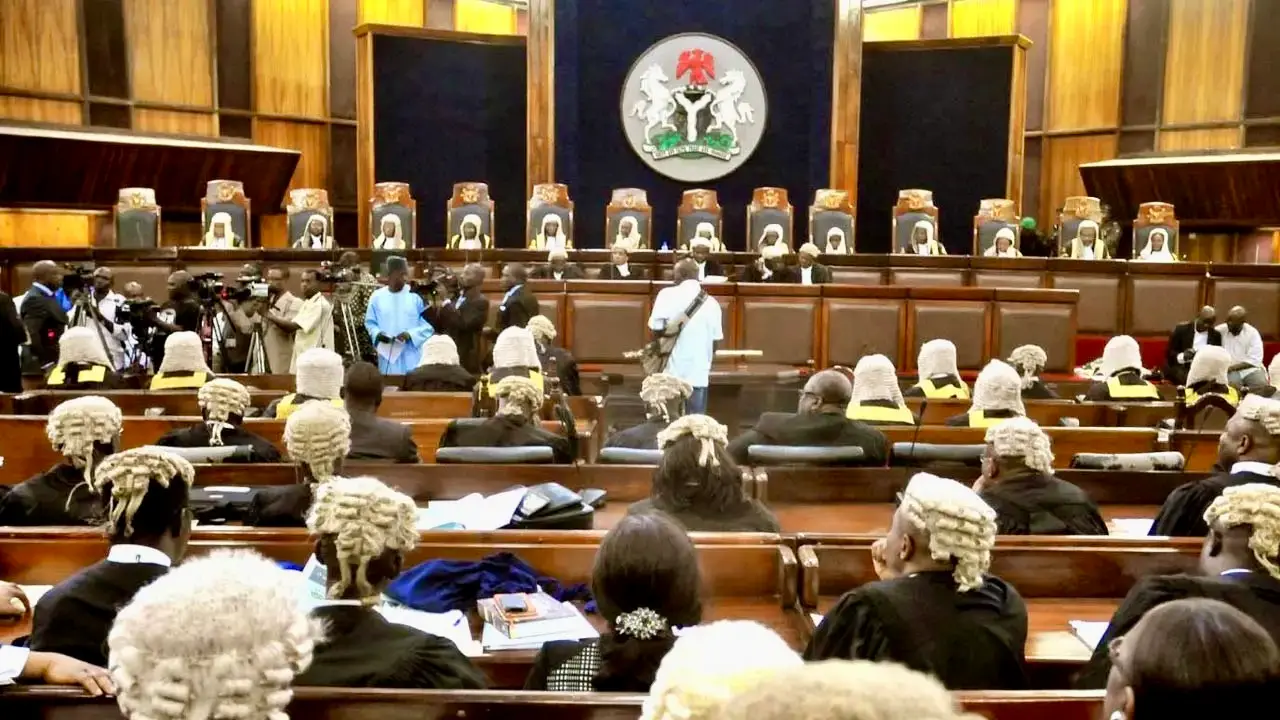
The Supreme Court of Nigeria has reinstated the Amaewhule-led Rivers State House of Assembly, rejecting Governor Fubara’s allegations of defection against 27 lawmakers. The ruling underscores constitutional governance, ordering financial restrictions on the state government until a proper legislative framework is restored, emphasising the importance of democratic integrity and the rule of law.
PORT HARCOURT, Nigeria — In a ruling that has rocked the political landscape of Rivers State and sent shockwaves across Nigeria, the Supreme Court has unequivocally restored the Amaewhule-led Rivers State House of Assembly.
The 62-page judgement—meticulously penned by Justice Emmanuel Agim—dismantles the unfounded defection claims against 27 lawmakers and marks a pivotal victory for constitutional governance and democratic integrity in the region.
A Crisis Born of Executive Hubris
For months, Rivers State has been embroiled in a bitter political crisis that saw the state governor, Siminalayi Fubara, attempt a unilateral coup against the legislative arm.
Claiming that 27 members of the People’s Democratic Party (PDP) had defected to the All Progressives Congress (APC), Governor Fubara’s allegations were designed to weaken the legislative structure and consolidate his control.
However, the apex court’s ruling has laid bare the sheer lack of evidence behind these claims, declaring them a mere red herring aimed at subverting the state’s constitutional order.
The judgment makes it clear that the governor’s actions were not merely politically motivated but amounted to a deliberate effort to destroy the very foundation of democratic governance in Rivers State.
By unlawfully reducing the House of Assembly to a token presence—reportedly recognising only four members—the governor sought to sideline the duly elected representatives and rule by decree.
In doing so, he not only undermined the constitutionally mandated structure of the House but also imperilled the balance of power critical to any functioning democracy.
Constitutional Imperatives and the Sanctity of the Legislative Process
At the heart of this sensational judgement lies a rigorous interpretation of the Nigerian Constitution. Justice Agim’s opinion is unambiguous: a House of Assembly can only exist as prescribed by Section 96 of the 1999 Constitution.
The document expressly mandates that the legislature be constituted of all duly elected members, a provision that Governor Fubara’s actions flagrantly violated.
The ruling further dismantles any attempt to invoke Sections 102 and 109 of the Constitution as a means to justify the illegal exclusion of the 27 legislators.
These sections, intended to preserve the legislative process in cases of unforeseen vacancies, were grotesquely misapplied by the governor to sanction his despotic interference.
The Supreme Court categorically ruled that these constitutional provisions cannot be stretched to endorse an enterprise that essentially seeks to render the legislature inoperative.
Such misinterpretations, the judgment warns, are tantamount to an assault on the rule of law and democratic principles.
The Judge’s Scathing Rebuff to Political Manipulation
Justice Agim spares no harsh criticism in addressing the governor’s strategy. The judgement notes that Governor Fubara had already withdrawn his defection allegations at the Federal High Court in Abuja—a tacit admission of their baseless nature.
Yet, even after this legal retraction, he persisted in his attempt to dismantle the legislative process, effectively collapsing the House of Assembly.
This manoeuvre was not only illegal but also a calculated effort to preclude the 27 members from discharging their legislative duties.
In a powerful denunciation of such tactics, the judgment highlights that political disagreements, however acrimonious, cannot justify contempt for the rule of law.
The governor’s actions are portrayed as an orchestrated campaign of chicanery—a desperate bid to forestall any challenge to his authority by eliminating the legislature altogether.
By doing so, he effectively aimed to govern unilaterally, a prospect that would have undermined the very essence of democratic accountability in Rivers State.
The Economic and Administrative Fallout
Beyond the immediate political ramifications, the Supreme Court’s decision carries significant economic implications.
In an unprecedented move, the court has ordered that the Central Bank of Nigeria and the Accountant General of the Federation should immediately cease all disbursements to the Rivers State government and its agencies until an Appropriation Law is duly enacted by the legitimate House of Assembly.
This directive is set to put a severe financial straitjacket on the state administration, compelling it to adhere strictly to constitutional protocols before accessing public funds.
Such measures are designed not only to restore fiscal discipline but also to act as a deterrent against any future attempts to undermine the legislative process for political gain.
In a state already grappling with developmental challenges, this ruling underscores the necessity of having a fully operational, democratically elected legislature to ensure that public resources are managed transparently and accountably.
Political Implications for Rivers State and Beyond
The restoration of the Amaewhule-led House of Assembly is more than just a legal victory; it represents a watershed moment for democratic governance in Rivers State.
By reasserting the supremacy of the Constitution over personal vendettas and executive overreach, the ruling sends a resounding message to all political actors in Nigeria.
It is a clarion call that the separation of powers—a cornerstone of the 1999 Constitution—will not be compromised for political expediency.
Political analysts have long warned that the continued erosion of the legislative arm in favour of executive dominance could lead to a collapse of the checks and balances that underpin Nigerian democracy.
In this context, the Supreme Court’s decision is hailed as a corrective measure that could restore balance in the state’s governance.
By affirming that any attempt to marginalise the legislature is both illegal and unconstitutional, the court has set a precedent that could reverberate across other states where similar power struggles are unfolding.
The Shadow of Past Political Battles
No discussion of this ruling would be complete without recognising the lingering influence of past political figures, notably former Governor Nyesom Wike.
The Amaewhule-led Assembly, widely believed to be loyal to Wike, represents more than just a political faction—it symbolises a commitment to a legacy of democratic governance and progressive leadership.
For many in Rivers State, the restoration of this Assembly is seen as a vindication of the democratic ideals that have been under siege by opportunistic political manoeuvres.
The judgement thus serves as a reminder of the enduring struggle between entrenched political interests and the quest for genuine democratic reform.
It is a battle that has raged in Nigeria for decades, with each victory for constitutionalism reaffirming the need for transparency, accountability, and respect for the rule of law.
Reactions and the Road Ahead
The reaction to the Supreme Court’s decision has been a mix of relief and cautious optimism. Legal experts, political commentators, and civil society groups have lauded the ruling as a robust reaffirmation of Nigeria’s constitutional principles.
However, many are also wary of the potential fallout. With the House of Assembly now mandated to resume full sittings, the challenge remains for political stakeholders to navigate the turbulent waters of re-establishing legislative authority in a state where executive dominance had taken root.
Critics of Governor Fubara argue that the ruling exposes the inherent dangers of unchecked executive power—a lesson that resonates far beyond the borders of Rivers State.
As political factions brace for the next round of confrontations, all eyes will be on the implementation of the court’s orders, particularly the financial sanctions imposed on the state government.
The coming weeks are expected to be a litmus test for whether the ruling can truly reverse years of institutional decay and restore a semblance of democratic order.
A Triumph for Democratic Ideals
In summing up this historic decision, it is impossible not to recognise its broader significance. The Supreme Court’s judgement is not merely about a single political crisis in Rivers State—it is about the sanctity of the constitutional process itself.
By decisively ruling against the misuse of constitutional provisions and executive overreach, the court has reasserted the principle that no individual or institution is above the law.
For the citizens of Rivers State, the restoration of the Amaewhule-led House of Assembly offers a renewed hope for a government that respects democratic norms and is accountable to its people.
It is a reminder that the fight for constitutional supremacy is an ongoing one—a struggle that must be waged relentlessly to safeguard the democratic fabric of the nation.
As Rivers State now prepares to resume its legislative duties, the road ahead remains fraught with challenges. However, with the backing of the highest court in the land, there is a renewed impetus to rebuild a governance structure that is both transparent and participatory.
This landmark judgement is a testament to the enduring power of the rule of law—a beacon of hope in a political environment all too often marred by subversion and authoritarian tendencies.
In a nation where political crises have become all too familiar, the Supreme Court’s intervention is a bold statement: the principles of democracy and constitutionalism will prevail, no matter how deeply they are challenged.
The restoration of the Amaewhule-led Rivers State House of Assembly stands as a powerful reminder that the true strength of any government lies in its commitment to justice, accountability, and the rule of law.
Atlantic Post will continue to monitor developments in Rivers State as this landmark ruling sets the stage for what promises to be a defining chapter in Nigeria’s political history.