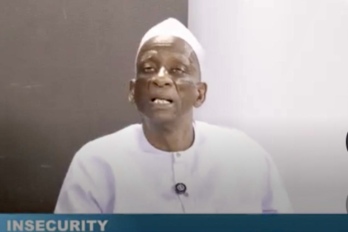
Katsina State has been thrown back into the centre of Nigeria’s insecurity debate after Dr Bashir Kurfi, convener of the Katsina Community Security Initiative, alleged that the state government paid about N10 million each to send some bandit leaders on Hajj to Saudi Arabia.
In the interview that has since spread across social media, Kurfi also alleged that government officials continued to meet and negotiate with notorious armed men, a claim that has reignited national anger over the moral and security cost of peace deals with violent groups.
The allegation is serious, politically explosive and, on the record reviewed for this report, unverified.
Kurfi’s most incendiary claim was not merely that dialogue exists, but that it may have crossed into what critics would see as dangerous legitimisation.
Referring to a bandit leader he named as Audu Lankai, he said the authorities “sit with him”, adding that government committees also go to meet armed leaders who are known by name and by family background.
He further argued that the arrangement could amount to public ridicule of religion, asking how a person accused of grave killings could be taken to Mecca and returned through a Nigerian airport as an Alhaji.
The allegation lands in an environment already defined by collapsing truces and lethal bargaining.
Reuters reported in February 2026 that 21 people were killed in Katsina in an attack that broke a six month peace pact between a community and armed men, while The Guardian reported in June that fragile local peace initiatives in north-west Nigeria continue to face collapse, retaliation and renewed violence.
In other words, the Katsina controversy is not emerging in a vacuum. It is unfolding inside a wider pattern where negotiation, appeasement and insecurity are repeatedly colliding with tragic consequences.
That wider pattern matters because Katsina’s own state machinery has publicly framed Hajj this year as a serious administrative and welfare undertaking.
The state government said Governor Dikko Umaru Radda inaugurated the 2026 Hajj Delegation Committee in April to ensure a smooth pilgrimage, while Punch reported that the administration later approved a N3.8 billion loan to secure 3,890 pilgrims, sponsored the Hadaya sacrifice and provided a $500 allowance for each pilgrim.
Those official moves show that Katsina’s Hajj operations were large, well financed and highly visible. They do not prove Kurfi’s allegation, but they do explain why the claim has struck such a raw nerve.
The allegation also collides with another public admission from the governor himself. In May 2026, Radda said bandits were being aided by informants and told Channels Television through The Guardian that security plans were being leaked within minutes.
He said, “This notorious person… we know him”, and warned that some communities were helping him by withholding the right information.
That statement is important because it confirms that the state is fighting not just armed gangs, but also a web of local concealment, compromised intelligence and silent collaboration.
In that atmosphere, even rumours of privileged access for criminal leaders can travel fast and harden into public belief.
Still, the central point remains that Kurfi’s Hajj claim has not been independently verified in the material reviewed. No direct public denial from the Katsina State Government surfaced in the sources examined for this report, and no documentary evidence was found in the public record provided to support the N10 million figure.
That is precisely why the allegation now sits in a dangerous space between advocacy, accusation and political grenade.
In a state where bandit leaders have previously been reported at peace meetings and where talks with armed groups have repeatedly generated controversy, even an unproven claim can shape public opinion quickly.
Kurfi’s broader argument is that community based security remains the more credible route because local people know the terrain, the names and the family networks of those involved.
That argument is not new. It reflects a long running reality in parts of the North West where residents often know who the armed actors are, where they come from and how they move, but often lack the protection or political backing to speak openly.
The Guardian’s recent reporting on community peacemakers in Katsina showed how some local actors have tried to broker fragile truces through familiarity and trust, even while warning that such arrangements can collapse if the state fails to deliver security and basic services.
What makes this latest controversy especially combustible is the ethical question at its core. If peace talks are being used to recover captives and reduce killings, supporters will argue they are a grim necessity.
If, however, state money is being used to confer prestige on men accused of murder, kidnapping and terror, critics will say the state has crossed a line from damage control into moral surrender.
Kurfi’s allegation has forced that debate back into the open. For Katsina, and for the wider North West, the test is no longer whether the state should talk. It is whether it can talk without deepening impunity, rewarding violence or eroding public trust.
Follow us on our broadcast channels today!
- WhatsApp: https://whatsapp.com/channel/0029VawZ8TbDDmFT1a1Syg46
- Telegram: https://t.me/atlanticpostchannel
- Facebook: https://www.messenger.com/channel/atlanticpostng