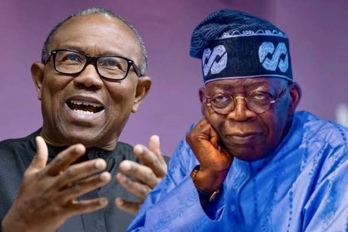
Peter Obi has once again forced Nigeria’s ruling class to confront an uncomfortable question: when does electoral mandate become a licence to persist, and when does it become a burden too heavy to carry? In a statement framed around the resignation of UK Prime Minister Keir Starmer, Obi urged President Bola Tinubu to step down, arguing that leadership failure should carry consequences and that “public office is a sacred trust, not an entitlement”. Starmer’s resignation was announced on 22 June 2026 amid political pressure in Britain.
Obi’s argument was simple but provocative. He said Tinubu had once demanded the resignation of then President Goodluck Jonathan over insecurity and hardship, and that Tinubu himself had promised better electricity, better welfare and a tougher fight against corruption during the 2023 campaign. Obi then turned the knife: “At present, however, these conditions have worsened,” he said, adding that Nigeria was in “the worst possible condition”.
That line is the political grenade at the centre of this row. Obi was not merely mocking a government under strain. He was trying to bind Tinubu to Tinubu’s own words, especially the widely circulated campaign warning that voters should not return him if he failed to deliver on power supply. In other words, Obi’s move was less a moral sermon than a campaign-era audit, and a reminder that election promises do not expire simply because power has been won.
The Presidency, through Bayo Onanuga, answered in the language it often reserves for Obi: sharp, personal and dismissive. The State House described the call as “childish and an unwarranted distraction”, accused Obi of a “selective and distorted view” of Nigeria, and argued that he was trying to harangue a president who still has a constitutional term to serve. It also insisted that Nigeria is not Britain, reminding critics that the country runs a presidential, not parliamentary, system.
Onanuga’s counter-attack did more than reject the resignation demand. It sought to recast the entire debate as a referendum on Tinubu’s supposed gains. The Presidency claimed progress in security operations, economic growth, oil output, foreign reserves, revenue, infrastructure delivery and power reforms, while portraying Obi’s criticism as political theatre. In the government’s telling, Tinubu is not failing; he is reforming, and the pain Nigerians feel is the unavoidable price of difficult change.
Yet the larger context is not as neat as the State House wants it to appear. Reuters reported in May and June 2026 that Tinubu’s economic reforms have won praise from investors and international markets but have also left households squeezed by inflation and cost-of-living pressure. Reuters also noted that insecurity, including kidnapping and violence in several regions, remains a major public concern even as the government points to fiscal improvements. That is why Obi’s attack lands: it speaks to daily frustration, not merely partisan irritation.
There is also an unmistakable 2027 undertone. Obi has already re-entered the opposition presidential race for the next election, while Reuters has reported that Nigeria’s opposition unity project has fractured, weakening the chance of a single anti-Tinubu front. The State House knows this. Its response was not only about the substance of Obi’s complaint; it was also about denying him the political oxygen that comes from being treated as Tinubu’s most credible challenger.
That is why the language has become so corrosive. Obi speaks of accountability, impunity and failed promises. The Presidency speaks of growth, reforms and patience. Both sides are fighting over the same terrain: the meaning of leadership in a country where voters hear many pledges and feel too few results. In that sense, the exchange is not really about Starmer, or even about resignation. It is about whether Nigeria’s leaders should be judged by aspiration, by delivery, or by the gap between the two.
For now, the political damage is already clear. Obi has sharpened his image as the opposition voice willing to name failure in blunt terms. The Presidency has sharpened its image as a machine that will not concede a rhetorical inch. And the public, trapped between soaring expectations and stubborn hardship, is left to decide which camp sounds more like reality.
Follow us on our broadcast channels today!
- WhatsApp: https://whatsapp.com/channel/0029VawZ8TbDDmFT1a1Syg46
- Telegram: https://t.me/atlanticpostchannel
- Facebook: https://www.messenger.com/channel/atlanticpostng