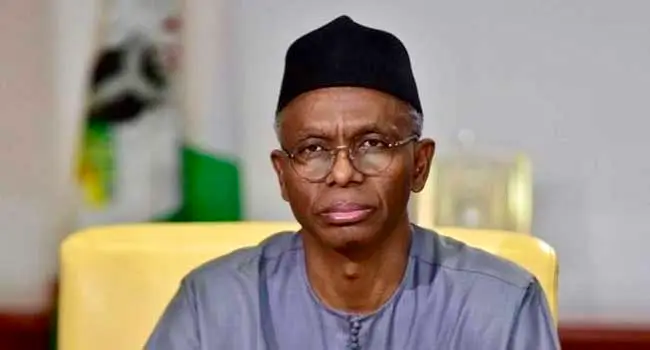
Former Kaduna governor Nasir El-Rufai has defected to the Social Democratic Party, citing a disconnect with the APC’s direction. The Kaduna APC leadership remains resolute, focusing on upcoming elections despite this turmoil. El-Rufai’s move raises questions about ideological divisions, but the APC is committed to its electoral goals and resilience in the political landscape.
KADUNA, Nigeria — In a development that has sent ripples through Nigerian politics, former Kaduna State governor Nasir El-Rufai’s dramatic switch to the Social Democratic Party (SDP) has been met with an unwavering stance from the Kaduna chapter of the All Progressives Congress (APC).
The party’s leadership, undeterred by the defection, has made clear that the political tides in Kaduna are shifting in favour of its ambitious electoral blueprint for 2027.
El-Rufai, a stalwart in Kaduna’s political arena, cited a growing misalignment between his personal values and the current direction of the APC as the impetus behind his defection.
This move, detailed in reports by PUNCH Online, has sparked a debate that transcends mere party politics, igniting questions about ideological realignment in a nation where political allegiances are often as fluid as the challenges faced by its citizens.
Kaduna APC’s Secretary, Yahaya Baba-Pate, responded with unshakeable confidence during a press briefing in Kaduna on Monday.
“We are unperturbed by former governor Nasir El-Rufai’s defection to another party,” Baba-Pate declared.
“Our main focus in Kaduna is on how to deliver the state to both President Ahmed Bola Tinubu and Governor Uba Sani in 2027.”
His resolute stance, coupled with an assurance of continuous growth within the party—evidenced by a steady influx of high-profile politicians—paints a picture of an organisation that is more determined than ever to steer Kaduna’s future.
The implications of this defection are manifold. On one hand, it has raised eyebrows among political commentators who wonder whether El-Rufai’s move is a principled stand or a calculated manoeuvre in a broader quest for political relevance.
On the other hand, it reinforces a narrative of internal divisions within the APC, as prominent figures weigh their loyalty against a backdrop of shifting ideological sands.
The former governor’s departure to the SDP, a party with its own distinct political branding, suggests that the political fault lines in Kaduna are becoming increasingly pronounced.
Despite the storm of controversy, the Kaduna APC’s narrative is one of resilience and forward momentum.
Baba-Pate’s emphatic dismissal of the defection as a mere “move” indicates that the party’s strategy is not only to consolidate its base but also to attract disillusioned elements from rival factions.
With Kaduna State emerging as a crucial battleground in the upcoming electoral cycle, the APC is betting that its inclusive governance model—a model once championed by its erstwhile leader—will continue to resonate with voters.
Critics argue that El-Rufai’s decision to abandon the APC might be symptomatic of deeper ideological rifts, questioning whether the party’s direction no longer mirrors the aspirations of its seasoned members.
However, supporters within Kaduna maintain that such defections are but temporary setbacks in an otherwise robust political machine that has long prided itself on its ability to weather internal dissent.
As the political landscape in Kaduna braces for the 2027 general elections, the saga of El-Rufai’s defection is set to fuel further debates over party ideology, loyalty, and the future of Nigeria’s democratic process.
One thing remains certain: in the high-stakes arena of Nigerian politics, the APC in Kaduna is determined to emerge unscathed, steering the state—and indeed the nation—toward a future envisioned by its stalwarts.
- Additional report by Osaigbovo Okungbowa, Atlantic Post Senior Political Correspondent