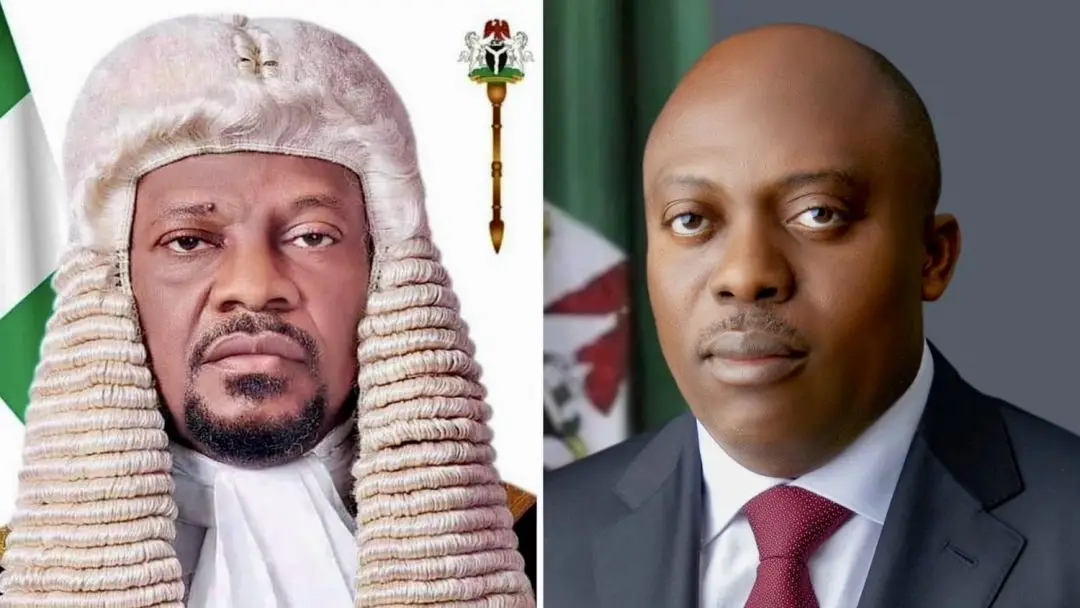
The Rivers State Assembly’s rejection of Governor Fubara’s commissioner nominations has ignited a political crisis, demanding new appointments within 48 hours. Accusations of constitutional breaches highlight the Assembly’s defence of legislative oversight against executive overreach, raising broader concerns about democracy and governance in Nigeria amid increasing tensions between state and federal authorities.
PORT HARCOURT, Rivers State — In a move that has sent shockwaves through the corridors of power in Rivers State, the House of Assembly has delivered a scathing rebuke to Governor Siminalayi Fubara.
With a dramatic ultimatum set at 48 hours, the Assembly demands a complete overhaul of the commissioner nominations—a demand that could herald a seismic shift in the state’s political landscape.
As Nigeria grapples with a constitutional and political maelstrom, this crisis not only threatens the delicate balance of power in Rivers State but also calls into question the integrity of Nigeria’s nascent democracy.
A Breach of Constitutional Protocol
The Rivers State House of Assembly, under the steadfast leadership of Speaker Martin Amaewhule, has accused Governor Fubara of bypassing essential legislative protocols by unlawfully swearing in 19 commissioners without proper screening and confirmation.
The Assembly’s letter—duly dated March 5—lays bare a litany of grievances. Among these, the appointment of Dagogo Iboroma as Attorney-General and Commissioner for Justice stands out as a glaring contravention of the constitutional mandate.
The Assembly’s criticism is unequivocal: by sidestepping the due process enshrined in the 1999 Constitution, Fubara has not only flouted the law but also imperilled the very foundations of good governance.
It is imperative to note that the Assembly’s insistence on legislative approval is not a mere bureaucratic formality—it is a constitutional safeguard designed to prevent executive overreach.
The explicit reference to Section 4(a) of the Rivers State Public Procurement Law No. 4 of 2008 and Section 44(3) of the Rivers State Local Government Law No. 5 of 2018 underscores the gravity of the infractions.
The Assembly’s detailed enumeration of names—from Lawrence Oko-Jaja to Goodlife Ben—paints a vivid picture of what many see as a systematic circumvention of statutory provisions.
The 48-Hour Ultimatum: A Clash of Powers
In its stern letter, the Assembly has set an unequivocal deadline: Governor Fubara must submit a fresh list of commissioner nominees within 48 hours. This ultimatum is not only a rebuke but also a clarion call for accountability.
The Assembly warns that the unchecked appointment of officials to positions requiring legislative vetting is “seriously threatening our nascent democracy”.
With such language, the lawmakers signal that the stakes are not merely bureaucratic but existential for the political order of Rivers State.
This confrontation between the executive and legislative arms is reminiscent of historical power struggles that have, in the past, redefined the contours of Nigerian federalism.
The Assembly’s bold stance reflects an increasing willingness among Nigeria’s elected representatives to challenge executive excesses, even when such challenges are likely to provoke a fierce response.
Today’s crisis in Rivers State is a microcosm of a larger national debate over the limits of executive power.
The Domino Effect: Supreme Court and Fiscal Fallout
The drama does not end with the Assembly’s protest. In a parallel development that has compounded the state’s political woes, the Supreme Court last Friday ordered the Amaewhule-led faction of the Assembly—as well as other elected lawmakers—to resume sitting.
This ruling, coming on the heels of an earlier Federal High Court decision, also barred the Central Bank of Nigeria and the Accountant-General of the Federation from releasing statutory allocations to Rivers State.
The apex court’s intervention is a double-edged sword. On one hand, it is a vindication of the Assembly’s right to legislative oversight and a corrective measure against potential fiscal mismanagement.
On the other, it exacerbates the tensions between the state government and the federal authorities, raising critical questions about the future of intergovernmental relations in Nigeria.
The nullification of the local government election held on October 5, 2024, further intensifies the crisis, suggesting that the judiciary is prepared to take drastic measures to uphold the rule of law.
Unpacking the Political Implications
The rejection of the commissioner nominations is not merely an isolated political spat—it is emblematic of a broader struggle for accountability and transparency in Nigerian governance.
Governor Fubara’s actions have elicited widespread condemnation from various quarters, with political analysts warning that the move could undermine public confidence in the state’s political institutions.
The cavalier manner in which constitutional provisions have been disregarded is viewed by many as symptomatic of a deeper malaise: the erosion of democratic norms in the face of unchecked executive power.
The Assembly’s decision is a calculated manoeuvre to assert the primacy of the legislative branch—a stance that, if sustained, could have far-reaching repercussions for the state’s governance.
Critics argue that Fubara’s overreach is not merely an isolated lapse in judgement but part of a deliberate strategy to consolidate power by bypassing the necessary checks and balances.
This move, therefore, must be seen in the context of a broader political realignment, where the balance between authority and accountability is being actively renegotiated.
The Role of the Assembly in Safeguarding Democracy
At its core, the Assembly’s vehement opposition to the governor’s actions is a defence of democratic principles. The insistence on legislative screening is not an arbitrary imposition; it is a cornerstone of Nigeria’s constitutional framework.
By demanding that appointments be made in accordance with established legal processes, the Assembly is upholding the rule of law and ensuring that public office is not treated as a commodity to be distributed at whim.
Furthermore, the Assembly’s actions serve as a cautionary tale for other state governments in Nigeria. The recklessness displayed by Governor Fubara could set a dangerous precedent if left unchecked.
In a country where the separation of powers has often been more theoretical than practical, this episode is a stark reminder of the need for vigilance in the exercise of executive authority.
It is incumbent upon all stakeholders—politicians, civil society, and the electorate—to demand adherence to constitutional norms.
A Nation on the Brink
The fallout from these events is likely to reverberate far beyond the boundaries of Rivers State. With the Supreme Court now involved and the local government election declared null, the political stability of the state—and indeed of the nation—is in jeopardy.
The crisis has the potential to trigger a domino effect, undermining the credibility of the electoral process and eroding the trust of Nigerians in their political institutions.
Political commentators have warned that this episode could lead to prolonged instability, with rival factions within the state government and the broader political elite engaging in a protracted power struggle.
The spectre of chaos looms large, and there are growing calls for a national dialogue on the state of Nigerian democracy.
Such a dialogue would need to address not only the immediate issues in Rivers State but also the systemic weaknesses that allow executive overreach to flourish.
Expert Opinions and Future Prospects
As a veteran political correspondent, I have had the privilege of witnessing numerous crises and their eventual resolutions. However, the current standoff in Rivers State is particularly disquieting.
Many seasoned political analysts contend that Governor Fubara’s insistence on unilateral decision-making is a dangerous gambit that risks alienating key stakeholders.
The Assembly’s demand for a new slate of nominees is a clear signal that any further deviation from constitutional norms will not be tolerated.
The role of the judiciary, as evidenced by the recent Supreme Court ruling, further complicates the political landscape. The intervention by the apex court suggests that the rule of law is not a negotiable commodity in Nigeria.
As the crisis unfolds, the eyes of the nation—and indeed the international community—are fixed on Rivers State, watching closely to see whether constitutional accountability can prevail over political expediency.
In the coming days, all parties involved will be under immense pressure to act judiciously. The governor must either demonstrate his willingness to abide by the legal framework or face the very real prospect of being isolated politically.
For the Assembly, this is an opportunity to reaffirm its mandate as the guardian of democracy in Rivers State. For the Nigerian polity at large, the unfolding events offer a critical test of the resilience of our democratic institutions.
Conclusion: A Call for Constitutional Adherence
The latest developments in Rivers State are a stark reminder that democracy is a fragile construct—one that requires constant vigilance and unwavering commitment to the rule of law.
Governor Fubara’s appointment spree, which flagrantly bypasses constitutional procedures, has not only ignited a political firestorm but also threatened to destabilise an already volatile political environment.
The Rivers State Assembly’s resolute stance is an affirmation of the principles that underpin democratic governance: accountability, transparency and adherence to the law.
As the 48-hour deadline looms ominously, the political community awaits Governor Fubara’s response with bated breath.
The outcome of this standoff will undoubtedly have profound implications for the future of governance in Rivers State and could very well serve as a bellwether for the state of Nigerian democracy in the coming years.
With seasoned political forces on both sides of the debate, the coming days are set to be some of the most critical in recent Nigerian history.
One hopes that this crisis will prompt not only a resolution of the current impasse but also a broader re-evaluation of the norms that govern the exercise of power in our beloved nation.
In this time of constitutional reckoning, the message is loud and clear: no individual, however high-ranking, is above the law. The integrity of our democratic institutions depends on it.
Atlantic Post – your trusted source for incisive political commentary and in-depth analysis, delivering the news that matters with the authority and expertise borne of decades of experience.