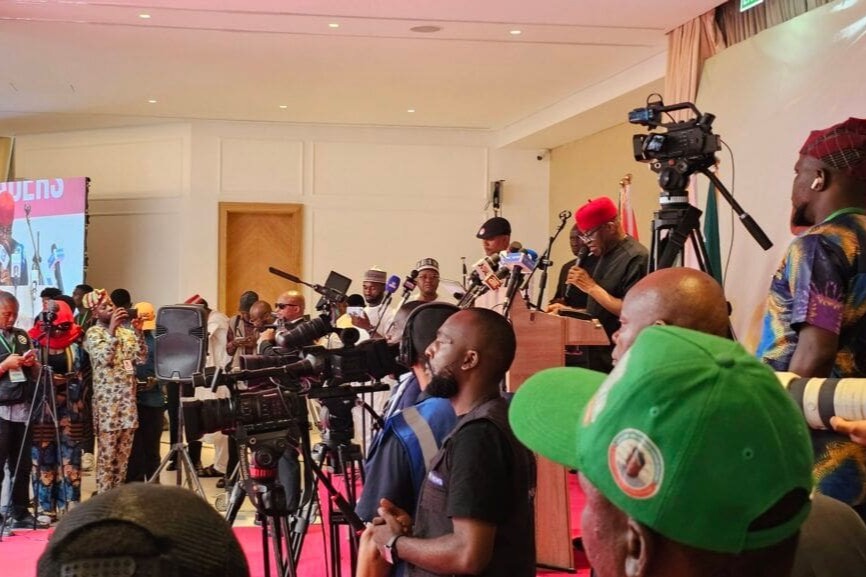
President Bola Ahmed Tinubu has accepted the resignation of Defence Minister Alhaji Mohammed Badaru Abubakar and is poised to name retired Chief of Defence Staff General Christopher Gwabin Musa as his successor, Atlantic Post has established from government sources.
The presidency’s official notice confirms Badaru’s letter of resignation dated 1 December 2025. It cites health grounds. The notice also says the President has thanked him for his service.
Tonight’s development follows public meetings between General Musa and Mr Tinubu at Aso Rock. Multiple outlets see this as the clearest signal yet. It indicates that the retired general will take over the ministry.
Independent correspondents placed Musa at the Presidential Villa on Monday evening. This was his first public meeting with the President since his retirement from the post of CDS on 24 October 2025.
The timing is consequential. Mr Tinubu declared a nationwide security emergency only days earlier. He ordered mass recruitment for the armed forces and police in response to rising abductions and attacks.
The President’s move is to expand the security apparatus. This includes a police recruitment target increase of roughly 20,000 officers. These actions underline the administration’s claim that extraordinary measures are needed.
Appointing a retired service chief to head the Defence Ministry will intensify scrutiny. Recruiting large numbers of personnel will also increase examination over the boundaries between military command and civil oversight.
The October service-chief reshuffle removed General Musa from the CDS post. It was a drastic step by the administration. This aimed to refresh military leadership amid protracted insurgency, banditry and separatist violence.
Observers will therefore treat Musa’s likely return to a ministerial post as a re-engagement of the old guard at a time of declared emergency. This raises the familiar questions: will ministerial leadership deliver better strategy and accountability? Or will it blur lines that protect civilian control of security policy?
Reuters’ account of the October changes noted the wholesale replacement of service chiefs. This was an attempt to reboot operations. This context must shape any appraisal of tonight’s appointment.
Security metrics give texture to the urgency the Presidency cites. Global indices and conflict analyses show that terrorism-related deaths and violent incidents across West Africa and Nigeria remain stubbornly high. The Global Terrorism Index and other regional reports document the persistence and spread of deadly attacks. This continues even as some theatres see tactical gains.
Policy choices now must weigh speed against oversight. The country can ill afford poor vetting of recruits. It should also avoid hasty centralisation of command.
Critical questions remain unresolved and demand public answers.
First, the Presidency says it will inform the Senate of a successor “later this week.” This signals that confirmation hearings and legislative oversight are imminent. The Senate will be the constitutional check on any ministerial appointment.
Second, opponents and analysts will examine Badaru’s stated health reasons. They will consider these reasons in the context of security performance and political calculation.
Third, the practicality of transferring a recently retired CDS into a civilian ministerial portfolio raises governance issues. Will the Defence Ministry under an ex-CDS be a vehicle for rapid operational fixes? Or will it be a prelude to a militarised policy posture that risks civil liberties and regional tensions?
For Nigerians watching supply lines, troop morale and civilian safety, the answer matters now. If Tinubu’s choice is confirmed, it will mark a decisive moment in his emergency strategy. He is gambling that placing a battle-tested commander at the ministry’s head will translate into swifter results on the ground.
It may deliver immediate operational coherence. However, it will invite intense calls for transparency. Measured civil-military relations and evidence-based performance indicators are needed. The public and legislature must demand these.
What to watch next: First, the official communication to the Senate. Then, the terms of Musa’s brief, including civilian oversight guarantees and chain-of-command clarifications.
Finally, consider the early metrics. The Presidency offers these to justify the emergency measures. These include recruitment numbers, deployment plans, and independent casualty or incident statistics.
All are essential if emergency powers are not to become permanent features of governance.
Follow us on our broadcast channels today!
- WhatsApp: https://whatsapp.com/channel/0029VawZ8TbDDmFT1a1Syg46
- Telegram: https://t.me/atlanticpostchannel
- Facebook: https://www.messenger.com/channel/atlanticpostng