The Economic and Financial Crimes Commission (EFCC) has recovered $60 million from indigenous oil and gas company Nestoil Limited, in what could prove to be a significant turning point in a sprawling debt dispute involving major Nigerian lenders, court battles over receivership and an ongoing investigation into alleged criminal aspects of transactions between the company and its creditors.
The payment, however, is far from the end of the matter.
Rather, it appears to be the first cash recovery under a structured repayment arrangement brokered through the EFCC, with the lenders warning that a substantial portion of the indebtedness remains outstanding. One report, citing sources familiar with the negotiations, said a further $40 million is expected in the next tranche, although that figure has not been publicly confirmed in the EFCC statement carried by THISDAY.
Behind the headline figure lies a much larger question: how did a long-running commercial lending dispute, allegedly involving more than $1 billion and hundreds of billions of naira, become sufficiently serious to draw the intervention of Nigeria’s anti-graft agency, trigger receivership proceedings and reach the Supreme Court?
The latest development provides part of the answer—but also raises fresh questions about accountability, bank exposure, the handling of distressed corporate loans and the boundary between commercial debt recovery and criminal investigation.
$60 Million Recovered Under EFCC-Facilitated Agreement
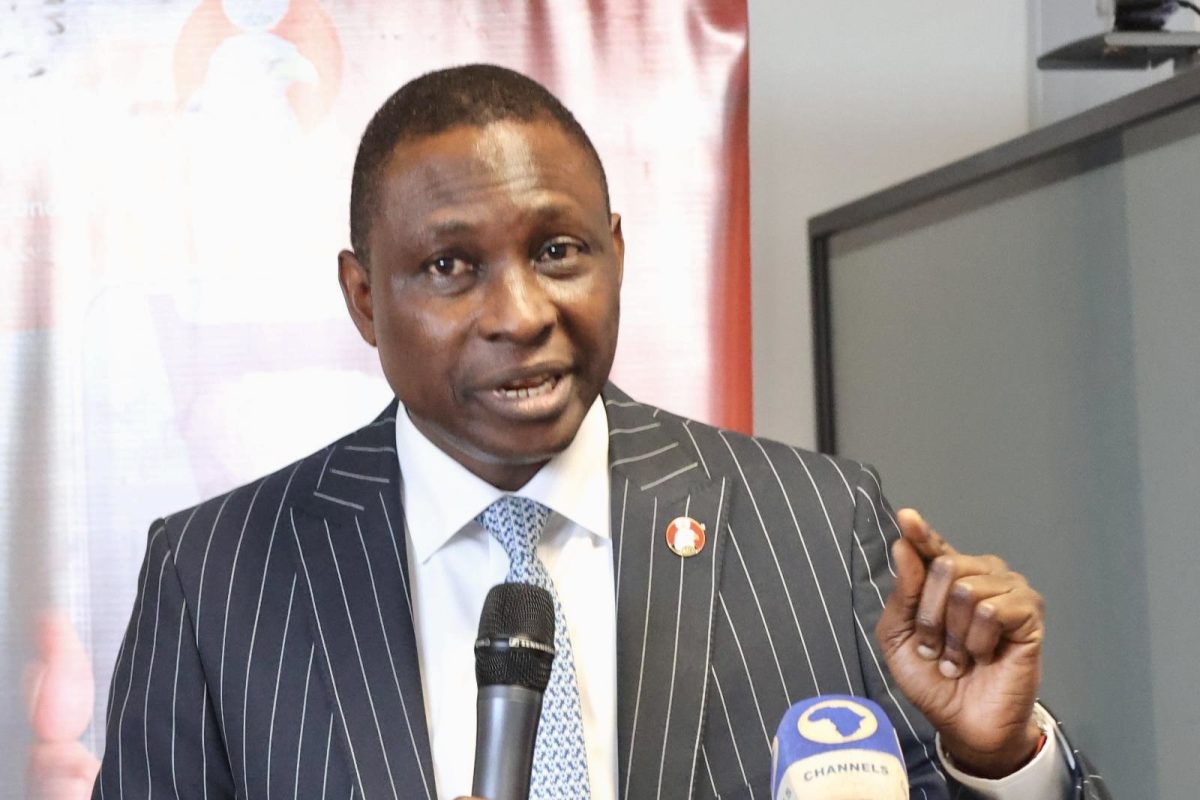
The breakthrough followed a meeting convened and chaired by EFCC Chairman Olanipekun Olukoyede, at which Nestoil and a consortium of lenders agreed to a structured repayment arrangement intended to address the company’s outstanding obligations.
According to THISDAY, the agreement had already produced a US$60 million payment to the lenders during the course of the EFCC investigation. The payment was facilitated by operatives of the commission’s Lagos Zonal Directorate 2, led by its Head of Investigation, Oguzi Moses.
The commission said the payment represented a significant milestone in its stated effort to promote accountability, protect financial institutions and safeguard depositors’ funds. It also reaffirmed that the investigation would continue and that recovery efforts would be pursued in accordance with the law.
The lenders, for their part, welcomed the payment but made clear that it is only the beginning.
They said it represents “only the first phase of the repayment process”, with substantial indebtedness still outstanding.
That distinction matters.
The $60 million is substantial in its own right, but it is relatively small compared with the scale of the debt claims that have been placed before Nigerian courts. Nairametrics reported that lenders said in June that Nestoil’s indebtedness had risen to approximately $1.084 billion and N469.43 billion. On the dollar component alone, the $60 million recovery amounts to about 5.5 per cent of the $1.084 billion figure, before the separate naira obligation is considered.
In other words, the EFCC-assisted repayment is important, but it does not remotely resolve the underlying financial exposure.
From Bilateral Loans to the “Global Club”
The roots of the dispute stretch back more than a decade.
The consortium of lenders has said Nestoil obtained several bilateral loan facilities from eight lenders dating back to 2010, before the company proposed consolidating the facilities into a broader restructuring arrangement known as the “Global Club”.
According to the lenders, the restructuring was intended to simplify administration of the indebtedness and create a more coherent repayment framework. It became effective in 2023.
But the lenders subsequently alleged that defaults continued even after the restructuring.
“Prior to the Court Action, Nestoil obtained several bilateral loan facilities from eight (8) lenders dating back to 2010 and serially defaulted on all the various repayment obligations,” the lenders said in a statement cited by PREMIUM TIMES. They added that they had agreed to restructure the facilities in good faith, but alleged that Nestoil again defaulted after the restructuring became effective.
The banks and financial institutions identified in reporting on the wider lending consortium include Access Bank, Zenith Bank, Ecobank, Afreximbank, First Bank, FCMB, UBA and Union Bank.
This is important because the public litigation has sometimes appeared to involve a smaller group.
The major court action was brought by FBNQuest Merchant Bank and First Trustees Limited, with the claim extending to Nestoil, Neconde Energy and principal promoters Ernest Azudialu-Obiejesi and Nnenna Azudialu-Obiejesi.
Thus, the dispute contains both a formal litigation structure and a wider banking exposure involving multiple lenders.
The Debt Claims That Triggered the Legal War
In October 2025, the dispute escalated dramatically when the Federal High Court in Lagos granted a Mareva injunctionover assets, bank accounts and shares associated with Nestoil, Neconde and their promoters. At the time, court documents put the alleged indebtedness at roughly $1.0126 billion and N430.014 billion, as of 30 September 2025.
The court also empowered Abubakar Sulu-Gambari, SAN, to act as receiver/manager and ordered enforcement measures involving several security agencies. Nestoil’s headquarters in Victoria Island, Lagos, was subsequently sealed.
That dramatic intervention transformed what had largely been a financial dispute into a national corporate, legal and regulatory story.
The receiver’s mandate extended to identified assets and to Neconde’s interest in OML 42, a major onshore Niger Delta oil asset. The Nigerian Upstream Petroleum Regulatory Commission’s June 2026 concession report identifies OML 42 as a joint-venture asset in which NNPC E&P Limited holds 55 per cent and Neconde Energy 45 per cent, with NNPC E&P listed as operator.
The scale of the asset explains why the dispute attracted such intense attention from creditors.
Supreme Court Ruling Changed the Receivership Battlefield
The legal position then shifted repeatedly.
After the Federal High Court later revoked the earlier receivership-enforcement order, FBNQuest and First Trustees appealed. The Court of Appeal subsequently issued a restorative injunction in November 2025 that reversed the lower court’s decision and restrained Nestoil, Neconde and their agents from obstructing the receiver.
The matter eventually reached the Supreme Court.
In June 2026, the apex court set aside the Court of Appeal’s order freezing the assets of Nestoil, Neconde and their promoters. The Supreme Court held that the appellate court had exceeded the limits of its jurisdiction in granting the relevant ex parte relief and criticised the use of the judicial process to stay proceedings at the Federal High Court.
That ruling was significant, but it did not amount to a declaration that Nestoil owed nothing.
Indeed, the lenders subsequently maintained that the Supreme Court ruling did not extinguish the underlying financial obligations.
This distinction is critical: a court setting aside a particular interim or procedural order is not the same thing as a final judicial determination that the alleged debt does not exist.
Another Legal Front: EFCC Investigation
The financial dispute also opened a separate legal front over the EFCC’s investigative authority.
Companies linked to the Nestoil Group—Amaranta Oil and Gas Development Limited and Jonescreek Hydrocarbon Limited—went to court earlier this year seeking to prevent the EFCC from investigating their activities.
The Federal High Court in Abuja initially issued interim orders in February and March 2026 restraining the anti-graft agency from probing the firms or taking certain enforcement steps.
But that protection did not survive.
On 15 April 2026, the court vacated the earlier ex parte orders, clearing the way for the EFCC to investigate alleged infractions involving the two firms. The court also rejected efforts to keep lenders and other parties from communicating alleged criminal issues to the commission.
The development was particularly consequential because Jonescreek Hydrocarbon is tied to the operation of OML 42, putting a strategically important oil-producing asset at the centre of a controversy that now spans debt recovery, corporate control and criminal investigation.
What Exactly Is the EFCC Investigating?
This is perhaps the most important question that the $60 million recovery does not answer.
The EFCC has described its investigation as concerning the “alleged criminal aspects” of transactions involving Nestoil and the lending consortium.
That wording should not be lost amid the headlines.
An investigation is not a conviction, and a payment made under a structured debt-recovery arrangement does not by itself establish criminal liability.
The EFCC must still establish, through evidence and due process, whether any transaction involved fraud, diversion of funds, falsification, money laundering, dishonest conversion or another offence within its statutory mandate.
For Nestoil and its promoters, therefore, the stakes extend well beyond the repayment calendar.
Nestoil Has Disputed the Debt Figures
Nestoil has previously challenged the basis and accuracy of the sums being claimed by its lenders.
In court-related filings reported by THISDAY in November 2025, the company argued that it needed a forensic reconciliation of its loan accounts and challenged the accuracy of the amounts being presented as outstanding.
Nestoil stated: “The amounts presented as representing Nestoil’s debt are incorrect and lack any proper basis.”
That position is important to the overall narrative because the figures circulating publicly—whether $1.01 billion, $1.084 billion, N430 billion or N469.43 billion—come from different stages of a contested financial relationship and should not be treated as a final judicially established debt figure.
The latest $60 million payment, however, demonstrates something else: whatever the legal disagreements over accounting, liability or enforcement, negotiations have now produced an actual cash transfer to the lenders.
Banks Also Have Skin in the Game
The Nestoil dispute has ramifications beyond one corporate borrower.
The lenders have warned that the distressed exposure has had broader consequences for bank balance sheets. PREMIUM TIMES reported that the lenders described the situation as having contributed to a “historic balance sheet reset” and a “lack of dividend payments” at some major Nigerian banks.
That is where the story acquires a public-interest dimension.
When a very large corporate credit exposure remains unpaid over a prolonged period, the consequences do not remain confined to the boardrooms of the borrower and creditor. Banks must recognise impairments, preserve capital, manage liquidity and protect depositor confidence.
Nairametrics reported that several of the institutions involved had already recognised substantial impairment charges linked to the exposure.
The EFCC’s decision to facilitate negotiations therefore reflects more than a narrow attempt to help banks recover money. It places the case within the broader question of financial-system stability and how Nigeria handles large distressed corporate loans.
The $60 Million Is a Breakthrough—But Not a Settlement
The easiest way to misunderstand the latest announcement is to describe it simply as “EFCC recovering Nestoil’s debt”.
The facts are more complicated.
The commission is investigating alleged criminal aspects of transactions. The lenders are pursuing recovery of outstanding facilities. Nestoil has contested aspects of the lenders’ calculations and the legal basis of some enforcement steps. Courts have issued conflicting interim orders. The Supreme Court has annulled certain Court of Appeal orders. And the underlying substantive litigation remains unresolved.
The $60 million should therefore be understood as a recovery milestone within a continuing dispute, not the final resolution.
Indeed, the lenders have expressly said that significant obligations remain outstanding. Nairametrics, citing sources familiar with the arrangement, reported that another $40 million could be expected in a subsequent tranche.
The next test is whether the structured arrangement can produce sustained repayments without reopening the cycle of defaults, litigation and emergency enforcement that has characterised the dispute since 2025.
What Happens Next?
Several developments now deserve close scrutiny.
First is the repayment timetable. The public needs clarity on how the remaining obligations will be serviced and whether the next tranche materialises.
Second is the EFCC investigation. The agency has pledged to pursue the matter to its logical conclusion, but the public will ultimately need to know whether investigators find prosecutable criminal conduct or whether the dispute proves principally commercial and contractual.
Third is the substantive court case. The Federal High Court Chief Judge, Justice John Tsoho, rejected an attempt by First Trustees to have the Nestoil-Neconde case reassigned, directing that the matter continue before Justice Daniel Osiagor. The decision was communicated in June and reinforces the importance of the lower court proceedings in determining the substantive issues.
Fourth is the future of OML 42, given its strategic value to the Nigerian oil industry and the competing interests surrounding its ownership, operation and financing.
And fifth is the condition of the affected banks.
A successful repayment programme could reduce pressure on lenders and strengthen confidence in Nigeria’s corporate credit system. A renewed breakdown, by contrast, could revive questions over provisioning, recoverability and whether Nigerian banks are adequately protected when large borrowers fall into prolonged distress.
The Bigger National-Security Question
At first sight, Nestoil’s debt dispute is a corporate finance story.
It is more than that.
Nigeria’s economy depends heavily on functioning banks, reliable energy assets and confidence in the enforceability of contracts. When a dispute involving more than a billion dollars, hundreds of billions of naira and a strategically significant oil asset becomes entangled in competing court orders and regulatory investigations, the consequences reach beyond the parties in the courtroom.
That is why the $60 million recovery matters.
It represents tangible money recovered rather than another legal argument exchanged on paper. But its real significance will depend on what comes next.
Can the repayment plan continue?
Will the remaining billions be recovered?
Will the EFCC investigation produce evidence of criminal wrongdoing, or will it ultimately reinforce the lenders’ position in what remains a commercial dispute?
And can Nigerian institutions resolve a dispute of this magnitude without allowing debt recovery to become another prolonged battle over control of critical national assets?
For now, the EFCC has secured its first major cash recovery.
But the real story is not the $60 million already paid.
It is the much larger mountain of debt that remains, the unanswered questions surrounding the transactions, and whether Nigeria’s financial and justice systems can finally bring the Nestoil saga to a lawful and durable conclusion.
Follow us on our broadcast channels today!
- WhatsApp: https://whatsapp.com/channel/0029VawZ8TbDDmFT1a1Syg46
- Telegram: https://t.me/atlanticpostchannel
- Facebook: https://www.messenger.com/channel/atlanticpostng