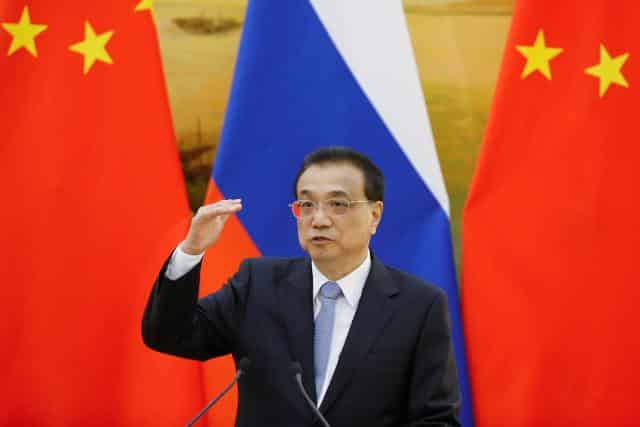
Chinese Premier Li Keqiang said on Monday Beijing will further open up its economy in the face of rising protectionism, as he headed for meetings with Asia-Pacific leaders in Singapore that are expected to focus on trade tensions.

Li’s remarks in an article in Singapore’s Straits Times newspaper, ahead of his arrival in the city-state later in the day, came as Singapore’s Prime Minister Lee Hsien Loong called for more regional integration, saying multilateralism was under threat from political pressures.
“China has opened its door to the world; we will never close it but open it even wider,” Li said in the article, in which he called for an “open world economy” in the face of “rising protectionism and unilateralism”. He did not directly refer to China’s bruising trade war with the United States.
Notably absent from this week’s meetings is U.S. President Donald Trump, who has said several existing multilateral trade deals are unfair, and has railed against China over intellectual property theft, entry barriers to U.S. businesses and a gaping trade deficit.
Vice President Mike Pence will attend instead of Trump, and Russian President Vladimir Putin, Indian Prime Minister Narendra Modi and Japanese Prime Minister Shinzo Abe are among those also expected to join Li and the ten-member member Association of Southeast Asian Nations (ASEAN).
It was not clear if Li and Pence will hold separate talks on the sidelines of the meetings, which would be a prelude to a summit scheduled between Trump and Chinese President Xi Jinping at the end of the month in Buenos Aires.
The encounter, if it happens, would come on the heels of high-level talks in Washington where the two sides aired their main differences but appeared to attempt controlling the damage to relations that has worsened with tit-for-tat tariffs in recent months.
Meanwhile, in remarks at a business summit on Monday ahead of this week’s meetings, Singapore PM Lee said:
“ASEAN has great potential, but fully realizing it depends on whether we choose to become more integrated, and work resolutely towards this goal in a world where multilateralism is fraying under political pressures”.
Lee has previously warned that the U.S.-China trade war could have a “big, negative impact” on Singapore, and the city-state’s central bank has warned it could soon drag on the economy.
Both Singapore and China are expected to rally support for the Regional Comprehensive Economic Partnership (RCEP) pact now being negotiated, showcased to be the free trade deal that will encompass more than a third of the world’s GDP.
The pact includes 16 countries, including China, India, Japan and South Korea, but not the United States. Li said China would work to “expedite” RCEP negotiations this week.
Also on Monday, the ten-member ASEAN group reached their first ever deal on e-commerce aimed at helping boost cross-border transactions in the region. (Reuters)