By Osaigbovo Okungbowa, Senior Political Correspondent
PORT HARCOURT, Rivers State — In what can only be described as a pivotal moment in Rivers State’s ongoing political drama, chaos erupted in Port Harcourt as men in police uniform stormed a major polling centre of an illegal local government election conducted by the Rivers State Independent Electoral Commission (RSIEC). The election, defying a Federal High Court ruling, was met with forceful intervention by the police, leaving a trail of tear gas, scattered voters, and seized electoral materials. The events of October 5, 2024, at Elekahia Primary School have once again raised serious questions about the state of democracy, law enforcement, and electoral integrity in Rivers State.

RSIEC’s Defiance: A Blatant Violation of the Federal High Court Order
The roots of the chaos can be traced back to the audacious decision by the RSIEC to proceed with local government elections despite a Federal High Court ruling explicitly prohibiting the exercise. The court had ordered a halt to the elections due to unresolved legal challenges surrounding RSIEC’s ability to conduct the process. These challenges ranged from procedural flaws in the setup of the electoral framework to allegations of improper appointment and bias within RSIEC itself.
However, in what can only be seen as an act of institutional defiance, RSIEC moved forward with the election, ignoring the legal judgement. By 8:00 AM, adhoc electoral officers had arrived at Elekahia Primary School, a major polling centre for Ward 19, Port Harcourt City Local Government, setting up accreditation stands and preparing for what they assumed would be a normal election day. But there was nothing legal or normal about this exercise. The sheer defiance of the court order by a state electoral body set the stage for the confrontation that would follow.
The implications of RSIEC’s action are alarming. If a governmental body entrusted with overseeing fair and lawful elections can so blatantly disregard a court decision, what message does that send to the electorate and to the international community? The erosion of respect for the judiciary signals a deepening crisis in Nigeria’s democracy, where the rule of law appears increasingly vulnerable to manipulation by political actors.
The Police Response: Enforcing the Rule of Law
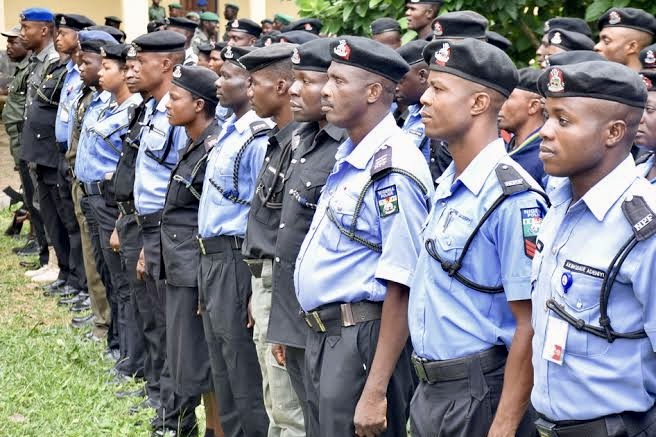
At around 9:30 AM, just as the accreditation process was about to begin, a convoy of 21 Hilux Patrol Vans with heavily armed police officers stormed the Elekahia Primary School. Contrary to initial reports suggesting an arbitrary police crackdown, it quickly became clear that the police were acting in response to RSIEC’s illegal conduct of the election. Their mission was to enforce the Federal High Court’s ruling, which had rendered the election null and void.
The arrival of the police was anything but subtle. Tear gas canisters were fired almost immediately, sending the RSIEC adhoc staff and waiting voters fleeing in different directions. The officers wasted no time in seizing election materials and dismantling the accreditation stands. A striking scene unfolded as one officer forcibly approached a member of the RSIEC adhoc staff, ordering them to remove their election vest, shouting, “Come here, remove that vest. What are you doing here?”
The police were clearly intent on ensuring that the election could not proceed under any circumstances. Tear gas was repeatedly fired into the crowd, creating a cloud of confusion as people scrambled to escape. Nearby residents and bystanders, including those who had come out to vote, were caught in the melee as the police enforced the court’s directive with military precision.
Public Outcry: A Democracy in Peril or Law and Order Restored?
The sight of police storming a polling station, firing tear gas, and seizing election materials is one that will undoubtedly leave a lasting impression on the people of Port Harcourt. However, the broader question remains: Was this an assault on democracy or a necessary intervention to uphold the rule of law?
On one hand, some critics argue that the use of force by the police is symbolic of a larger problem in Nigeria’s political system—where power, rather than democratic norms, often dictates the outcome of elections. The chaotic scenes in Elekahia Primary School, where voters were running for their lives, gave the impression of a state machinery that responds to political crises with brute force, rather than diplomacy or dialogue.
On the other hand, the police had a legal mandate to enforce. RSIEC’s defiance of the Federal High Court ruling was an affront to the judicial process and posed a threat to the credibility of the entire election. Allowing such an illegal exercise to proceed would have undermined the sanctity of Nigeria’s legal system and set a dangerous precedent for future elections. In this light, the police operation, while heavy-handed, was necessary to prevent the erosion of law and order.
The question Nigerians must now confront is this: Is the integrity of the electoral process more important than the method used to uphold it? Can democracy thrive in an environment where judicial rulings are ignored, and must it rely on force to restore order?
Rivers State on Edge: Political Implications of the Crackdown
The political implications of the police action in Port Harcourt cannot be overstated. Rivers State, a political battleground, has long been plagued by electoral violence, voter intimidation, and allegations of fraud. This latest development only adds to the perception of instability and uncertainty that has haunted the state’s political landscape for years.
RSIEC’s decision to proceed with the election in violation of a court order has raised eyebrows. Was this merely an administrative oversight, or was it a calculated move by political actors seeking to advance their own agenda? The fact that the electoral body was willing to disregard a Federal High Court ruling raises uncomfortable questions about the integrity of the institution and its susceptibility to political manipulation.
For the ruling party in Rivers State, the fallout from this incident could be significant. Already, opposition parties are seizing on the chaos to question the legitimacy of the election process and to paint the ruling government as a violator of democratic principles. The swift and forceful intervention by the police, while necessary to restore legal order, could also be seen as evidence of a state machinery working in the interests of certain political elites.
Police Spokesperson’s Silence: An Ominous Sign
When contacted for a statement regarding the police’s role in the disruption of the election, Grace Iringe-Koko, the spokesperson for the Rivers State Police Command, stated that she was unaware of the incident, replying tersely, “I’m not aware. You are just telling me now.” This statement, or lack thereof, adds another layer of uncertainty to the unfolding drama.
The apparent disconnect between the police operation on the ground and the official narrative from the State Police Command is troubling. If the spokesperson was genuinely unaware of such a large-scale police operation, it raises questions about the coordination and communication within the police hierarchy. Conversely, if the statement was an attempt to deflect responsibility or downplay the severity of the situation, it speaks to a larger problem of transparency and accountability in Nigeria’s law enforcement agencies.
The Battle for Nigeria’s Democratic Soul
As the dust settles in Elekahia, the events of October 5, 2024, will likely be remembered as a defining moment in Rivers State’s political history. RSIEC’s defiance of the Federal High Court ruling has exposed deep cracks in Nigeria’s democratic process, where institutions meant to safeguard electoral integrity can so easily succumb to political pressure.
The police, while enforcing the law, have now become embroiled in the broader narrative of political contestation and state power. Their actions, though legal, will be interpreted by different actors in different ways—some as an essential restoration of order, others as a dangerous overreach of state authority.
As Nigeria continues its journey toward democratic consolidation, the balance between upholding the rule of law and ensuring that democracy is not stifled by force remains delicate. In the case of Rivers State, that balance was severely tested, and the ramifications will be felt for months, if not years, to come.
Conclusion: What Does This Mean for Nigeria’s Democracy?
The incident in Port Harcourt was not merely about an illegal election; it was a clash between lawlessness and the rule of law. While RSIEC brazenly defied the court, the police acted to enforce judicial authority. But the method of enforcement—tear gas, force, and violence—raises troubling questions about the state of Nigeria’s democracy.
As Rivers State grapples with the aftermath, it is clear that democracy remains fragile. Institutions must uphold the law, but they must do so in a way that does not erode public trust. For the people of Rivers State and indeed all of Nigeria, this is a moment of reckoning. Will the country emerge stronger with renewed respect for the judiciary, or will the events of October 5 signal a deeper erosion of democratic norms?
With reporting from Kalada Jumbo, Atlantic Post Political Correspondent