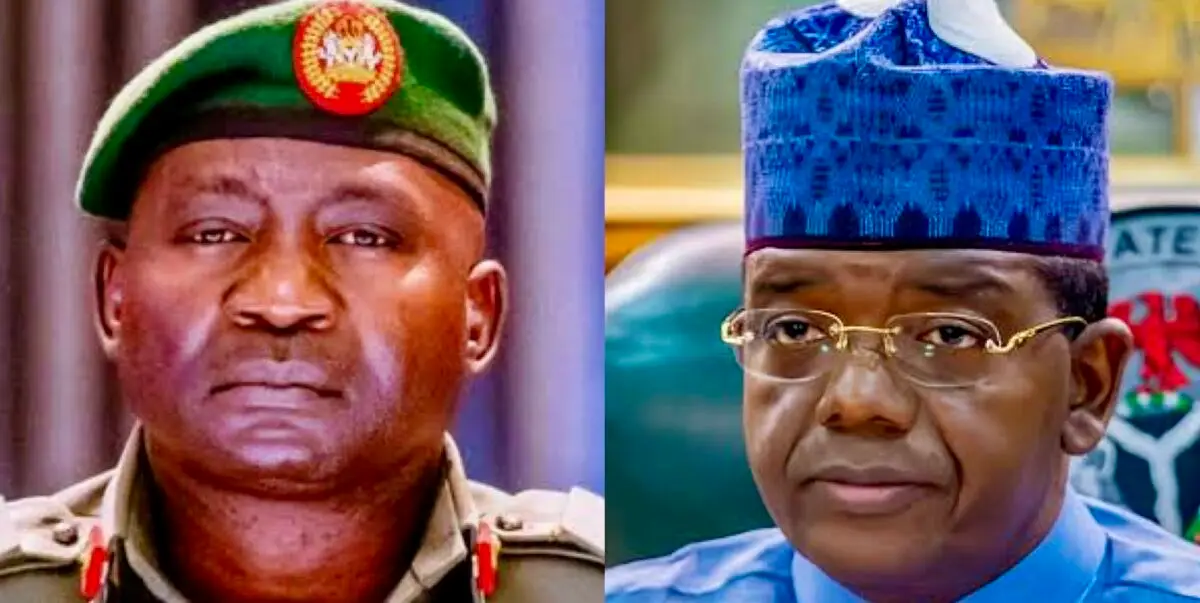
ABUJA, Nigeria — In a move that has sent shockwaves through international diplomatic circles, Canada’s refusal to grant visas to certain high-ranking Nigerian military officials—including the esteemed Chief of Defence Staff, General Christopher Musa—has triggered a fierce reaction from Nigeria’s Federal Government.
The incident, unfolding against the backdrop of an event intended to honour war veterans in Canada, has rapidly escalated into a full-blown diplomatic crisis, raising serious questions about the state of bilateral relations between Nigeria and Canada.
The Unfolding Controversy
The saga began when a delegation of senior military officials was invited to participate in an event commemorating war veterans on Canadian soil. While several members of the delegation secured their visas without hindrance, a select group, including General Musa, were unexpectedly denied entry.
Speaking at the maiden annual lecture of the National Association of the Institute for Security Studies in Abuja, General Musa described the episode as a stark “wake-up call” for Nigeria, urging the nation to fortify its sovereignty and stand unyielding in the face of perceived disrespect.
This abrupt visa denial not only left the delegation dismayed but also ignited a firestorm of criticism within Nigeria’s political and military echelons. The incident is being seen by many as emblematic of a broader pattern of disregard for Nigerian national pride on the international stage.
A Government in Outrage
Senior Nigerian officials have not held back their ire. The Minister of Interior, Olubunmi Tunji-Ojo, and the Minister of State for Defence, Bello Matawalle, have both signalled that Nigeria may retaliate “decisively” if a satisfactory explanation is not forthcoming from the Canadian side.
Tunji-Ojo was particularly scathing, condemning the embassy’s decision as an affront not only to General Musa but to Nigeria as a whole. In a fiery address on Channels Television’s ‘Sunrise Daily’, he emphasised that the principles of fairness and reciprocity are paramount in managing international migration and visa processes.
Minister Matawalle echoed these sentiments, decrying the incident as more than a bureaucratic mishap. “This is not merely a case of administrative error—it is a serious affront to our national dignity and integrity,” he asserted.
The minister further warned that unless Canada provides a clear and justified explanation, Nigeria would be compelled to adopt measures that could include turning back Canadian nationals at its borders—a move reminiscent of past diplomatic tit-for-tat scenarios.
The Canadian High Commission’s Response
In a bid to downplay the gravity of the incident, the Canadian High Commission in Nigeria released a statement acknowledging the media reports but refrained from addressing the specifics of the visa denials. The statement noted:
“The High Commission of Canada in Nigeria is aware of media reports related to planned travel by senior officials. However, for privacy reasons, we are unable to comment on the status of visa applications of specific individuals.”
This terse response has done little to mollify the growing discontent within Nigerian circles, with many accusing the Canadian authorities of obfuscation and insensitivity.
Diplomatic Ramifications and Historical Context
The ramifications of this incident extend well beyond the immediate visa dispute. Analysts and retired diplomats have long warned that the absence of senior representation in Nigerian embassies—a chronic shortcoming in Nigeria’s diplomatic structure—could undermine the country’s international standing.
Mohammed Mabdul, a former diplomat to Algeria, lamented that the lack of ambassadors in key postings has diminished Nigeria’s ability to negotiate effectively on the world stage.
Ogbole Amedu-Ode, a retired ambassador to Mexico, recalled a similar incident from the 2000s involving General Yakubu Gowon, suggesting that history may be on the verge of repeating itself.
Adding further fuel to the fire, Nigeria’s National Security Adviser, Nuhu Ribadu, unleashed a characteristically blunt rebuke by stating that “Canada can go to hell”—a remark that underscores the deep-seated frustration within the highest echelons of Nigerian defence and security.
Potential Reciprocal Measures
Insiders within the Nigerian Immigration Service have hinted at possible reciprocal measures should the Canadian High Commission fail to resolve the issue promptly.
One senior official, speaking on condition of anonymity, warned that Nigeria might soon begin turning back Canadian nationals at its borders—a response that echoes a similar incident involving South Africa.
Earlier this year, Nigeria retaliated against perceived slights by denying entry to a South African airline carrying dignitaries, an action that nearly precipitated a major diplomatic crisis.
Such bold measures, if implemented, could fundamentally alter the dynamics of Nigeria-Canada relations, potentially leading to a broader realignment of diplomatic priorities.
The incident has thus become a litmus test for Nigeria’s resolve in defending its national honour and asserting its sovereign rights on the global stage.
Expert Opinions and Legal Perspectives
Amidst the diplomatic storm, legal experts and human rights advocates have offered their analyses on the possible motivations behind Canada’s visa denials.
Prominent human rights lawyer Femi Falana has suggested that the decision might be linked to concerns over human rights abuses or allegations of corruption involving certain Nigerian military officials.
According to Falana, “Countries often impose visa restrictions on high-ranking officials if there is credible evidence of anti-democratic practices or human rights violations.”
Such assertions have only intensified the debate, with many questioning whether the visa denials are a punitive measure aimed at compelling Nigeria to address internal issues related to military conduct and governance.
Falana’s commentary underscores the delicate balance between national sovereignty and international human rights standards—a balance that is now being tested to its limits.
Diplomatic Blame Game and Institutional Critique
Further complicating matters is the internal debate among retired diplomats and former government envoys. Some have pointed to Nigeria’s own diplomatic shortcomings as a contributing factor to the current crisis.
The absence of high-ranking diplomats in Nigerian embassies, especially in key countries like Canada, has led to criticisms that Nigeria has allowed its diplomatic clout to wane.
Dr Yemi Farounbi, Nigeria’s former Ambassador to the Philippines, argued that while Canada has the sovereign right to manage its visa processes, a more robust Nigerian diplomatic presence could have preempted or at least mitigated the fallout from such incidents.
This internal critique is emblematic of a broader discussion about Nigeria’s place in global diplomacy. As the nation grapples with its evolving role in international affairs, incidents like the current visa debacle serve as a stark reminder of the need for a more proactive and resilient diplomatic strategy.
The Road Ahead
As the Nigerian government weighs its next steps, the international community watches with bated breath. The coming days are likely to see heated diplomatic exchanges, and the possibility of reciprocal visa restrictions looms large.
For many Nigerian officials, the incident is more than just an isolated administrative error—it is a challenge to national honour that demands a robust and assertive response.
Minister Tunji-Ojo’s call for fairness and reciprocity, combined with Minister Matawalle’s insistence on a thorough investigation, signals that Nigeria is not willing to let this episode pass without a firm response.
With high stakes on the line—not least Nigeria’s reputation as a key player in global military and diplomatic affairs—the government is under pressure to deliver a response that is both measured and resolute.
Conclusion
The unfolding crisis over Canada’s visa refusals has transformed what might have been a minor diplomatic hiccup into a major international incident. As Nigeria confronts this affront to its national dignity, the world is reminded of the intricate interplay between domestic pride and international protocol.
With senior officials threatening decisive measures and diplomatic channels buzzing with urgent activity, the coming days will be critical in determining whether Nigeria can reassert its sovereignty or if the incident will lead to a protracted diplomatic stalemate.
In an era where global diplomacy is increasingly defined by rapid and often unpredictable shifts, Nigeria’s response to this incident may well set the tone for its future international engagements. For now, the message is clear: Nigeria will not be treated with levity, and its national honour remains non-negotiable.
For further updates on this developing story, stay tuned to Atlantic Post, your trusted source for international diplomatic affairs.