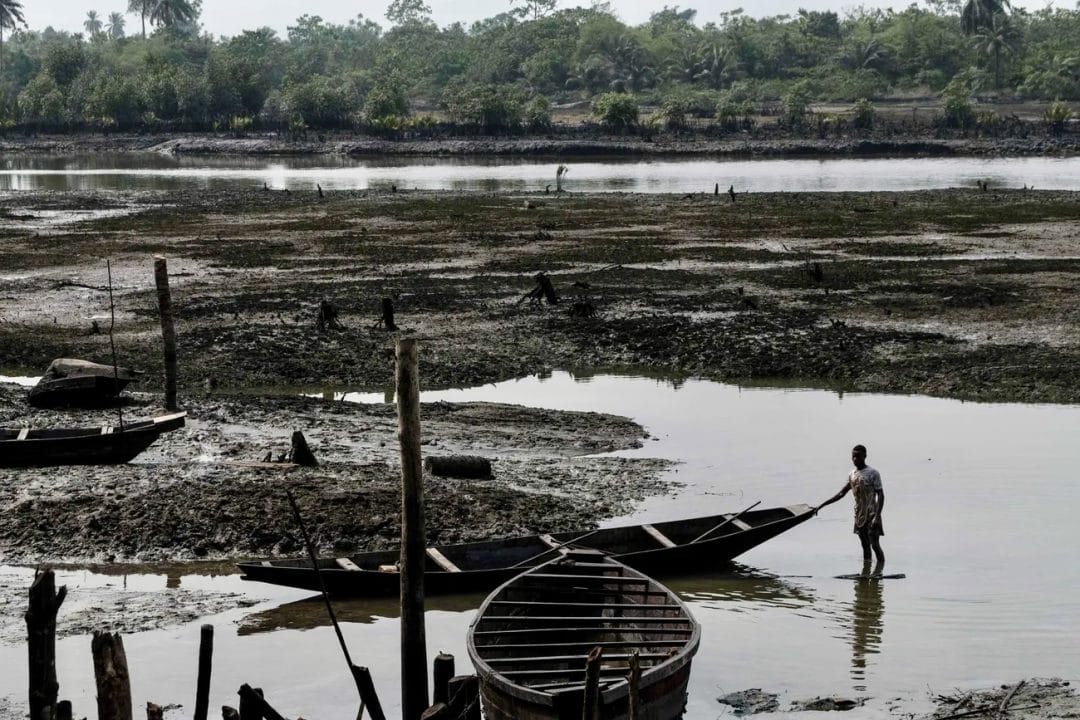
Bodo community sues oil consortium in London High Court to force a £500 m clean-up of 2008 Niger Delta spills, exposing corporate and regulatory failures.
The London High Court trial that opened on 8 May 2025 pits the Bodo community of the Niger Delta against Renaissance Africa Energy Company (RAEC) in a last-ditch bid to compel a comprehensive clean-up of two massive oil spills from 2008 that devastated local fisheries and farmland.
If successful, the community could secure funding—potentially up to £500 million (around $663 million)—for remediation, shifting liability from Shell (which sold its onshore assets in a $2.4 billion deal) to the consortium of Nigerian firms now operating those fields and pipelines.
This case highlights enduring failures of earlier settlements, the gap between corporate promises and community realities, and broader struggles for environmental justice in oil-rich but ecologically ravaged regions of Nigeria.
Historical Legacy of the Bodo Oil Spills
Two Devastating Spills and Unfulfilled Promises
In August and September 2008, two catastrophic pipeline failures in the Bodo area of Rivers State unleashed crude oil into creeks and farmland for weeks on end, devastating the community’s subsistence fisheries and agriculture.
Shell’s Nigerian subsidiary, the Shell Petroleum Development Company (SPDC), accepted responsibility and negotiated a settlement in 2015, agreeing to pay £55 million and to fund a clean-up under the Bodo Mediation Initiative.
Yet by 2023, residents and independent experts had raised serious concerns that the remediation was superficial at best, leaving oil-soaked mangroves, contaminated waterways and poisoned drinking sources intact.
Enduring Impact on Livelihoods and Health
Seventeen years on, the Bodo community continues to suffer from polluted water, fish kills and soil infertility, imperilling their right to food, water and a healthy environment.
Amnesty International reports have documented elevated benzene levels—a known carcinogen—in local wells and fish tissue, underscoring the long-term health hazards that flow from inadequate clean-up efforts.
Subsistence farmers and fishers now face dwindling catches, forcing many into poverty or unsafe alternative livelihoods such as illegal refining, which brings its own dangers and pollution.
The London High Court Trial
Claimants and Defendants
On 8 May 2025, the High Court in London opened proceedings as the Bodo community’s legal team, led by Leigh Day solicitors, seeks a mandatory injunction compelling RAEC to fund and execute a full remediation of the legacy spills.
RAEC comprises four Nigerian oil companies and an oil trader that in March 2025 acquired Shell’s onshore assets—including the Trans-Niger Pipeline that served the Bodo fields—in a $2.4 billion transaction.
Legal Arguments and Stakes
The community argues that RAEC stepped into Shell’s shoes and inherits its environmental liabilities, including the duty under Nigerian and English common law to ensure effective clean-up of contamination caused by its predecessors.
RAEC, by contrast, contends that it should not be bound by obligations for historic spills it did not cause, and that remedial responsibility remains with Shell or Nigeria’s national oil spill agency, NOSDRA.
A ruling in favour of the claimants could force RAEC to underwrite a £500 million operation, equivalent to roughly $663 million, to restore Bodo’s creeks and farmland.
Broader Struggle for Environmental Justice
Corporate Evasion and Asset Sales
Shell’s exit from onshore Nigeria, culminating in its 2025 sale to RAEC, symbolises a trend of international majors divesting costly, polluting assets to local firms ill-equipped to manage legacy damage.
Critics argue that asset sales should include escrow funds or guarantees for clean-up before transfer, preventing scenarios where communities bear the cost of neglect once multinationals depart.
Regulatory and Government Failures
Despite Nigeria’s robust environmental laws on paper, enforcement has been sporadic, underfunded and undermined by corruption.
NOSDRA’s limited budget and political interference have allowed unchecked oil theft and ageing pipelines to proliferate, aggravating spill frequency and severity.
Meanwhile, state and federal authorities have failed to hold polluters to account, forcing communities like Bodo to seek justice abroad.
Critical Analysis and Call for Accountability
Failures of Previous Settlements
The 2015 £55 million agreement, touted as a model of remediation, has delivered negligible environmental benefits.
Independent assessments in 2023 showed oil puddles still covering mangrove roots and residual sheen on waterways, betraying the hollow nature of Shell’s promises.
This underscores a pattern: compensation payouts without genuine ecological restoration.
The Imperative of Robust Legal Remedies
The London trial is emblematic of the necessity for clear legal pathways enabling affected communities to compel not just monetary compensation but actual environmental repair.
A successful judgment would set precedent for similar claims across the Niger Delta, pressuring corporate actors and host governments to prioritise ecological integrity over short-term profits.
Sensational Political Implications
As a consortium of Nigerian firms stands accused of inheriting a toxic legacy, the trial raises questions about national capacity to manage oil wealth responsibly.
Political actors face scrutiny: will they champion local rights against domestic oil barons, or collude in perpetuating ecocide for revenue?
The outcome could reshape Niger Delta politics, galvanising grassroots activism and influencing policy reforms ahead of Nigeria’s next elections.
- Additional reports from Kalada Jumbo, Omonigho Macaulay and Peter Jene