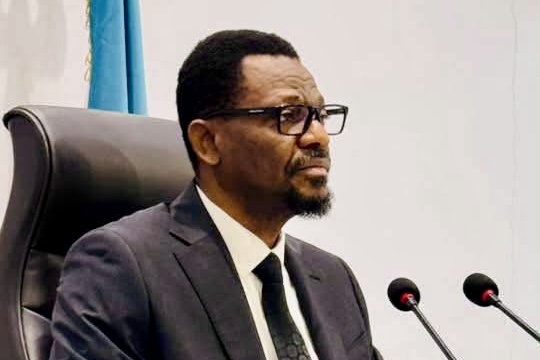
In a scathing address at Government House, Yenagoa, Bayelsa State Governor Douye Diri lambasted the “endless” exercise to amend the 1999 Nigerian Constitution, branding it a “waste of time and resources.” As a former National Assembly committee member (2015–2020), Diri’s critique carries the weight of insider experience, and his impassioned plea for implementation strikes at the heart of Nigeria’s perennial governance malaise.
Historical Context of the 1999 Constitution Review
Since the return to democracy in 1999, Nigeria’s Constitution has undergone repeated review attempts, yet fundamental structural reforms remain unimplemented.
According to the Centre for Constitutional Studies, the National Assembly has initiated five distinct review efforts, producing at least thirty separate amendments at a cumulative cost exceeding ₦24.8 billion over 24 years—averaging ₦1 billion annually for “jamboree” alterations that seldom resolve core governance faults.
Diri’s Critique: Waste of Time and Resources
“I appreciate the Speaker for sustaining this ritual,” Diri told the Constitution Review Committee, “but we cannot be holding Constitution review and nothing comes out of it. It is becoming a waste of time and resources.”
His pointed use of “ritual” and “jamboree” underscores frustration with perfunctory hearings that conclude with grand reports but no policy enactment.
The Oil Factor: Bayelsa’s Economic Contribution vs Political Neglect
Though Bayelsa accounts for roughly 18–20 percent of Nigeria’s oil production, yielding about US $10 billion in federal revenues annually, its own development remains stifled by skewed federal allocations.
From Oloibiri’s first gusher to today’s offshore platforms, the Niger Delta has borne the environmental and social costs of extraction, yet political reforms lag far behind economic realities.
Comparative Analysis: Bayelsa’s LGAs vs Other States
Diri lambasted the injustice of Bayelsa’s mere eight local government areas, despite ranking 20th in the UNDP’s Human Development Index and surpassing nine other states by landmass.
States with fewer resources and smaller populations command more LGAs—and thus greater statutory funds—while Bayelsa’s skeletal structure hampers grassroots governance and service delivery.
| State Group | Number of LGAs | HDI Rank (2023) |
|---|---|---|
| Bayelsa (oil‑producer) | 8 | 20 |
| Delta | 25 | 13 |
| Rivers | 23 | 17 |
| Kwara | 16 | 18 |
Fiscal Federalism: The Case for Equity
Nigeria’s 1981 Revenue Allocation Act apportions Federation Account receipts at 48.5 percent to the federal government, 24 percent to states, and 20 percent to local governments, with the remainder to extrabudgetary funds.
Bayelsa’s oil wealth fuels the national purse, yet its derivation share fails to secure proportional development.
True fiscal federalism demands a recalibrated formula acknowledging resource contributions, geographic size, and social needs—a stance Diri champions.
Political Stakes: Successive Administrations’ Failures
Every new National Assembly since 1999 has echoed calls for devolution of powers, state police, and local government autonomy—only for recommendations to gather dust.
Diri’s experience on the 2015–2020 committee proved telling: “I was a member of this same committee and nothing happened,” he lamented, pinning blame on executive inertia across military‑derived institutional legacies.
Voices from the National Assembly: Past Review Efforts
Sixth Assembly (2007–2011): Debated and signed three amendments, yet the resultant “Grundnorm” failed to address power imbalances.
Seventh Assembly (2011–2015): A single omnibus bill, vetoed by President Jonathan, stalled wholesale reforms.
Eighth Assembly (2015–2019): Piecemeal committee approach; insufficient time led to unpassed bills.
Ninth Assembly (2019–2023): Introduced 16 alteration bills with scant progress; only 37 memoranda received by September 2024.
Current Tenth Assembly (2023–2027): Vows to conclude reviews by December 2025 and transmit to state assemblies in line with timetable.
Environmental and Social Cost of Inaction
Beyond fiscal inequity, Bayelsa’s people face environmental devastation: over a quarter of recorded oil pollution incidents ravage fragile mangrove ecosystems, poison farmlands, and trigger health crises.
As long as constitutional reforms stall, regulatory gaps embolden oil majors and corrupt networks at the expense of host communities.
Diri’s Call for Action: Implementing Recommendations
Diri’s rallying cry is simple: end the cycle of perfunctory hearings by enforcing a binding timeline for implementation.
He expresses hope that President Tinubu’s administration—characterised by democratic credentials—will champion enactment, not just deliberation.
“I want to believe that this government has what it takes to implement the decisions that will be arrived at this time,” Diri asserted.
Wider Implications for Nigeria’s Democracy
The spectacle of annual constitution jamborees without substantive reform erodes public trust and fuels cynicism.
A decisive overhaul—incorporating genuine public participation, transparent processes, and enforceable outcomes—could recalibrate Nigeria’s federal equilibrium, stimulate development across regions, and stem secessionist agitations.
Conclusion
Governor Douye Diri’s fearless exposé lays bare a cycle of constitutional consultations that enrich no one but event planners.
With Bayelsa’s oil riches financing the federal engine, the state’s marginalisation crystallises the broader failure of Nigeria’s governance architecture.
Unless President Tinubu and the National Assembly pivot from ritual to resolution—implementing the varied recommendations from successive committees—Nigeria’s quest for justice, equity, and national cohesion remains stalled.