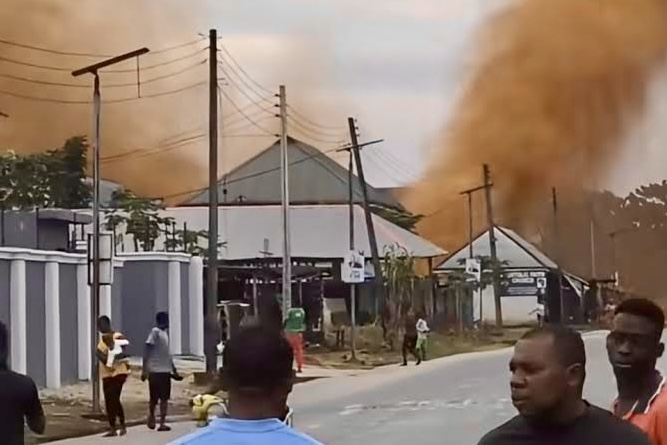
The Lagos State Ministry of the Environment and Water Resources has confirmed that officials of the Lagos State Environmental Sanitation Corps apprehended an individual for cooking on the median of Admiralty Road, Lekki Phase 1.
The commissioner Tokunbo Wahab framed the action as enforcement of existing environmental and sanitation regulations. He reiterated the administration’s commitment to the #KeepLagosClean and #ZeroToleranceLagos campaigns.
At first glance the episode reads as a routine application of urban regulation. The deeper story reveals friction. A growing city insists on order. This contrasts with informal acts of kindness that arise from economic strain.
LAGESC is the agency responsible for policing sanitation and public order in Lagos. Its mandate comes from recent efforts to remove street trading from highways and medians. The agency also works to maintain public infrastructure. Its remit includes issuing notices and removing unauthorised structures or activities on public land.
Yet the lawfulness of a specific enforcement action rests on the finer points of planning and permit rules. Lagos State’s physical planning and permit regulations set out how public space may be used. They need approvals for alterations or persistent commercial activity on public rights of way.
The regulations are explicit about setbacks and the protection of public utilities and highways. Organisers of mobile or temporary food distribution must obtain the necessary local permits. They need to work with relevant agencies to avoid health and traffic hazards.
There are two competing public interest arguments. The state advances a plausible list of risks. Cooking on a traffic median can damage landscaping and utility fittings. It can create contamination and smoke risks at road level. Furthermore, it distracts drivers, thereby increasing the likelihood of accidents.
Lagos authorities say that unchecked use of medians erodes the aesthetic and functional integrity of city infrastructure. It also undermines efforts to control waste and disease. Those are legitimate concerns in a densely populated megacity.
On the other hand, there is a body of scholarship and advocacy. It stresses the social value and economic reality of informal food distribution. Street vending is also emphasized.
Research on street vendors across African cities shows that informal traders often fill gaps left by formal welfare mechanisms. Community food initiatives also play a significant role in addressing these gaps.
Heavy handed enforcement without clear, accessible alternatives risks criminalising poverty and alienating civic actors who seek to feed the vulnerable. That tension explains why some public actors call for more nuanced regulation rather than blanket removal.
This incident thus exposes a policy gap. If Lagos wishes to preserve order while enabling philanthropy the state must do more than arrest and remove equipment.
It must publish clear guidelines for charitable food distribution. It should assign lawful places for mass feeding. Additionally, it must give an expedited permit process for bona fide community groups.
It must also explain how enforcement will be proportionate. It should be accompanied by outreach. This ensures that goodwill is not extinguished by fear of sanction.
For now the Admiralty episode is a test case. Lagos can show an approach that balances infrastructure protection with compassion. Alternatively, it can double down on zero tolerance. This choice risks fuelling a narrative that public space is off limits even to citizens trying to help neighbours. Either choice will shape how the city manages urban life in the years ahead.
Follow us on our broadcast channels today!
- WhatsApp: https://whatsapp.com/channel/0029VawZ8TbDDmFT1a1Syg46
- Telegram: https://t.me/atlanticpostchannel
- Facebook: https://www.messenger.com/channel/atlanticpostng