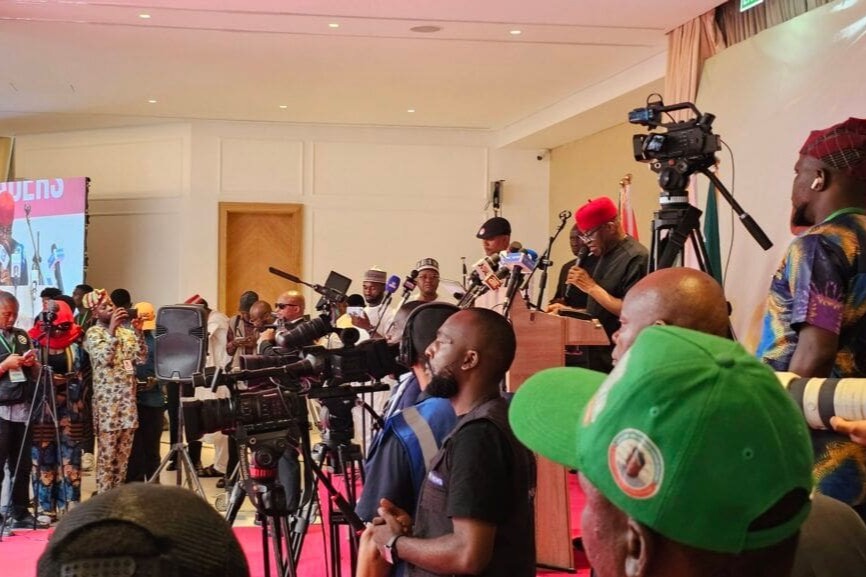
President Bola Ahmed Tinubu’s commissioning of 2,000 modern tractors on 23 June 2025 in Abuja marks what his administration calls the dawn of an “agricultural renaissance” in Nigeria.
Unveiled at the National Agricultural Seeds Council in Sheda, this deployment under the Renewed Hope Agricultural Mechanisation Programme seeks to shatter the century-old shackles of subsistence farming and catapult Nigeria towards global agribusiness prominence.
Yet, critics ask: can a single, high-profile rollout alter a sector that still employs over one-third of Nigerians largely at a subsistence level?
From Hand-Hoe to Horsepower: Bridging a Technological Chasm
For generations, Nigerian farmers have relied on rudimentary tools—hoes, cutlasses and ploughs drawn by oxen.
That paradigm contributed to stagnating yields, post-harvest losses approaching 30%, and food imports skyrocketing to ₦3.35 trillion between 2016 and 2019.
The freshly arrived Belarus-manufactured tractors—each paired with disc ploughs, ridgers, mobile workshops and GPS-enabled trackers—promise to revolutionise land preparation, sowing and harvesting on over 550,000 hectares, producing an estimated 2 million metric tons of staples in the 2025 season alone.
Ambition vs. Accountability: The Service-Provider Model Under Scrutiny
Tinubu’s administration has adopted a “service-provider” distribution model, placing tractors with local operators who lease them to smallholder farmers on a pay-per-use basis.
This approach aims to overcome barriers of capital and maintenance.
Yet past schemes—such as the 2003 Presidential Initiative on Mechanised Agriculture—crumbled under graft and logistical failures.
Observers insist that transparent stakeholder accountability, stringent GPS monitoring and pro-rata repayment plans are non-negotiable if this programme is to avoid the graveyard of abandoned machinery and unpaid debts.
A Bilateral Ballet: Nigeria–Belarus Ties Deepen
The tractor fleet, delivered under a September 2024 roadmap signed at Minsk’s Belagro Expo, underscores a deepening Nigeria–Belarus partnership.
Belarusian Deputy Prime Minister Viktor Karankevich hailed the deal as a testament to “enduring friendship” and pledged further phases: local assembly plants, grain storage complexes and service centres across Nigeria.
President Tinubu personally lauded former Chicago classmate Alex Sigman for brokering this unusual trans-continental venture, blending tech transfer with youth training in fabrication and machinery upkeep.
Reviving Rural Economies: Jobs, Skills and the Youth Dividend
With rural unemployment near 22.6% and nearly 40% of Nigerians living below the poverty line, the mechanisation drive pledges over 16,000 direct jobs in equipment operation, logistics, extension services and agritech innovation.
Mandatory operator training and GPS-monitored deployments aim to professionalise farming, entice youth back to the land, and stem urban drift.
Yet experts caution that without parallel investment in road networks, storage facilities and value-chain linkages, these jobs risk becoming seasonal or under-utilised.
Historical Context: Nigeria’s Mechanisation Missteps
Nigeria’s agriculture sector once boasted a 1960s mechanisation push that faltered amid oil windfalls and policy neglect.
Today, agriculture still contributes roughly 22 percent of GDP and employs over one-third of the workforce, albeit largely at the subsistence level.
Past interventions—often donor-driven—failed to achieve scale or sustainability.
Tinubu’s Renewed Hope agenda thus faces the twin challenge of delivering tangible yield uplifts while institutionalising maintenance, spare parts logistics and farmer education across 774 local government areas.
Food Security or Food Sovereignty?
With climate shocks and rising import bills threatening national stability, mechanisation is portrayed as the “bedrock of food sovereignty”.
However, sceptics note that technology alone cannot offset weaknesses in land tenure laws, irrigation infrastructure and access to credit.
The Renewed Hope programme’s success may hinge on integrated reforms: land reforms, rural electrification, agro-processing hubs and inclusive financing that empowers women—who comprise up to 80% of small-scale farm labour in sub-Saharan Africa—to maximise the return on mechanisation.
Economic Ripples: From Farms to Financial Markets
Should yields and incomes surge, Nigeria’s broader economy could benefit from lower food inflation—currently above 30%—and reduced pressure on foreign reserves from grain imports.
Rural prosperity may spur demand for consumer goods, fuel agro-processing industries and attract domestic as well as diaspora investment.
Still, financiers stress the need for transparent commodity exchanges, warehouse receipt systems and price-discovery mechanisms to ensure farmers capture value beyond the field.
Accountability and the Road Ahead
President Tinubu’s stern call for “maximum efficiency” and “strict stakeholder accountability” sets a high bar.
The Ministry of Agriculture and Food Security has pledged pro bono allocations to research institutes and mandatory training, but civil society groups demand public dashboards tracking equipment usage, loan repayments and outcome metrics.
Only by marrying technological innovation with governance reforms can Nigeria hope to turn 2,000 tractors into 20 million metric tons of food, truly heralding an agricultural renaissance.