The Bola Tinubu presidency has fixed September 3, 2026 for the President to receive the Executive National Policing Bill for review, in what is shaping up to be one of the administration’s most consequential security reforms.
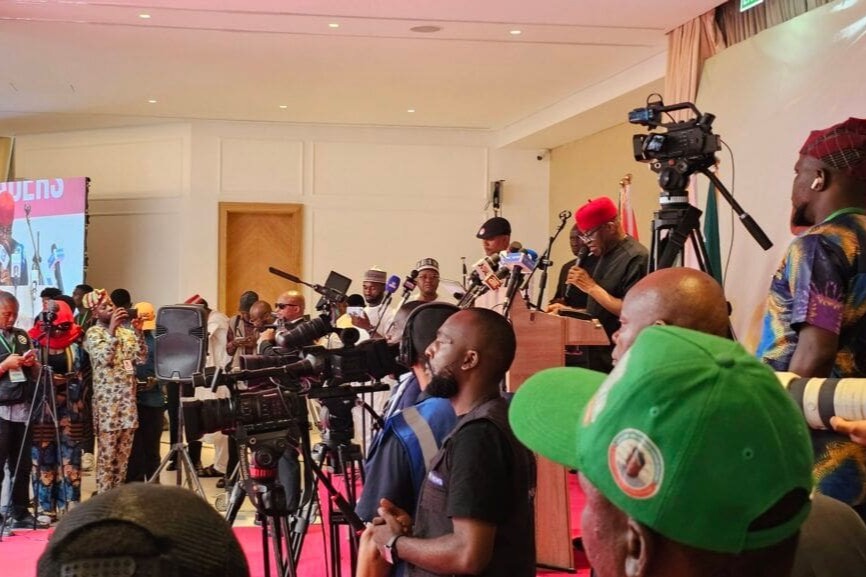
The announcement came from the Chief of Staff to the President, Femi Gbajabiamila, after a meeting of the Presidential Working Group on the National Policing Bill at the Aso Rock Villa in Abuja.
The Presidency also rolled out nationalpolicingbill.com, a public portal where Nigerians can submit memoranda and position papers before the draft is finalised.
The timetable is not casual. Gbajabiamila said the work programme runs as a “seven-week, milestone-driven exercise”from July 27 to September 14, 2026, with the Executive Bill package scheduled for presentation to the President on September 3.
He said the draft would still undergo national consultation before final approval and formal transmission to the National Assembly, a signal that the presidency wants the process to look participatory rather than purely executive.
What makes this development significant is that Nigeria is not starting from zero. The National Assembly has already moved on the constitutional side of the reform.
According to the Presidency’s own explanation, the Senate approved the State Police constitutional proposal on June 24, 2026, while the House of Representatives passed the Executive State Police Bill on July 23, 2026.
But Gbajabiamila stressed that the amendment is not yet in force because it still requires the approval of the State Houses of Assembly, as required by the Constitution.
Until that process is completed, he said, there is no operational State Police Service anywhere in Nigeria, and the Nigeria Police Force remains the constitutionally recognised police institution.
That constitutional reality matters because the reform is being sold as a remedy for a long-running security problem that has overwhelmed the federal police structure.
AP reports that Nigeria’s centralised police force has been stretched by worsening insecurity, especially in rural communities where police presence is thin and militant groups have exploited the vacuum.
The proposed system would allow each of Nigeria’s 36 states to create a police force that meets minimum national requirements, while the federal police would retain counterterrorism, border patrol and other national security functions.
Gbajabiamila framed the reform as a once-in-a-generation correction to a system Nigerians have debated for years. He described it as a “monumental reform” and said the objective is to design a “lawful, professional and sustainable”federal and state policing structure that places stronger capability closer to the people while preserving national security and constitutional rights.
The National Assembly’s role, in other words, is only part of the story; the presidency is now trying to build the legal, administrative and fiscal machinery that would make the reform workable if it survives the political hurdles.
The most politically sensitive part of Gbajabiamila’s remarks was his insistence that state policing must never become a tool of intimidation. He warned that “no political officeholder should be able to direct the arrest of an opponent” or use the law to suppress lawful political activity.
He also argued that federal intervention must remain “exceptional, evidence-based, proportionate, time-limited and reviewable”.
The message is plain: Abuja wants to decentralise policing without creating 36 politically owned security outfits that could be turned against opponents, journalists, activists or ordinary citizens.
That concern is not theoretical. Nigeria’s fear of state police has always been tied to memories of political abuse, partisan policing and weak accountability at subnational level. Gbajabiamila’s answer is minimum national standards, not free rein.
The Presidency says the final package will include schedules, an explanatory memorandum, a legal audit, a consequential amendments matrix, clause-by-clause analysis, a state readiness framework, a fiscal and implementation note, a validation report, a risk register and a controlled digital archive.
Those are the kinds of documents that suggest the government is trying to anticipate legal challenges before they arrive.
Funding remains the bluntest unanswered question. Gbajabiamila declined to give a cost estimate, saying any figure now would be guesswork. He said the cost will be evidence-based and determined on a state-by-state basis because states differ in personnel needs, infrastructure and local security demands.
He added: “There is no cost to securing life and property.” That line will play well politically, but it also exposes the core challenge: a state police system without predictable funding, training, oversight and pension architecture could collapse under its own weight.
Public participation is the other major pillar of the presidency’s pitch. Gbajabiamila said the portal nationalpolicingbill.com is already live and will allow Nigerians to submit memoranda for roughly two weeks, with the possibility of an extension.
He also suggested the site would likely migrate to a .gov.ng domain. His argument is that the public should help shape not just the principle of state policing, but the safeguards, transition arrangements and implementation details that will determine whether the reform succeeds or becomes another Abuja promise.
The wider political test begins now. The presidency has opened the consultation window, the National Assembly has advanced the constitutional framework, and state governments are being invited to weigh in.
But the real battlefield is still ahead: state assembly ratification, funding, recruitment standards, oversight mechanisms and the question of whether governors can be trusted not to weaponise a force created in their own backyard.
On paper, this is a reform to bring policing closer to the people. In practice, it will only work if Nigeria can solve its oldest security problem without creating a new one.
Follow us on our broadcast channels today!
- WhatsApp: https://whatsapp.com/channel/0029VawZ8TbDDmFT1a1Syg46
- Telegram: https://t.me/atlanticpostchannel
- Facebook: https://www.messenger.com/channel/atlanticpostng